Archives » A God in Ruins

Human Croquet by Kate Atkinson

Doubleday, 1997, 347 p.

This was Atkinson’s second novel and it exhibits many of the traits which would come to dominate her fiction. The family dynamic here is reminiscent of the one in Atkinson’s first novel, Behind the Scenes at the Museum, and of the Todds in Life After Life and A God in Ruins. In this one our heroine Isobel finds herself slipping backwards and forwards in time and there is here the first adumbration of the thought found in the Todd books that it would be a boon if somehow we could live our lives over again in order to get them right. There is a Scottish flavour; neighbour Mrs Baxter – I was irresistibly reminded of the old soup adverts, especially since her daughter is named Audrey – lards the text with Scots aphorisms, though the prominence here of trees and forests is more of a preoccupation of English fiction. The house Isobel lives in is even called Arden.

We begin with a literary allusion, “Call me Isobel.” Implicitly to compare herself to Herman Melville is quite a statement by Atkinson of confidence in her abilities. But the book as a whole is dense with allusion or references – and also repetition, but repetition with a purpose, not merely saying the same thing over again in slightly different ways. For example, “The beginning is the word and the end is silence. And in between are all the stories. This is one of mine.” There is also a reversal of Tolstoy’s Karenina Principle in, “I suppose all unhappy families resemble one another (but all happy families are happy in their own way of course)” along with the addition of “But then, do happy families exist, or happy endings come to that, outside of fiction?”

After a starting chapter headlined ‘Beginning’ there are several sections each of ‘Present’ and ‘Past’ narratives outlining Isobel’s story, her family’s and Arden’s, before we end with ‘Future’. ‘Beginning’ is a history of the land on which Arden stands ‘Present’ is narrated by Isobel in first person; ‘Past’ is in the third person.

In the ‘Present,’ Isobel (Fairfax) is a sixteen-year-old schoolgirl mooning after the desirable Malcolm Lovat who, to Isobel’s chagrin, sees her as a friend. Her father, Gordon, vanished for seven years after mother Elizabeth was said to have absconded ‘with a fancy man’ but the circumstances are barely ever mentioned by their grandmother, the Widow, and the getting on for elderly spinster aunt, Vinny, in both of whose care they have been left. Both Isobel and her brother Charles try to make the most of things. When Gordon returns it is with a new wife.

The three primal motivations in literature, love, sex and death are well to the fore here. Gordon met Elizabeth by rescuing her from a bombed house during the Blitz, “My hero,” and was thereafter besotted by her feminine dazzle (the widow and Vinny are not so easily taken in.) There are incidents of murder and reported incest and Isobel imagines her part in Malcolm’s death over and over again but is unable to prevent it each time. A rational gloss to these experiences and her apparent time travelling is provided as symptoms of possible fly agaric poisoning.

While Human Croquet is exceedingly well written and intricately plotted – as well as diverse – a tangled web of relationships is revealed during the novel, to not all of which is Isobel privy; possibly too many connections between the characters to be fully convincing. (This is a trait I also noticed recently in Joseph O’Connor’s Star of the Sea.)

The game of Human Croquet, rules and a picture of which act as a three page appendix, is one of the pastimes Isobel has read of from an illustrated book of Home Entertainments. It involves a blindfolded person being aurally guided through hoops formed by two people making an arch between them.

In Human Croquet, the novel, Isobel has no such guide and has to make it on her own. As we all do.

Pedant’s corner:- hot-bed (does it need that hyphen? – ‘hotbed’,) Charles’ (many times Charles’s,) “help me Boab” (at least twice. This Scottish phrase is actually not an invocation to someone called Bob to provide assistance but rather an expression of disbelief or disconcertment, and is written ‘help ma boab’,) Keats’ (Keats’s,) beseeched (an apparently acceptable alternative to ‘besought’.) “‘Who understand them?’” (understands,) “CO2  + 2H 2A + light energy – (CH 2) + H2O) + H2A” (supposedly the equation for photosynthesis. It isn’t. And in any case CO2, H2O and H2A, OHOHO) Zeus’ (Zeus’s,) Ysggadril (Yggdrasil,) “the cries of the baby upsets my” (upset my,) “they bid their mother one last terrible farewell” (they bade their mother,) “less discretely” (not less separately [discretely,] but rather less inconspicuously, ‘less discreetly’,) aureoles (x 2, areolas; or areolae,) “to staunch the throbbing” (stanch,) “would he chose for a consort” (would he choose,) “smoothes the sheets” (smooths,) Glebelands’ (Glebelands’s,) de’el (usually spelled ‘de’il’, or deil,) “the amoeba and bacteria” (if it’s supposed to be plural then ‘amoebae’ – or even amœbae.)
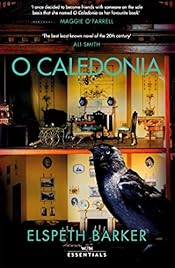
O Caledonia by Elspeth Barker

Weidenfeld & Nicolson Essentials, 2021, 212p, plus vi p Introduction by Maggie O’Farrell. First published 1991.

From the outset we know where this tale of growing up as a misfit is going; Barker shows us in her prelude, titled Janet. This is not foreshadowing as such – it goes beyond prolepsis even – but it does set up an intriguing question. Why will what Barker tells us happened, happen? Why was Janet’s misadventure so easily glossed over? What was it about her that made her dismissable? But this is arguably fairer on the reader than Kate Atkinson’s revelation in A God in Ruins which turned upside down what we thought we had learned in all its pages up to that point.
Some reviewers have observed similarities to Dodie Smith’s I Capture the Castle (written much earlier than O Caledonia) but the characters of Cassandra Mortain and Janet are very different and Barker is a much subtler writer but I did wonder while I was reading O Caledonia if Kate Atkinson was familiar with Barker’s novel. I found the weird incidents of Janet’s childhood oddly similar to the manifold earlier days of Ursula Todd in Life After Life; there were perhaps even greater similarities to Atkinson’s first novel Behind the Scenes at the Museum (from 1995.) Still, it allows Barker the acid observation “The subject was closed in favour of the living, who offer continuous material for persecution.”

Janet is a child in wartime living in the manse inhabited by her grandfather and subject to many an admonitory sermon. Scotland’s religious heritage, though never pushed, is an intermittent drum beat through the book as in, “At this time there were many Polish officers in the village. The Marine hotel had been requisitioned for them. They were popular with the lonely girls and the more flighty wives, so that after the war some stayed on and married, while others left behind girls who were even lonelier now, alone with tiny children in the unrelenting chill of a Calvinist world.” (This sort of memory of Polish soldiers was familiar to me from the tales told by an acquaintance who had lived in Kelso during the Second World War.) Barker also has Janet remark, “There seemed no place for gallantry and romance among Calvinists,” and, in a particularly self-flagellating moment “the nature of Caledonia was a pitiless nature and her own was no better.” That it had unintended effects is illlustrated by a passage wherein nannies asked children if they had done what they should today (ie moved their bowels) and unwittingly unleashed dissembling – “a horde of artful dodgers on the world.”

It is when the family inherits Auchnashaugh, a crumbling pile in the Highlands, that Janet’s alienation blossoms. She resents her younger siblings, fails to comprehend adult concerns or live up to their expectations and when older, retreats into books, having an appetite for things beyond her age, Latin and Greek tags and the like. Her experience is summed up by Proust’s phrase ‘l’étouffoir familial’ the family suffocation chamber. Of how many sensitive souls has that been true.

She similarly fails to fit in at St Uncumba’s, the boarding school she is sent to far south in England where her distaste for, and inability at, games and liking for literature are mocked. Until she learns to dissemble.

The signal feature of her otherness is her adoption of a not yet fledged jackdaw whom she names Claws and who is her constant companion at Auchnashaugh.

O Caledonia is far too little known for a book so accomplished. How it did not get onto the list of 100 best Scottish books is beyond me. Perhaps its reissue far too late (2021) could explain it.

Pedant’s corner:- The young Janet sees the beam of a lighthouse sweep her bedroom (but this was in wartime; the lighthouses were switched off as part of the blackout precautions,) “she sucked a vengeful Pandrop” (a pan drop,) “the baby prone within” (the baby supine is more likely,) “golden rod” (goldenrod,) “je men fous” (je m’en fous,) “Miss Wales’ grizzled hair” (Wales’s,) “the gaping maw of the furnace” (stomachs do not gape,) standing in a great Victorian cemetery in Glasgow for her grandfather’s funeral (at that time in Scotland women did not go to interments, still less children,) clipe (usually spelled clype,) “Sir Patrick Spens’ lords (Spens’s,) Sawney Bean is said to have carried out his cannibalistic activities on the Aberdeenshire coast (most accounts put this legendary tale in Ayrshire,) “True Thomas’ faery queen” (Thomas’s,) “Euripides’ Medea” (Euripides’s,) “Barr’s Iron Brew” (the proprietary name is Irn Bru,) “came Francis’ voice” (Francis’s,) “the war memorial” (War Memorial – used later,) “‘a wee Doc and Doris afore ye gang awa’!’” (usually spelled Deoch-an-Doris,) Kiichen (a manuscript misreading of Küchen?) “Watt and Grants” (Watt and Grant’s,) swop (swap,) “Francis’ voice” (Francis’s,) “she was couched out there” (crouched makes more sense,) “Propertius’ poem” (Propertius’s,) “Tiresias’ description” (Tiresias’s) “Claws’ residence” (Claws’s,) “jeune jille” (jeune fille,) “passage from the Georgies” (the Georgics that would be,) “Orpheus’ final loss” (Orpheus’s.)

Big Sky by Kate Atkinson

Doubleday, 2019, 363 p.

The title on the cover of this is preceded by the words “A Jackson Brodie novel.” After her initial success with Behind the Scenes at the Museum, followed by two less well received novels (one of which I reviewed here) Atkinson went on to write four novels featuring her private detective of that name. She then embarked on technically accomplished (and more ambitious) novels dealing with the fallout from World War 2 in A God in Ruins, Life After Life and Transcription.

The action here revolves around towns on the Yorkshire coast in the area of Whitby and Scarborough, the hangover from the activities of two since-jailed local child abuse abetters called Bassani and Carmody, and the present-day sex-trafficking partnership of a group of golfing friends.

Oh, and there’s a murder. That, though, is resolved off-stage and does not impinge much on proceedings.

Big Sky has at least ten viewpoint characters and its chapters tend to be short – sometimes with very short sections within them from some of those different viewpoints. All this conspires to make the experience of reading Big Sky bitty.

There was something about the writing here that I found a little off. A misjudgement of tone, (female detectives named Ronnie Dubicki and Reggie Chase. Detectives called Ronnie and Reggie. Seriously?) unnecessary repetitions of phrases – though perhaps some of this was to imply Vince Ives was protesting too much – and intersecting timelines which were not well handled so that we saw the same scene’s events repeated very soon after their first appearance but with very little difference in the reader’s sense of what had occurred. Combined with the occasional descent into cliché this gave the impression, to this one anyway, that Atkinson was writing down to her readers.

This is no A God in Ruins nor a Life After Life, nor a Transcription even, but perhaps after her achievements in those books Atkinson needed a rest – or to have some fun. She overdid it though.

Pedant’s corner:- On a visit to a museum Brodie tells his son Captain Cook was the ‘first man to sail around the world.’ (No. That would be members of Ferdinand Magellan’s expedition [Magellan himself did not survive the journey.]) Croyden (Croydon?) “she had strived hard” (striven,) “he’d compèred Saturday Night at the London Palladium (Sunday Night surely?) “It was a raucous lot that were in tonight” (that was in,) crack cocaine is implied to have been a drug widespread in the 1970s, (it wasn’t till the 80s) focussing (focusing.) “None of them were” (none of them was,) Mellors’ (several times, Mellors’s,) “his act finished on such a crescendo” (such a climax.) The remains of a handsome sunset was still staining the sky” (the remains … were still staining,) a missing full stop. “With his luck he would bob around till the lifeboat found him or a stray fishing vessel” (has its syntax awry; why would a lifeboat find a stray fishing vessel? Try instead, ‘till the lifeboat or a stray fishing vessel found him’,) staunch (stanch,) focussed (focused,) “the news’ afterburn” (the news’s,) staunched (stanched,) “where a cluster of bridesmaids … were waiting for them” (where a cluster …. was waiting.)

The Gone-Away World by Nick Harkaway

William Heinemann, 2008, 540 p.

 The Gone Away World cover

The Jorgmund Pipe circles the Gone-Away world, protecting its environs from the Stuff which conjures new people and things out of dreams snatched from the minds of survivors of the Go Away War by delivering FOX (inFOrmationally eXtra-saturated matter) into the air surrounding it. It is the aftermath of said War, so-called because of the deployment of Go Away bombs (which do as their name suggests; their targets simply disappear.) Not quite as secret a weapon as its original users thought, though, since retaliation in kind came swiftly, leaving only pockets of normality in its wake and the unforeseen side-effect of strange apparitions/demons/monsters, (delete as to taste) swirling out of the affected areas, manifestations of Stuff.

Nothing hereafter ought to detract from what in the end turned out to be an engaging, emotionally involving read. Harkaway is a talent, as he has shown in subsequent books, but this novel is not without its flaws – even if it does have a daring conceit as its turning point.

We kick off when (despite an anonymous phone call advising its employees not to) the Haulage & Hazmat Emergency Civil Freebooting Company of Exmoor County, of which our narrator is a member, takes up a contract to put out a fire which threatens to destroy both the Pipe and the factory producing FOX. The company’s unwieldy title is an indicator of Harkaway’s approach here, an exuberance of word-play which tends to the wearing – at least until the book settles down. The author is certainly not afraid to call a spade a horticultural implement and otherwise circumlocute all the way around a subject in an attempt to provide levity, or (if you wish to be generous) to avoid cliché or the humdrum. It certainly makes for an impressive word-count. It was Harkaway’s first novel though, so we may forgive a little exuberance. (A little, but not a lot.)

Despite the destruction wrought by the Gone-Away bombs, there are still buses and cars (leaving me to wonder where the petrol for them came from) streetlamps, shops – gentlemen’s outfitters no less – and hierarchies of wealth much like that in the world before the war. Despite all having changed, in the larger settlements of the Pipe’s environment things appear to be much as they were before the War. (A nit-picking complaint, I agree, the author’s invention and creativity have been expended in other areas and it is possible to ask too much of a narrative, but it seemed to me to land on a default which the scenario would have made unlikely and thus undermined it.)

Then there is the book’s structure. By all means begin as near to the end as possible (as a piece of writing advice I read recently had it) but it is perhaps a mistake to presage a set-piece then – for all that it is the novel’s fulcrum – delay its depiction for well more than half the book. From that set-up we jump to our narrator’s back-story and relationship with his lifelong friend, Gonzo Lubitsch, his tutelage by a Zen master known as Wu Shenyang, his dabbling with roughly left-wing politics as a means to accessing girls, his targeting as a subversive and turning into a soldier and counter-insurgent, his encounter with the inventor of the Go-Away bomb, his awareness of the dirtiness of politics and international financial manœuvrings, his experience of the War and of its aftermath in the building of the Jorgmund Pipe. One highlight of this is a description of the difficulties of organising and carrying through a first-date – or making flapjacks – in a war zone; a ‘normal’ war zone at that.

The piece of authorial bravado at the heart of the book – which in its own terms justifies that structural choice – does not quite make up for it. For what happens when we are finally shown the Civil Freebooting Company extinguishing the fire – and incidentally discover along with the characters just how FOX is made – calls into question all that has come before. Not quite as in Kate Atkinson’s A God in Ruins but in a similar vein (yet opposite sense.) It does though highlight the question of what it might mean to be human. That is, of course, fiction’s job.

Pedant’s corner:- a few commas missing before pieces of direct speech, “one less layer” (one fewer,) “to test their metal” (Dearie me! The thing is you test is mettle,) hiccough (there is no derivational evidence for this spelling; hiccup,) “dinted grill” (grille,) appalls (appals,) genii (except in the sense of ‘spirit’ – which here it was not – the English plural of genius is geniuses,) infinitessimal (infinitesimal,) “so now there is now a crowd” (one ‘now’ too many,) “layed out” (laid out,) “beautiful woman are not rare” (women,) rarified (rarefied,) “‘I thought you were a gonner’” (a goner,) “I have kneeled” (knelt,) burglarised (for heaven’s sake! The word is burgled,) squidgey (squidgy,) Archimedes’ (Archimedes’s,) an opened parenthesis which is never closed (unless it was by the parenthesis later on the same page. But it didn’t read like that.)

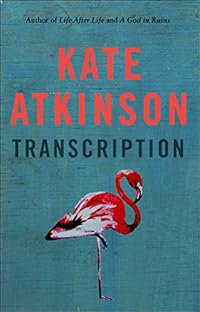
Transcription by Kate Atkinson

Doubleday, 2018, 346 p.

 Transcription cover

This once again, as in Life After Life and A God in Ruins, finds Atkinson turning to the Second World War for inspiration. Her focus here is not the RAF’s Bomber Command, though, but the intelligence service – to which Juliet Armstrong was recruited by Miles Merton in early 1940. The novel is bookended, however, by sections set in 1981 and flits between the war and Juliet’s subsequent experiences at the BBC in 1950 as a radio producer of children’s programmes.

In her war work Juliet typed up the voice recordings for an MI5 sting operation on German sympathisers who believed they were conspiring with a Gestapo officer, and also, in the guise of one Iris Carter-Jenkins, infiltrated the circle of a Mrs Scaife. The 1950s part of the novel sees Juliet receive an anonymous note saying, You will pay for what you did, which she believes must be from one of those sympathisers setting her on a path to investigate those who are left.

Marvellously readable, the narration is in a kind of joky, referential style reflecting Juliet’s thoughts. The MI5 code phrase, ‘Can I tempt you?’ seems to be said to her by everyone she meets; and in fact many whom she does, also work for MI5. This is a novel inhabiting spy territory; nothing may be what it seems. Towards the end, reflecting on the identities she had adopted she thinks, “then there was Juliet Armstrong … who some days seemed like the most fictitious of them all, despite being the ‘real’ Juliet. But then, what constituted real. Wasn’t everything, even this life itself, just a game of deception?” Well before this there are faint echoes of le Carré. In particular MI5 operative Oliver Alleyne’s name seems to allude to that author’s Percy Alleline. There are many subtleties though and Juliet’s transparent naivety is a cunning authorial device – the reader knows long before Juliet that her immediate MI5 boss, Perry, is a homosexual – but that naivety, approaching levity at times, is a surface phenomenon. It serves to hide as well as expose, though the injunction, ‘Never trust a coincidence,’ might just be good spycraft.

Paranoia strikes deep. Once a spy it’s hard to rid yourself of a spy’s habits. Sitting in the National Gallery in front of Lundens’s copy of Rembrandt’s painting, Miles Merton tells Juliet that, since the original was pruned to fit a space in Amsterdam’s Town Hall, “‘The counterfeit is in some ways truer than the real Night Watch.’” This is after all, MI5 in the mid-twentieth century.

The source of the note turns out to be less menacing than Juliet assumed, but at the same time more dangerous. Juliet’s service did not finish with the war. She reflects that, “She would never escape from any of them, would she? She would never be finished.”

I suspect Atkinson enjoyed writing this. There is a lot to admire in it and the dénouement, as in A God in Ruins, leads to the reader reassessing what has gone before, if not quite to the remarkable extent of that book. But having a character say to Juliet, “‘Come now, quite enough of exposition and explanation. We’re not approaching the end of a novel, Miss Armstrong,’” when the reader is doing just that, is over-egging it a bit, even as an authorial nod and wink.

Pedant’s corner:- “there were a number of files” (there was a number,) maw (it’s a stomach, it can’t swallow anything,) “from whence” (whence means ‘from where’ so ‘from whence’ means ‘from from where’,) “foraged from War Office” (from the War Office,) prime minister (Prime Minister,) imposter (I prefer the spelling impostor,) “the air fields” (airfields,) “MI5 were always bringing fifth-columnists in, questioning them..” (MI5 was always… .)

free hit counter script