Posted in Architecture, History at 12:00 on 30 January 2020
Dunning’s biggest landmark is St Serf’s Church.

Church and tower:-

Tower:-

St Serf’s houses the 1200 year-old Dupplin Cross, dedicated to Constantine, one of the last kings of Pictland.

This was in place outside the church – subject to all that Scottish weather – until 1999. Despite that it’s in great condition:-


No Comments »
Posted in Altered History, Reading Reviewed, Science Fiction at 12:00 on 29 September 2012
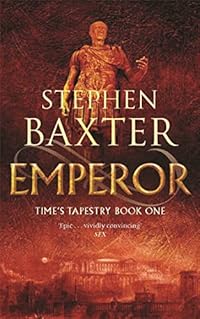
Timeâs Tapestry Book One Gollancz, 2006, 302 p.
In the prologue, set in pre-Roman Britain, a woman giving birth starts to speak in tongues. Handily there is someone on hand who has traded with Rome and not only understands the Latin phrases but can note down her words. These are later interpreted as a prophecy.
The main narrative is then structured round the descendants of those who attended the birth who pass the legend down the generations. The three main sections are set centuries apart; during the second Roman invasion of Britannia (Claudiusâs undertaking,) Hadrianâs decision to build his wall between the Tyne and the Solway and Constantineâs visit to these islands. The families are moved to intervene at each of these critical junctures. One of the families interprets the prophecy as being the attempts of a Weaver of time pulling at the threads of its tapestry.
In the epilogue another birth is accompanied by a similar phenomenon but this time the words are in Saxon, so cueing Book Two.
I wasnât quite sure whether to list Emperor under Altered History or not. Our history isnât altered (of course a different history may have been) but there are discussions of the possibility of alteration. These discussions, while necessary for the overall arc of Baxterâs Timeâs Tapestry sequence, seemed to me to be a bit too modern, jarring a little with the setting.
The style of the narrative unfortunately required a prodigious quantity of information dumping and historical description. Reading a novel is a relatively painless way to access history, though, and what I know of those times wasnât contradicted by the narrative. There was also a strange mixture of British usages (shag and screw for example) and Americanisms (âfitâ as a past tense.) Baxter also incorporates a mention of the iniquities both of wealth disparities and of excessive taxation, the first of which may be a relatively recent concern – in historical terms. The characterisation was sketchy, though adequate, but characterisation isnât the main point in a book like this, the speculation is. Indeed at one juncture Baxter makes a defence of âimaginativeâ fiction in precisely these terms.
Emperor isnât high literature but isnât setting out to be. Enjoyable enough, though.
No Comments »