Posted in Reading Reviewed, Science Fiction at 12:00 on 26 August 2019
Puffin, 2014, 262 p.
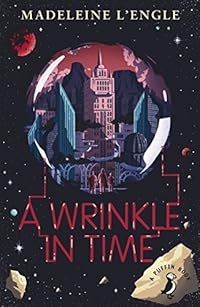
Meg lives a more or less normal life with her family of three brothers, twins Sandy and Dennis and the younger Charles Wallace, one of those children who are slow to speak but when they finally do so it is in complete sentences. Normal that is, apart from her mother having a chemistry lab in the back room, and a physicist father who has disappeared (accompanied by all sorts of rumours as to where; and with whom.) Meg, Charles Wallace and her friend Calvin meet three odd women who are secretly inhabiting the local “haunted” house. Mrs Whatsit was once a star in the sky, Mrs Who speaks in quotations (Latin, Greek, French, Italian, Spanish, as well as Shakespearian,) and Mrs Which talks in ddoubblle cconnssonnannttss with the occasional double vvoowweell. Mrs Which can also ‘wrinkle’ space-time and so is able to send Meg, Charles Wallace and Calvin off to battle the forces of evil which have trapped Meg’s father.
On their interstellar journey they encounter a Black Thing in the interstices of space, which almost draws the life from them, strange multi-tentacled creatures who restore them to health, eventually moving on till they reach the planet Camazotz, where Meg’s father is captive and which is home to a large pulsating brain dubbed IT (which nowadays reads slightly differently to how L’Engle would have intended it) bent on total control of the universe.
Meg is disappointed that, once freed, her father can not set the universe right by himself. It is she and her love for Charles Wallace that is the key to overcoming IT’s baleful influence.
Regarded as something of a children’s classic, this was first published in 1962, making the descriptions of card- or tape-fed computing machines, with dot-dash punched print-outs somewhat quaint to modern eyes. Mrs Who’s quotations and Mrs Whatsit’s comparison of the children’s lives to a sonnet, expression within strict constraints, do not talk down to its intended readership. The resolution, though, is a little forced and more in line with early 1960s attitudes than more modern ones.
Pedant’s corner:- Jenkins’ (Jenkins’s,) “in ITs clutches” (IT here is a proper noun not a pronoun, so ‘in IT’s clutches’.)
No Comments »
Posted in Reading Reviewed, Science Fiction at 12:00 on 7 June 2014
Illustrated by George Craig. Nelson, 1960, 186p.

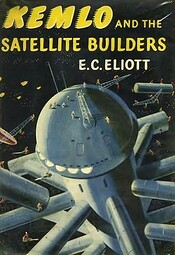 I bought this in a charity shop in Linlithgow. One time I was there they had a swatch of (overpriced) E C Eliott books with wonderfully nostalgic covers – in particular one called Tas and the Postal Rocket. On my next visit most had gone but this one had been brought down from a frankly ridiculous £19.99 to something more reasonable for a book without its dust-jacket. At the same time I bought a Prof A M Low book of similar vintage.
This is perhaps what was once called a juvenile – young adult would be pushing it a bit; it’s definitely not a grown-up kind of tale. Kemlo is a Space Scout, brought up in space on a satellite as part of a quasi-military organisation. Space infants are kept in a nursery looked after by their mothers and nurses. Scouts graduate to their own quarters between the ages of six and nine. The boys’ and girls’ quarters are separate – and this is all we hear of the girls. Despite this apparent distancing and a large degree of control over their own activities the Scouts still have reverence for and defer to their parents who can visit at any time but are mostly absent. Nevertheless Kemlo’s relationship with his father and mother seems not very different from one in a “normal” family.
The story is a farrago of nonsense about the imminent building of a huge satellite mixed in with a rudimentary plot about the extension of the restrictive social arrangements down on Earth up into the space environment. There is also a load of guff about weightlessness and gravity. The station has gravity “rays” and levers which can switch gravity on and off. For some odd reason – unexplained here – the Scouts all have names which begin with K. There are lumps of info dumping and conversations which exist only to outline or advance the plot.
Spookily there is a chief engineer who speaks in Scotticisms. Perhaps Gene Roddenberry read Kemlo books! By the way I’ve still to find the plaque in Linlithgow to Star Trek’s Scotty, the one that says he’ll be born there in 2222 or something. Apparently it’s in Annet House Museum.
Kemlo and the Satellite Builders is firmly of its time in its social and political attitudes but there is something unabashedly optimistic in it. And the illustrations are a retro delight. Not that that redeems its many failures.
Pedants’ corner:- Gravity rays! “We get our power by feeding gravity rays across the generator fins of our power units, because we’ve no natural gravity up here.” So: 1) where does the power for the “gravity rays” come from? 2) the generator fins obviously do not generate, they transform, 3) they do have natural gravity, they just won’t notice its effects because they’re in free-fall.
The Scouts are told the new satellite will, “not be in orbit with Earth. It therefore will not spin on its own axis in order for it maintain the velocity necessary to retain it in an orbit.” Satellites do not need to spin to stay in orbit. Simple velocity (linear, not rotational) balancing the attractive force of Earth is enough.
The Satellite is made of uraniametal, “the strongest and lightest substance known to man.” Really? Substitute least dense for lightest and metal for substance and you might get close. Otherwise a kilo of uraniametal will still be 1,000 times heavier than a gram of lead (or a gram of anything come to that.) Oh; and any gas is much, much “lighter” than the equivalent volume of any solid.
4 Comments »
Posted in Other fiction at 23:02 on 13 January 2009
The above is one of the enduring requirements of children’s fiction. It extends all the way from Enid Blyton’s Famous Five and Secret Seven to Harry Potter. It might almost be considered a necessary condition for the form. The absence of parents is the mechanism which allows the child in the story to have the adventure, whatever that adventure is.
With parents, a child is tethered, circumscribed; any wanderings are restricted. In fiction, the absence of parents is made safe; it is the character(s) whose parents are missing, allowing the reader the vicarious adventure, which they almost certainly cannot ever experience in real life.
Most modern parents would freak out if their child were to take part in the activities of the protagonists in children’s fiction – confronting criminals and so on. In this regard the freedom of children in older stories such as the Railway Children, the Famous Five and Just William is striking to modern eyes, in a world where parents are reluctant to let children out of their sight for fear of abduction and worse.
– Despite this fear, the yearly incidence of stranger abduction of children has remained static in Britain since the 1930s. It is in fact remarkably low. But high profile cases stoke the fear. (It may be they were less reported in the past to avoid just this fear effect.) Of course, the possibility of a playing child being killed by a car also looms larger these days. –
Spoiler warning for next sentence.
Philip Pullman’s His Dark Materials perhaps takes the absence aspect to an extreme: one of Lyra’s parents is not only estranged, she is actually the enemy. That heightens the estrangement but also cleverly plays on a child’s resentment of restriction, the thought that parents actually are enemies in this regard.
My thanks go to the good lady for the idea this post expounds.
(Edited 15/1/09 to take account of comments.)
No Comments »