Archives » Buddha Da

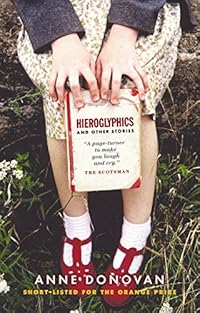
Hieroglyphics by Anne Donovan

Canongate, 2004, 173 p.

This is a fine collection of short stories by the author, whose novels Buddha Da, Gone Are the Leaves and Being Emily I enjoyed immensely. As a glance at the titles shows, most of the stories here are written in very broad Glasgow dialect.

Title story Hieroglyphics is narrated by Mary, a schoolgirl who cannot read nor write because all she sees is the letters “diddlin aboot.” Inspired by her knowledge of Egyptians her class studied in Primary School she can however express herself using pictograms.
Clare, the narrator of All That Glisters, is also a schoolgirl. Her father is bedridden from asbestosis but she brightens his life with a Christmas card she made for him using glitter pens. The ending is bitter sweet.
The Ice Horse is a rocking horse kept in the cold shed at Anna’s grandfather’s home. Her dearest wish is to look into its un-ice-covered eyes.
Virtual Pals is in the form of an exchange of emails between Siobhan and Irina. The latter was supposed to live in Shetland but her replies are emailed from Jupiter. This gives Donovan the opportunity to comment on the mores of young teenage life in Glasgow.
In Dear Santa another young girl who feels her younger sister is her parents’ favourite swithers about asking Santa for what she really wants for Christmas.
Wanny the Lassies is the tale of a schoolgirl causing problems for her male teacher through an essay indicating he had inappropriate relations with her.
A Chitterin Bite draws a parallel between the betrayal of a young girl by the friend she goes swimming with who drops her by taking up with a boy, to her later affair with a married man.
Me and the Babbie tells of the intense bond a mother feels with her new-born son.
In Away in a Manger a mother and her child go to see the Christmas Lights in Glasgow’s George Square. Both are shocked to see a homeless man in the background of the nativity tableau.
The Doll’s House her father made for her is being decorated by a mother for her son.
While out Brambling a woman and her child get lost.
A mature student takes some children for drama classes in The Workshop. It brings her into close contact with their male teacher.
Marking Time tells of a South European immigrant to Glasgow who remembers his time sweeping the beach of his home town when news of a bequest reaches him.
A Ringin Frost is the story of a woman whose husband is the only person who can warm her cold heart.
In A Change of Hert a woman searches for the reason why her husband’s preferences have changed after his heart transplant.
Dindy is told in short paragraphs illustrating fragments of memory.
Loast is narrated by an unmarried woman losing in old age her memory for words.
Zimmerobics is the bright idea of a young woman to lighten the existence of people in an old folks’ home.

Pedant’s corner:- “chitterin bite” (usually spelled chittery bite,) “aware that this eyes scan the room” (his eyes,) “painted the it coral pink” (no ‘the’ needed,) “round the the cars” (has a ‘the’ too many.)

Being Emily by Anne Donovan

Canongate, 2008, 316 p.

I doubt the novel as a form will ever fade away so long as it deals with those perennial biggies love, sex and death. That and the fact that people find stories irresistible. There may only be seven different plots but boy meets girl – with complications ensuing – is usually a winner. Being Emily gives us that proposition in reverse. It is, though, a grounded book, redolent of and true to its milieu. The characters’ speech is rendered in italics, which effectively does away with all that quotation marks and commas gubbins, and the text – not just the dialogue – is written in Glaswegian dialect, with phrases like “from the resty us,” (rest of) “in fronty” (in front of) “thegether,” (together) “mines” (mine,) photies (photos,) used firmly and unapologetically.

Fiona O’Connell has been brought up in Glasgow in a loving Catholic family. She has an older brother, Patrick, and twin younger sisters, Mona and Rona. (The family joke is that if they had been triplets the third would have been named Shona. Even Fiona’s name follows the rhyme.) She has long held a fascination for Emily Brontë, on whom she wishes to write her Sixth Year Studies assessment essay, but also has a talent for art.

Her life changes when her school can not provide all three subjects she wishes to take in Sixth Year and consequently has to attend the non-denominational (her father calls it ‘Proddy’) school. There she meets Jaswinder (Jas) Singh, a more talented artist but one who is destined to join his family’s pharmacy business and so will take Chemistry at University. This relationship gives Donovan the opportunity to kick against the automatic assumptions people make about others. Jaswinder is, for example, a vegan through choice, not for religious reasons. Both he and his brother Amrik – through different motives – upset their now dead father, one by taking up the sitar, the other by cutting his hair.

Fiona’s life is thrown into turmoil when her mother, the bedrock of the family, dies in childbirth along with the child. Here. Now (as Fiona rails angrily,) in the twenty-first century. Her father goes to pieces with Fiona trying to keep things together in the family without the authority to do so. She channels her feelings into her art and, despite the competing allure of Brontë, winning the local section of a nationwide art competition persuades her to go to (Glasgow) Art School. But it is Fiona’s burgeoning relationship with Jas which is the story’s pivot, a deep friendship which is on course to develop into something deeper but has never been consummated.

Then, within two days, it’s over. Fiona asks us rhetorically, But how do you break up with your best friend? then provides her own solution. Answer: You don’t. You betray him.

Foreshadowing is an essential literary technique, but this is not foreshadowing so much as outright telling us what’s about to (or, from Fiona’s point of view, as she’s recollecting all this from a later date, what did) happen. Yet those two lines have undeniable power. Even though Fiona has already told us of her regret at her actions, they come with the force of a punch. And they convey the gravity of her choice – though she is in retrospect hard put to it both to understand and to justify (most of all to herself) how she behaved, beyond the confusion and bodily discomposure she felt at the time. Treachery is of course another literary staple, guilt a powerful emotion.

There is still the major part of the book to go at this point and although Fiona kind of flits through her degree course – though her degree piece is a strain – we are given acute portrayals of her father’s confusion at modern life, Jas’s mother’s kindness, Rona’s fairly abrupt transition into adult responsibilities, Amrik’s preciousness about musical performance, not to mention the almost unnoticed drifting away of her schoolgirl friendships. The characterisations here are sound. The reader feels she/he knows these people.

It would be unkind to suggest that through all this Donovan forgot about the Emily connection but it is only returned to very near the end where it does seem a bit of an afterthought. But in any case the novel doesn’t actually need it; Fiona’s story is sufficient unto itself and well capable of holding the attention on its own.

Like Donovan’s previous novel Buddha Da and her later, absolutely magnificent, Gone Are the Leaves, Being Emily is a very good novel indeed and needs no other prop. And it is not so much about being Emily as being Fiona.

Pedant’s corner:- sometimes “to” is given as “tae” at others it is as usual. “they’d of,” “never of,” “would of” etc (I know this is perhaps true to the characters’ phonetic speech but I hate that use of ‘of’. In any case the way I hear those phrases uttered in real life they sound like ‘they’d uv,’ ‘never uv,’ ‘would uv,’ etc,) “Jas could sense the tiniest molecule of carbon monoxide sighing into the air” (this was in the context of global warming, so, carbon dioxide,) a missing coma before the quote mark at the opening of a piece of direct speech quoted within dialogue, “simmet” (though ‘simmet’ is how it is pronounced the usual spelling of this undergarment is ‘semmit’,) “a couple of month after” (months,) shaughly (is usually spelled shoogly.) “I’d work late at Art School then went hame tae my da’s” (should really be ‘then go hame’,) swopped (swapped,) “that have laid derelict for years” (lain – even in Scottish dialect.)

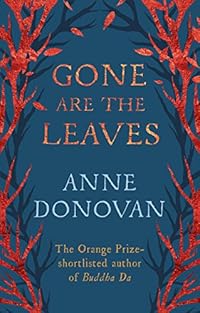
Gone Are the Leaves by Anne Donovan

Canongate, 2014, 361 p.

 Gone Are the Leaves cover

This is another very fine Scottish novel (my second such in a row) but it’s an odd coincidence that both this and Ronald Frame’s The Lantern Bearers should have a boy’s treble singing voice as a significant plot driver.

The main narration duties here are carried out in the first person by Deirdre, a young embroideress in an unspecified Scottish castle overseen by a couple only ever referred to as the Laird and my Lady. Interspersed with Deirdre’s remembrances are third person segments from the viewpoint of the peripatetic priest Father Anthony, and further first person snippets from singing master Signor Carlo and nun Sister Agnes.

The Laird’s daughter, Lady Alicia, is on the marriage market and my Lady has brought back from France, where she has relatives, a suitor with an entourage containing a page, Feilamort, of obscure origin but in possession of a voice like an angel. Feilamort is not the most robust of boys but he and Deirdre make friends and begin to spend some of what spare time they have together playing in the woods.

This being the Middle Ages and the glorification of God a bounden duty, the preservation of His instrument to that end, a pure singing voice, is an active consideration. In particular, Signor Carlo sees great prospects for himself in Rome with Feilamort under his tutelage. Feilamort himself accepts it is probably his best option for a secure future but before the procedure takes place asks Deirdre if he can know her as a man knows a woman. After initial hesitation she consents, and the novel’s path is set.

Deirdre’s secret revealed to Father Anthony, he arranges for her to travel overseas in the company of Sister Agnes. She ends up in an unusual castle belonging to a Lord known as the Master, where resides an artist called Monsieur Alberto (who has echoes of Leonardo da Vinci.) The Master commissions Deirdre to sew an embroidery of a unicorn from one of Monsieur Alberto’s paintings but otherwise why she was brought there remains a mystery to her. The nature of Feilamort’s – and therefore Deirdre’s – connection to the place slowly unravels while in the background lurks the shadowy figure of a Monsieur Garnet.

The Deirdre passages are rendered in a very braid Scots indeed. It was here I had some initial reservations as Donovan is not entirely consistent in applying this. “To”, for example is sometimes given in English and elsewhere appears as “tae”, whereas Deirdre would almost certainly always have used the latter exclusively. Similarly I noticed “afternoon” where “efternoon” or even “efternin” would seem more natural. But I can understand why Donovan made the choices she did. The liberal use of Scottish words – albeit mostly weather related and hence perhaps more readily understandable – might otherwise present too much of a barrier to readers not familiar with written Scots. A (short) glossary appears at the end but by no means covers all the Scots words in the text. They do, however, provide the flavour of the novel which would, I submit, be a much lesser thing if written in standard English. The expressiveness of these Scots words is a major part of the book’s overall impact. They might even be said to heighten the book’s literary qualities.

The mediæval Scottish setting reminded me vaguely of Andrew Greig’s Fair Helen but Gone Are the Leaves is its own thing entirely. Donovan captures superbly the fears and misgivings of the adolescent – going on adult – Deirdre, the suspicions of Signor Carlo and the wisdom of Sister Agnes. In this light her decision to render Father Anthony’s sections in the third person is entirely appropriate.

Even if resolution comes via frankly unlikely means (but justified within the novel’s narrative) and the ending has a very traditional Scottish feel this is an exemplary work – better than Donovan’s earlier novel Buddha Da.

Pedant’s corner:- whisps (wisps,) Agnes’ (Agnes’s,) Jacques’ (Jacques’s,) Feilmort (x1, elsewhere always Feilamort.)

free hit counter script