Poseidon’s Wake by Alastair Reynolds
Posted in Alastair Reynolds, Reading Reviewed, Science Fiction at 12:00 on 26 January 2016
Gollancz, 2015, 600 p.

Poseidon’s Wake is the third book in Reynolds’s Poseidon’s Children series, my reviews of the first two of which, Blue Remembered Earth and On the Steel Breeze, can be found by following the links. By the time of this novel the enhanced elephants to which Goma Akinya has devoted her life on Crucible, the planet of the sun 61-Virginis round which humans first encountered the enigmatic machines known as Watchkeepers and where is sited the still mysterious construction the Mandala, left by the M-builders, are losing their intelligence to genetic drift. Things are stirred up however when a message is received from the direction of the star Gliese-163 hitherto thought not to have been visited by humans. The message contains only two words, “Send Ndege.” Ndege is Goma’s mother and was the instrument by which Crucible’s greatest disaster, the sudden loss of the habitat Zanzibar girdling the planet with a ring of its remains, occurred when Ndege managed to activate the Mandala. Despite Crucible’s relative poverty an interstellar ship is prepared but Ndege is thought too old to withstand the rigours of such a journey and Goma goes in her place.
Meanwhile on Mars, Kanu Akinya, like Ndege a child of one the Chiku Akinyas from On the Steel Breeze, suffers extremely severe damage in a terrorist incident. The machines of the Evolvarium – to which he had been an ambassador – manage to revive him though, but while doing so insert into his consciousness one of their own, an intelligence named Swift. Under Swift’s influence he deviously procures a lift to Europa on a ship belonging to his ex-wife Nissa Mbaye. From there he retrieves his own interstellar ship and sets off for Gliese-163.
The narrative follows Goma and Kanu and their various companions in alternate chapters till very near the end of the book. Goma experiences troubles en route to Gliese, Kanu less so but things only really motor up when we get to that system which contains a huge waterworld, Poseidon, with strange wheel-like objects protruding from its ocean up into space. Poseidon moreover is guarded by lots of moons, getting too near which provokes them to “examine” intruders and induce in them a phenomenon (felt as “the Terror”) as a result of its revelation of knowledge of the end of the universe. These guardians do not allow the Watchkeepers anywhere near Poseidon but only creatures of a certain degree of consciousness. The signal which brought them all to the system had had nothing to do with Poseidon though. It was sent by Eunice Akinya, progenitor of the Akinya clan, not now the artilect we met in previous books but restored to human form by the Watchkeepers. Also in orbit in the system is part of Zanzibar the habitat it was thought Ndege had caused to be destroyed. This (large) remnant of Zanzibar is run by Dakota, an enhanced elephant now at the level of human intelligence or beyond, who fell out with Eunice and banished her – along with six elephants loyal to her – to Orison, another planet in the system.
This set-up takes some while to put in place but even once we get to Poseidon the pay-off there isn’t as great as a three book sequence perhaps requires. Reynolds has though left ample scope for further exploration of his scenario.
Further note: compare the cover of this book to the previous two in the sequence.

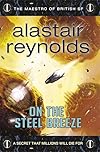
That is seriously odd. When I first saw Poseidon’s Wake’s cover I thought Reynolds had published a novel not in the sequence. I know that the paperback covers are now in broadly similar form but for owners of all three in hardback it will make their shelves look askew.
Pedant’s corner:- The inside cover blurb has the message to Crucible which kicks things off reading as “Send Nedgi.”
Despite the speed of light being an absolute barrier the habitat Zanzibar was transported seventy light years with the people (and elephants) on board feeling only a few days at most had passed “in their frame of reference.” Surely even at only a fraction under the speed of light they would experience the interval as being much longer than this? I must confess, though, the intricacies of time dilation effects are beyond me.
Otherwise:- with offset with disquiet (was offset,) ‘I feel obligated to point out’ (I feel obliged to point out,) they might yet make it our alive (out,) the new generation of engines were faster (the new generation was faster,) before any of them were allowed (was allowed,) the link between his name and artist’s (and the artist’s,) epicentre (centre,) rolled over into his belly (onto,) ‘what his surname?’ (what’s his surname?) inside the orbit of the moons (orbits,) ‘Have you told spoken to her about it?’ (no “told” needed,) ‘with disarming speed – and an equally disarming lack of concern for their own safety – the figure appeared to descend the crag in a series of perilous backward hops’ (the figure; therefore “its” own safety,) ‘we might have wait’ (to wait) Nhemedjo (Nhamedjo,) ‘as to not matter’ (as not to matter,) rigor (rigour,) appraised (apprised,) ‘that we still recovering (we are still recovering,) had brought some valuable time (bought,) forsee (foresee,) a skull-faced person clasping their hands to the bony bulb of their head (her/his hands, her/his head,) ‘into it deepest secrets (its,) ‘when we returned from Poseidon (return,) it might signal a change of heart on Dakota’s behalf (on Dakota’s part,) ‘I’d be glad if weren’t going deeper now’ (if we weren’t,) rancor (rancour,) waiting the deliverance (awaiting the deliverance,) a century and half (a century and a half.)

