Posted in Trips, War Graves, War Memorials at 20:00 on 7 June 2018
Situated just by the side of the N313 road and its junction with the Felix Nadarstraat in St Julien (Sint-Juliaan,) West Flanders, Belgium, the cemetery contains 248 graves. It lies only a kilometre or so from the Canadian war memorial known as the Brooding Soldier.
Cemetery gates:-

As can be inferred from the above view and this one of the graves this is yet another “corner of a foreign field”:-

No Comments »
Posted in Trips at 19:00 on 20 May 2017
Some photos of the Markt (Market Square) in Bruges:-


The statue you can see in the above photo – a seat for tired tourists – is of Jan Breydel and Pieter de Coninck, two local heroes from the 14th Century:-

These horse-drawn carriages were offering trips round the city. At €50 each we gave that a bye. Shanks’s pony is better for you anyway.

I liked this compasstower. It has a Deco feel (rule of three in the windows) but I suspect it is much earlier:-

The Provincial Court takes up one side of the square:-

On the square’s south side lies the Belfry of Bruges:-

Alternate view of the Belfry from its courtyard:-

No Comments »
Posted in Trips at 23:04 on 19 May 2017
Bruges (Brugge) in West Flanders in Belgium is a lovely small city with great buildings.
We entered it through Smedenpoort, a gatehouse built over what looked like may once have been a moat:-

Smedenpoort from the city side of the gate:-

View to right from bridge seen above:-

View to left:-

The streets into the centre were festooned with banners. I couldn’t quite make out what they were displaying:-

No Comments »
Posted in War Graves, War Memorials at 12:00 on 19 July 2016
Just outside the town of Langemark (formerly Langemarck) in the municipality of Langemark-Poelkapelle, West Flanders, Belgium, lies a German War Cemetery which contains the bodies of more than 44,000 soldiers including the German air ace Werner Voss and two British soldiers who died in 1918. Many of the smaller German war cemeteries in this part of Belgium were consolidated into larger ones such as Langemark in the 1950s.
Langemarck village (as it was then) was the site of the first German gas attack in April 1915.
Stone by Langemark War Cemetery entrance. The five crosses design is the motif of the Volksbund Deutsche Kriegsgräberfürsorge, the German war graves commission:-

Langemark War Cemetery Entrance:-

Volksbund plaque inside entrance building:-

This basalt cross is at the cemetery’s corner by the path from the car park to the entrance. Blockhouses can be seen in the cemetery’s interior:-

Blockhouses and graves from cemetery exterior:-

On a series of basalt blocks in the area just behind the cemetery’s entrance are engraved the names of those known soldiers who are buried in the mass grave here, known as the Comrade’s Grave (Kameraden Grab.) The plaque on this first one commemorates British Privates A Carlisle, Loyal North Lancs Regiment and L H Lockley, Seaforth Highlanders:-
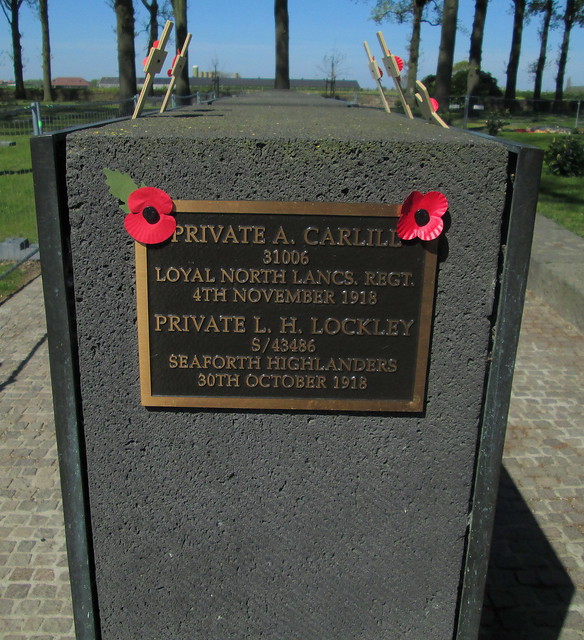
Names of some of the known soldiers in the Kameraden Grab. There are 68 bronze panels of these names:-

Langemark War Cemetery, Statues. When we visited this grouping was set behind the entrance building though previously it had been moved from there to the cemetery’s rear boundary. It was designed by Emil Krieger who gained his inspiration from a photograph of mourning German soldiers taken in 1918:-

No Comments »
