The Translator by John Crowley
Posted in Other fiction, Reading Reviewed at 12:00 on 1 October 2026
Harper Perennial, 2003, 301 p.
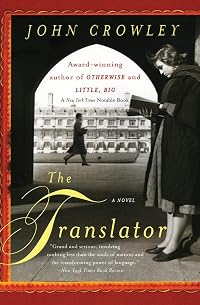
Presented as a memoir (of sorts,) this tells of the relationship in the early 1960s between Christa (Kit) Malone, a nascent US poet, and Russian refugee poet Innokenti Isayevich Falin.
Kit’s life has been peripatetic as her father flits from job to job (or post to post: there are hints he works for the government in some sort of secret capacity.) As a result, she is very close to her brother Ben, so much so that when he leaves home to join the army she is all but devastated. This leads her to an unwise decision to lose her virginity. Her resulting pregnancy would have been bad enough at the time for any young woman but her family is Catholic. The child though, when born, is severely incapacitated and dies. Hence Kit is enabled to go to college where she meets Falin and enrols in his class. Their rapport through poetry soon builds. She learns Russian and they begin to collaborate on translations of his work. She later makes her name as a translator of Falin’s poetry.
Part of this story is told as a kind of retrospective when she travels to post-communist Russia to a celebration of the 75th anniversary of Falin’s birth, and of his life and poetry, in St Petersburg, 1993, where her main interlocutor is Gavriil Viktorovic Semyonov. Through him she gleans even more of the conditions under which Falin had lived before his exile.
Living in the Soviet Union taught you to be invisible, not to bring attention to yourself. Falin had begun life (or at least his memories began) as one of the besprizornye – ragamuffins/urchins, lost or orphaned children – which throughout its history Russia has thrown up in profusion. Gavriil Viktorovich tells her, “We were all besprizornye. The whole society. We were all torn away from common bonds that we had been born into. All had to rely on others, on those we found around us, yet never trust them.” Not, then, examples of New Man as Soviet doctrine had it, but self-preserving individuals. “All against all.” Falin had said something similar to her.
Semyonov reflects on the post-Soviet era. “In her dark time Russia was kept alive by the poets. Perhaps now in the new time” of biznesmeny and konsultante “they will pass …. cease to be souls, or persons, and become only books.”
The campus scenes here reminded me of Sylvia Plath’s The Bell Jar, and, because of the Russian and poetry connections, there were resemblances to Vladimir Nabokov’s Pale Fire.
The background to them is the Kennedy Presidency and the Cuban Missile Crisis. Kit has a sort of friendship with Jackie Young of the People’s Socialist League. The Fair Play for Cuba Committee march with their Hands off Cuba banners and encounter discontent.
On an occasion when Falin is away and Kit is looking after his house a man called Milton Bluhdorn intrudes on it. Falin it seems is suspected of being a plant (they didn’t let Pasternak out so why him?) and Kit is invited to spy on him. Instead, she tells Falin of the approach.
But most of their talk is of poetry. Falin says of poems, “You cannot translate. You can only make other poems.” He also contends that countries have greater and lesser angels. The lesser angel is all that the greater angel isn’t but sometimes prevails. It is left open to the reader to decide whether or not Falin and Kit are lesser angels of their countries.
While leaning into the ramifications of the Kennedy assassination and its associated conspiracy theories, The Translator is a work about the moral responsibilities of the individual and the operations of the agents of the state. But most of all about the importance of poetry, words, and personal relationships.
Pedant’s corner:- occasionally questions in dialogue are not followed by a question mark, “the Ukraine, the Crimea” (nowadays just Ukraine, Crimea.) “Gavriil Viktorovich Semyonov” (in British transliteration, Viktorovic.)
Tags: Historical Fiction, Historical Novel, John Crowley, Literary Fiction, The Translator
