The Essex Serpent by Sarah Perry
Posted in Fantasy, Other fiction, Reading Reviewed at 10:00 on 3 August 2017
Serpent’s Tail, 2016, 430 p.
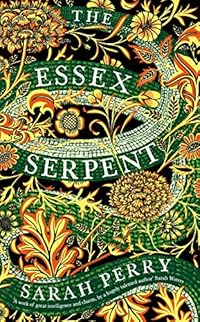
To all intents and purposes this is a nineteenth century novel but it is one written with a modern sensibility. The text is divided into a prologue set on (an unspecified) New Year’s Eve followed by four parts split into unevenly distributed sections which are titled consecutively January to September and then finally November, all interspersed with letters written between the characters.
In it the recently (happily) widowed Cora Seaborne with her son Frankie – who seems to have OCD or at the least autistic traits – and his childhood nurse Martha travel to Colchester to get away from London. The doctor who attended her husband’s death bed, Luke Garrett, has meanwhile formed an unreciprocated attraction to her. An earthquake eight years before the book starts has, according to rumour, let loose again the Essex Serpent which for a short time in 1669 roamed the waters of the Essex coast. Every local mishap or disappearance is now blamed on it. In the Blackwater estuary village of Aldwinter, there is a representation of the serpent carved onto a pew in All Saints Church. Through a mutual acquaintance an introduction is arranged between its vicar, William Ransome, and Cora, who has an interest in ancient creatures inspired by Mary Anning. Both Cora and Ransome erroneously imagine the other to be a stereotype of their respective statuses. They first meet by accident while rescuing a sheep from the muddy river bank but on further introduction strike up an intellectual, if verbally combative, friendship. Ransome is at odds with his congregation in being unwilling to address or assuage their belief in the creature. Ransome’s wife, Stella, is a consumptive, who is pleased by, even encourages, the friendship between her husband and Cora, and herself befriends Frankie.
The ingredients are here for a tale of forbidden love (or two eternal triangles even) set against a backdrop of supernatural horror but Perry does not play that game. She is more subtle – and too good a writer. Yet something about the enterprise nevertheless misses the mark.
The prologue mentions the banks of the River Blackwater in its first sentence. Having once lived by that river’s banks myself – but way upstream not near the estuary – I was therefore disposed to like the book, but as time went by I grew increasingly frustrated by it. It is not that it is not accomplished in its way or fails to provide memorable characters – even the relatively minor ones are rounded and all too human. There was just something about it that felt askew. About halfway through the thought crystallised.
Perry has yet to learn economy. Accumulation of detail normally lends verisimilitude, but she overdoes it. Descriptions frequently contain at least one observation too many. There is too much telling, too many extended ruminations by the various characters. And is Cora just a little too modern in her attitudes? In this regard the sub-theme of the problem of social housing and high rents also seemed to be straining for contemporary relevance. And – this last was actually a grace note, so not infelicitous as such – I did wonder if Martha had been named solely so as that another character might say to her, “‘Martha, my dear.’”
A pointer to Perry’s intentions for the novel may be found when she puts into the mouth of Will Ransome the thought, “‘far from being one truth alone there may be several truths,’” but we are never in any doubt that there is only one reality here. In that regard the putative fantasy element of the serpent promises more than it delivers.
While Perry has a facility with character and behaviour and The Essex Serpent has much to recommend it, it is more than a touch overwritten.
Pedant’s corner:- a missing comma before a speech quote (x 3,) fit (fitted, x 2,) “no sooner had she grown accustomed to one Cora, another would emerge” (than another would emerge,) “‘Still gadding about with hookers, is he?” (hookers was not a British usage in Victorian times I’d have thought. It still isn’t,) “he’d showed her” (shown,) “that of a minor royal greeting dignitaries at the opening of a library” (did minor royals perform such functions in the nineteenth century?) “Fifty miles south as the swallow flies and London’s at her best” (London? South of the Blackwater estuary as the swallow flies?) “Think of the set to when Galileo sent the earth spinning round the sun” (that was Copernicus, not Galileo, but it was in a character’s musings. He may have been intended to be mistaken but he was otherwise presented as scientifically literate,) imposter (impostor,) curb (kerb – which was used only seven pages later!)
Greetings to the word croat (meaning a cross) which was a new one on me.
Tags: Fantasy, Martha My Dear, Mary Anning, Sarah Perry
