A Dead Man’s Memoir (A Theatrical Novel) by Mikhail Bulgakov
Posted in Other fiction, Reading Reviewed at 12:00 on 6 August 2016
Translated from the Russian Театрализованное Роман (Teatralizovannoye Roman) by Andrew Bromfield. Penguin Classics, 2007, 174 p including 5 p notes: plus iv p chronology, xii p introduction by Keith Gesset, i p Further Reading and A Note on the Text ii p. First published in Novy Mir 1965. The book seems also to have been published in English in 1968 under the title Black Snow: A Theatrical Novel.
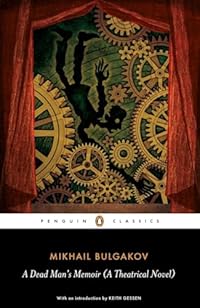
Sergei Maksudov has written a novel: but it cannot be published. All who are shown it comment unfavourably, critically or dismissively and universally tell him it won’t pass the censor. He makes an abortive suicide attempt but then is invited to a meeting with a theatre director who has read the book and wants him to turn it into a play. It is only then that Sergei’s troubles begin. Not only does he sign an onerous contract on poor terms, he has to put up with interference with the text, actors’ jealousies, a misguided director and sundry other difficulties.
A Dead Man’s Memoir is semi-autobiographical, satirising Bulgakov’s experiences in the theatrical world of Moscow. This edition’s text is annotated with references to the real-life models for various characters. There is apparently a lampooning of Stanislavsky among others. The novel, however, remained unfinished as Bulgakov began instead to put his energies into work on his masterpiece The Master and Margarita. It stops on the eve of the first performance of Maksudov’s play.
I know the roman-à-clef is a well-established form but I have reservations about it as it leads some to believe that no characters in a work of fiction are ever entirely made-up. In this instance, though, the book can also be read as an allegory of the labyrinthine workings and the absurdities of the Soviet bureaucracy but in this it is nowhere near as powerful as The Master and Margarita.
Pedant’s corner:- in the introduction; Likopastov (Likospastov.) Elsewhere: “a sturdy man with a beard by the name of Vasily Petrovich.” (I didn’t know Russians named their beards….. The translator could have avoided this ambiguity by writing “a sturdy, bearded man by the name of,”) wee cucumbers (a Scottish translation of a Russian term is unusual,) span (spun.)
Tags: Mikhail Bulgakov, Other fiction, The Master and Margarita, Translated fiction
