Stepping Out by Cynthia Rogerson
Posted in Reading Reviewed, Scottish Fiction at 12:00 on 22 September 2015
Salt, 2012, 256 p. Borrowed from a threatened library.
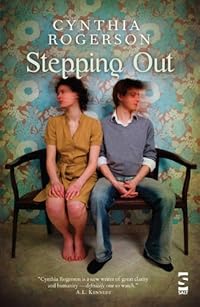
Rogerson is a North American who has been settled in Scotland for decades. The book, a collection of her short stories, is structured in seven sections (each with a theme whose title is given in capitals.)
ACCIDENT’s theme is obvious. A Dangerous Place examines the reactions and emotions of two recent immigrants to California as their youngest son undergoes surgery after a car accident. The Etiquette of Accidents inhabits the thoughts of three women friends and a male biker who have decided to go up Ben Bhraggie. The women are on the cycle path when the biker hits one of them on his way down and is thrown off. In Homesick fourteen year-old Izzy hates her mother – especially when she gets killed at milk crate corner. On the day of the funeral Izzy feels free, but homesick. Rubbish Day has a forty-five year-old unemployed man whose wife hates sex, whose son disrespects him and whose only function is putting out the rubbish reflect on his life when the son goes missing.
ELISABETH relates six incidents from the subject’s young life. In The Bear, on holiday in a log-cabin settlement, six year-old Elisabeth is allowed to sleep over with her new friend. She misses her family. By the next story, Room, the family has moved house (not for the first time) but this time Elisabeth has a room of her own. It takes her a while to get used to it. In Enough Room Elisabeth reacts to the death of the father of her friend next door, Robbie, just before Christmas. Home on the Road sees Elisabeth’s family, minus Sam, on a trip to see her grandparents. All the familiar things happen, but towards the end of the journey Elisabeth has an epiphany. Eleven now, Elisabeth watches as her brother, Sam the Man, suddenly grows up – and away – on his wedding day. Summer sees Elisabeth and her friend Debs, in their fourteenth summer, hang out, tease each other and anticipate adulthood.
JACK AND MILDRED* chronicles a marriage. Wait for Me, Jack introduces us to cocky, too charming Jack and to Mildred who decides she is ready to settle down. Stepping Out is the story of Jack’s (first?) extra-marital affair after twenty years of marriage. When sixty, Jack goes Wine Tasting while Milly is beginning to forget things. First sees the couple in old age. Mildred becomes complaining while both she and Jack wait to see which of them will go first.
FRANK AND MARTHA deals mostly with Frank. When The World and Things in it starts, Martha has just discovered a lump in her breast. Meanwhile her white hen broods on his eggs after their red cockerel has been killed. In To Dance, eight years later, Martha’s lump long since removed, her annual scan is followed by a recall. Narrator Frank reflects on what he doesn’t know. By The Truth About Roller Coasters, Martha is dead, the kids still at home much more helpful than before; not-roller-coaster person Frank takes his more-or-less grown up family to Alton Towers. After a ride he realises that, “Dying is not fun. Almost dying is.” The Purpose of Photographs has Frank, now seventy-nine, losing his eyesight. He goes through the family albums and picks out five photographs.
TRUE STORIES may or may not be. Like Singing has Flora seeing things. Her brother, the preacher of a charismatic religious group, appears as an alsatian. He tries to get her to join his sect. Belated Love Letter From a Famous Writer is a story about the ways in which writers perceive and misperceive. Sonoma Finch lies waiting, hoping to know what her last experience on Earth will be but receives a letter from Ernest Hemingway (even though he’s dead) suggesting she was his muse. In Persephone’s Passion Persephone thinks her latest squeeze, Arthur, is dead. He’s actually the devil (or at least lives in Hell.) Herman’s Night Out features a woman who has wet dreams about her friend’s husband, but later finds some of the things her dream lover says are true. Christopher’s Room appears in Sarah’s flat; as does Christopher. He thinks she has appeared in his. A ghost story.
ALONE’s link is also obvious. My Favourite Things presents the thoughts of an art gallery attendant as he or she sits on a chair and observes the visitors. A woman comes across a house which lies In Abeyance. Her experience is interspersed with that of the Pole who came to Buchan in 1940, worked the land and was asked to stay. A lass, just finished her Highers, lies in The Top Field. It’s so warm she takes her shirt and bra off and imagines her true love chancing upon her. Instead, it’s Fergus. The Long Missing of a woman’s dead husband of fifteen years only begins after she takes up with someone new.
LOVE’s stories are mostly about its absence. In Begin Sheena finds she is pregnant. The father is Daniel whom she has not known long enough; but it’s a beginning. Ten O’Clock Trim relates a – somewhat charged – conversation between a woman and her hairdresser. Bus Stop is a fairy tale about Angus and Zoe. It even begins Once upon a time and also contains the phrase And they live happily ever after. But endings are never really the end. “Everyone has just remembered they are Scottish and that Scotland is a lot of sad things these days, and actually a thousand years of sad things, but it is also their beautiful place.” “On Saturday nights in Inverness pubs, it is impossible to be too sentimental.” A Good Wife seems to be one who confides in photographs of her dead relatives, and kisses the best lover she never had. In Instead of Beauty Addie decides after giving up on love she will settle for non-prepossessing Joe, who smells of fish, to father the child she wants. “Single men in Lochinellie gravitate to the bar at dusk, like single men everywhere in the Highlands.” Joe is nevertheless reluctant. In Fly A woman, her man and her thirteen-year old son go fishing. She strolls off, panics, and returns. The boy is oblivious.
*To British eyes of a certain age that just looks wrong. It should be George and Mildred – except Mildred in this case isn’t as domineering. (In this section’s second part either we are seeing a different Jack and Mildred from in the first or else Jack has forgotten his pre-marital affairs.)
Pedant’s corner:-
There are eight new paragraphs not indented and one superfluous line break at the bottom of a page, focussed (focused,) lay (lie, x 7,) Dunrobbin Castle (Dunrobin,) less (fewer, x 2,) “Elisabeth imagines the chipmunks and red squirrels she feeds by day” (Okay, she’s imagining them, but red squirrels? In the Sierras?) outside of (outside,) de ja vu feelings (déjà vu,) Debs’ (Debs’s,) a middle-aged women (woman,) tisks (the alphabetic representation of the sound of a “tut” is usually spelled tsk, x 2,) the climatic night (climactic,) Glen Miller (Glenn Miller,) pine martins (pine martens,) closet (cupboard,) knit (knitted,) Damascus’ (Damascus’s,) “I’ve never see you drink anything either (I never see or I’ve never seen,) sandwiches crumbs (sandwich crumbs,) “a pain the arse,” (pain in the arse – this is British usage but we had “rowboat” in the same story; in British English it’s called a rowing boat,) spasm-ed in the middle of a line, he unpeeled it off (he unpeeled it, or he peeled it off,) an new type (a new type,) “everyone begins to breathe again and move away” (moves,) lifesomething else (like something else?) cloths (clothes,) cafetierre, (cafetiere,) chilli (chili) and in the credits, oka (aka?)
Given this list I found the thanks in the acknowledgements to Peter, for patiently proofreading every version of every story, a bit ironic. (I’m tempted to suggest, next time try harder. Or try me. I wouldn’t charge much.)
Tags: Cynthia Rogerson, George and Mildred, Scottish Fiction

Denis Cullinan
22 September 2015 at 15:21
Nifty Pedant’s Corner catches—
1. “everyone begins to breathe again and move away” (moves)
2. “focused” This is Usian. In this country we have “traveling,” “programing,” etc. ad inf. Usian usage here is wrong.
3. “closet” for “cupboard” Usian again. In these parts, we do have cupboards–they’re kitchen cabinets for cups, dishes, and like that.
note on “half-ass”. The usage in The U.S. is wrong. We say “half-assed,” which can’t help meaning “supplied wirh but one half of an ass (viz., a pair of buttocks). The correct thing is to understand that a half ass is a fool who is half man and half ass (donkey).
jackdeighton
22 September 2015 at 19:15
Denis,
Lay for lie is USian too. Or at least the good lady’s blog friend Peggy used it that way.)
I knew about closet but this was a British publication – and Rogerson has been over here for thirty years I think.
Focussed just annoys me as does gasses. One “s” please.
In the translated text of Umberto Eco’s Name of the Rose there was a reference to some novices with bare asses in (I think) a kitchen. In my mind I saw donkeys.
We say “half-arsed” to mean not quite complete, or not thought through (since, I suppose, half an arse would be useless.)