The Time Traveler’s Wife by Audrey Niffenegger
Posted in Other fiction, Reading Reviewed at 14:47 on 18 December 2009
Jonathan Cape, 2004, 519p
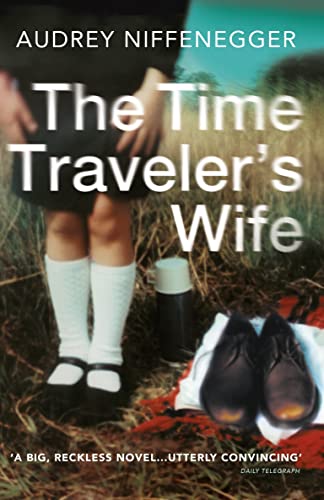
This is the fruit of one of the local library book sales I have mentioned. A previous reader has “kindly” corrected the German spelling in it. Pity they didn’t do the same for the English. (The word for floral tributes spelled wreathes, anyone? Flowers called gladiolas?)
Or should that be American? I really resented having to omit the second “l” in traveller in this post’s title. The edition I read was printed in the UK. Why were British spellings not used? I’m quite sure that British novels released in the States are made over for that market. In these days of “Find and Replace” it is relatively simple to amend a copy-ready file, surely? Or is it just too easy for the publisher to take the US version whole and make us swallow it?
Notwithstanding that, there is something unsavoury about the whole enterprise. This begins from the cover (see above) which shows, from the waist down, a young girl in a skirt and knee socks, while lying beside her on a blanket on the ground is a man’s shirt on which his shoes are placed.
The central relationship involves Clare, who meets her future husband Henry when she is six and he is thirty years older. The catch is he is a time traveller who when she first encounters him is, in her future, already married to the woman she will become. It is nevertheless unsettling to be reading about clandestine meetings between a grown man and a child who is also his wife – even if Niffenegger is at great pains to point out that the affair is not consummated until Clare is eighteen. I don’t think this absolves her of the whiff of transgression, however.
Henry does have an excuse of sorts. He does not meet Clare in real time until she is twenty and he twenty-eight - and he has no conscious control over his time-travelling.
Each section is headed with a date and a note of Clare and Henry’s respective ages at the time. This is indicative both of flaws in the concept and/or inadequacies in the writing. It is really only a species of information dumping. Such background is surely more smoothly imparted via the narrative. We should not need our hands held in this way. Or, rather, the crutch it offers the author should be eschewed. Each section also begins with the name Clare or Henry to indicate viewpoint. Should we not be able to distinguish different narrators by their individual styles?
While there would be no story without it, the time travelling is itself problematic. The episodes we are shown (we are told there are others) are there purely to unveil the plot. Henry usually travels into the past but can on occasion go into the future. He also sometimes meets himself. Yet we are to take it on trust that he doesn’t let his future self know about Clare – the love of his life – until after they meet in real time. And they never try to alter what happens to them (except for Henry, once.) Nevertheless Henry and Clare are not above using his foreknowledge to play the stock market in order to make their lifestyle comfortable. Plus Henry still keeps on his job in a library.
Niffenegger is having her cake and eating it here.
Moreover, the rationale provided for the time travel is inadequate. It is a genetic variation, yet “a bit like epilepsy,” as Henry describes it to his boss when two of his incarnations turn up at the one time. Henry is supposed by another of the characters, a medic, to be a new stage in evolution; the first Chrono Displaced Person. And nowhere is the space travel aspect of time travel addressed.
Henry is also a bit of a prick, the sort of man whom Clare would be unlikely to fall in love with or be attracted to were it not for the unusual circumstances in which she met him. There is an implication of predestination here, or self fulfilling prophecy, which sits badly with free will. In the one instance where Henry does affect the future he is also manipulative.
Rid yourself of these quibbles, though, and the novel is a more-or-less engaging love story. But no more.
Tags: Audrey Niffenegger, Other fiction

Twenty-first Century SF Mistressworks – A Son of the Rock -- Jack Deighton
20 April 2011 at 17:46
[…] up to do it would seem.) At least one, though, The Time Travellerâs Wife, I would not – did not – define as […]
The Shining Girls by Lauren Beukes – A Son of the Rock -- Jack Deighton
9 December 2013 at 12:01
[…] of the novel which I found a little unsatisfactory. Like the ability in Audrey Niffenegger’s The Time Traveler’s Wife there is no rationale for Harper being able to travel in time. This tumbles the story into fantasy. […]