Archives » Germany

1864

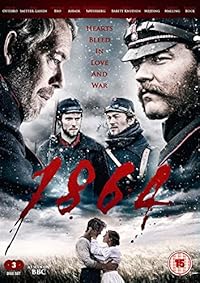
 1864 cover

When this Danish TV series – the most expensive production in Danish television history – was first trailed on the BBC and I saw the blue uniforms I thought it would be about the War Between the States (known on this side of the Atlantic as the American Civil War) as the date fitted. I was immediately interested. I’ve read a lot about that conflict and watched the Jim Burns TV series several times. Looking more closely I realised that I didn’t recognise the painting shown on the trailer or the figures within it (I most likely would have for an American Civil War painting) and of course the uniforms’ details weren’t quite right.

I was therefore even more intrigued when it dawned the series was about the Second Schleswig War as that was something I knew vaguely about from History, at school. Once read, who can forget the comment the UK Prime Minister at the time, Lord Palmerston, made about the intricacies of the Schleswig-Holstein question – which in the series was uttered to that fine actress Barbara Flynn, in the person of Queen Victoria – that there were only three men who ever understood it; the Prince Consort, who was dead, a German professor who had gone mad and Palmerston himself, who had forgotten all about it?

As presented in the series, the war seems to have been provoked by Denmark in a fit of collective insanity. The programme, which has been criticised for historical inaccuracies (it would be difficult to portray any conflict televisually without some of that I’d have thought) certainly presented the Danish Prime Minister, Monrad, as an utter nutter. There seemed to be an element of hysteria in the air that prefigured the Germany of 1939. (Then again there was widespread welcome to Britain’s declaration of war in 1914, so no need to point fingers; except the UK hadn’t sought that conflict – at least not directly.)

However the dire results of the Second Schleswig War for Denmark meant that, to that country’s credit, no Danish military action outside its frontiers again took place until the NATO bombing of Kosovo in 1999.

Scenes were shown from both sides of the conflict and also the sidelines as Palmerston affected to intercede. The subtitles were no intrusion (1864 went out in the BBC 4 European detective slot on Saturdays at 9 pm.) As near as I could tell each nationality in the series spoke in its own language. (I have a smattering of German but no Danish except what I could glean from the dialogue’s similarities to German, English and, occasionally, Scots.)

For the series the necessity of introducing a human aspect to the conflict in the shape of estate manager’s daughter Inge and the two brothers Laust and Peter, with whom she has a special bond, allowed the introduction of those perennial literary concerns, love, sex and death. There was love to be sure, but not much sex – only four scenes as I recall, three of them having not much to do with love, plus another featuring boys attempting to masturbate – but enough death and destruction to slake anyone’s desires. The battle scenes were impressive – and visceral.

Overall the series was magnificent television, well worth checking out if you didn’t catch it, but I thought the elements of mysticism involving one of the soldiers from the village were unconvincing and the framing device wherein a disaffected young woman from our century sent to his house for a form of community service helps read out Inge’s memoirs to an old man (who is Inge’s grandson) was perhaps unnecessary, though it did give the sense of consequences cascading down the years and a contrast to the privations of the soldiers of 150 years earlier.

When I last looked in the BBC shop, the DVD of this was out of stock but the Blu-ray was available.

Günter Grass

I see that Günter Grass has died.

I haven’t actually read any of his novels – he’s one of those novelists whom I meant to get round to sometime. The closest I have come was when I watched the film that was made of his novel The Tin Drum. The film was excellent.

There was a stooshie when he revealed he had been a member of the Waffen SS – mostly because he had managed to keep the fact to himself for 60 years and in the interim had been outspoken about Germany’s post-war attitude to the Nazis. I doubt, though, many German seventeen year-olds would have resisted being called up in 1944. In any case his war record can have had no bearing whatsoever on his abilities as a writer. As a person perhaps; but not as an author. (There were doubtless many more in Germany, Austria and various parts of Eastern Europe who may have had more reason to keep theirs quiet.)

The Nobel Committee saw fit to award him its prize in literature in 1999. That puts him in good company.

Günter Grass: 16/10/1927 – 13/4/2015. So it goes.

Dutch War Memorials

I didn’t expect to see War Memorials in out of the way places in The Netherlands. The country didn’t take part in the Great War but was of course invaded by Germany in 1940. The Dutch were unable to combat the Luftwaffe bombers – the centre of Rotterdam was destroyed – and surrendered to avoid destruction of their other cities. The fighting lasted seven days.

But then there were also the almost constant Allied bombing raids over Germany in the latter part of the war (the run-up to D-Day excepted) which flew over The Netherlands en route and on return.

It seems two such aeroplanes were shot down over or near Opende.

This view shows both memorials:-

The distinctive headstones of Commonwealth war graves can be seen. I assume these were erected after the war.

The inscription on the brick wall reads :-
In Memory of the seven heroes whose plane crashed in Opende, 15 Feb 1944.
The Residents of Opende

This is the other end of the memorial:

The aircraft was a Halifax bomber with seven crew, six of whom were Australian. It was shot down. The details are here.

Links to more information about the crew can be found on this webpage.

The other plaque on the site is for a US B 17, “Sky Queen” which came down on 28 Jul 1943.

More information about this crew is here.

In the nearby town (I would call it a town but by the Dutch definition it’s a village) of Surhuisterveen there is a War Memorial plaque on the other side of the clock tower from this view.

The inscription reads:-
In memory. To our local fallen in the war 1940-45.

And Now I’m Back

I’ve been in Holland.

Well, strictly speaking, since it was on the borders of the Friesland and Groningen provinces, make that The Netherlands.

The good lady’s eldest brother lives there. We had been supposed to visit for years but life got in the way.

We needed to renew our passports first. I sent the applications away late in July. Despite all the talk on the news about delays we got the new ones inside a week. (As I remember it was four days.) Maybe the Glasgow Passport office is more efficient than down south.

So another country visited. Apart from the constituent parts of the UK (though I only just made it into Wales) I’ve been to Sweden (Stockholm,) the Soviet Union (Leningrad as was) and Denmark (Copenhagen) on a school cruise when I was at Primary School, Portugal (the Azores, Madeira, Lisbon) and Spain (Vigo) on a Secondary School cruise, and as an adult to Germany (near Stuttgart) and France twice (Normandy for the D-Day beaches and Picardy for World War I battlefields.)

Since the good lady didn’t fancy being on a RoRo ferry overnight we drove down to Harwich (with an overnight stop) and the same on the way back. I’m knackered.

The Great War Anniversary

One hundred years ago today, at midnight Central European Time, the event that shaped the twentieth century came into being. Or at least the British Empire’s participation in it began.

Germany had invaded Belgium that morning so we were a bit late. (A squad of Germans had invaded Belgium the previous evening but had jumped the gun – so to speak – not getting the delaying telegram in time and were recalled. They were soon back though.)

Yet those were not the first shots. Hostilities had started seven days earlier on 28th July when Austro-Hungarian troops opened fire on Serbia in response to the true first shots – the ones fired by Gavrilo Princip and which killed Archduke Franz Ferdinand of Austria and his wife Sophie but even those had their roots in the welter of national entanglements which plague the Balkans even yet.

Those entanglements were mirrored in the system of alliances that dictated that Germany had to attempt to defeat France first before swinging round to take on Russia and so necessitated a march through neutral Luxembourg and Belgium.

Ironies abounded. Without attacking Belgium, Germany might have avoided war with Britain and so the holding up of the German armies by the BEF at Mons and later the Allies at the battle of the Marne might not have succeeded and so gained Germany the victory in the west it desired. Russia managed to invade eastern Germany earlier than the Germans had anticipated and troops were hurriedly withdrawn fron the Western Front to face the threat which I believe was actually defeated at the Battles of Tannenberg and the Masurian Lakes before these reinforcements could get there.

The Great War is remembered for the bloody stalemate of the trenches yet in these first encounters when it was still a war of movement daily casualties were enormous – especially for the French – much higher than in most later battles; though the Somme has a grim reputation in Britain.

I heard a woman on BBC Radio 2’s Pause for Thought this morning say she refused to call it the Great War “as there was nothing great about it.” Wrong meaning of great I’m afraid.

Germanic Hegemony Looms

Over the past eight years Spain dominated the international football tournaments in which they took part – though they had a premonitory blip in last year’s Confederations Cup (and what a misleading pointer that final turned out to be.)

After the win by Germany in Rio on Sunday we could be in for a longer period of domination than the Spanish enjoyed as the German players are quite young and will only have gained in confidence from their achievement. I don’t know if I can stand that thought, though.

Still, at least it gives Scotland an early opportunity to claim their scalp as the two countries meet on Sep 7th in the first qualifying game for the 2016 European Championships.

The late World Cup has unified the FIFA and Unofficial Football World Championships. Going into it Uruguay were the holders of the unofficial title but swiftly lost it to Costa Rica.

For historical reasons Scotland is actually at the top of the unofficial football championship rankings. The September game will give Scotland a chance to reclaim the actual title – if Argentina don’t beat the Germans in their friendly a few days before.

The Team That Made All Brazil Cry

So. There is to be no redemption. Brazil’s historical trauma of the Maracanã in 1950 known as the Maracanazo has been surpassed. Will this one become known as the Mineirãoza?

The country of Brazil has never been involved in a war (except, perhaps, internally.)* The national consciousness has been invested in football. The 1950 defeat was akin to a national humiliation. How much worse, then, a 7-1 hammering by a team who had never beaten them in a competitive game? And a first home defeat in competition for 29 years.

It’s been coming, though. They weren’t convincing in the group games, Chile pushed them close in the second round and Colombia didn’t deserve to lose to them either. Both those sides perhaps had too much history with Brazil to overcome. (And the hoo-hah over Neymar’s injury is over-confected. Brazil spent most of the Colombia game kicking “Oor Hamish” – James Rodriguez – all over the park. Given the outcome of the semi-final the real loss was in fact Thiago Silva.) The Germans didn’t care about reputations or history; they did what German teams do.

Brazil’s scapegoat in 1950 (“Look! There’s the man that made all Brazil cry!”) was Moacyr Barbosa. At least this time they can’t blame it on a black goalkeeper.

Make the most of the last few days of this Brazil-hosted World Cup. I doubt there will be another one.

*Edited to add. I have since found out that not being involved in a war is only true of the Brazilian Republic and not of the Empire which preceded it. The Republic has had internal conflicts.

di Stéfano

The football legend who has died today had a name that needed no further explanation. He was part of that legendary Real Madrid side that captivated the football followers of Glasgow and Scotland at the European Cup Final of 1960 – played at Hampden Park. di Stéfano scored a hat-trick.

I was too young to be aware of it at the time but the folk memory was promulgated and persists. Such was the effect of that display of what football could be that the names of the forward line still trip off the tongue with no need for googling. Canario, Del Sol, di Stéfano, Puskas and Gento. Mind you, I see film of that game now and think, “Where was the marking?”

One curiosity is that I believe the Eintracht Frankfurt team that formed the opposition that day were all amateurs – as was German football as a whole.

di Stéfano may be unique in having played international football for three different countries, his native Argentina, Colombia, where he played league football for a while, and Spain for whom he was naturalised in 1956. That was the type of scenario that I thought had been resolved by FIFA with its rules on eligibility but in the recent World Cup one of the commentators remarked that Kevin-Prince Boateng who played for Ghana in the tournament had previously played for Germany (but not, it seems, for the senior side.)

The World Cup was one stage that di Stéfano did not grace, for various reasons, but his thirteen national titles (two in Argentina, three in Colombia and no less than eight in Spain) and five European Cups – not to mention his scoring record – speak for themselves.

Alfredo Stéfano di Stéfano Laulhé: 4/7/1926 – 7/7/2014. So it goes.

Euro 2016 Draw

So Scotland gets Germany, Republic of Ireland, Poland, Georgia and Gibraltar.

It could have been worse, I suppose. (Could it have been worse?)

We won’t finish ahead of Germany. I don’t think we’ve beaten them for over forty years.

Ireland, Poland and Georgia are all tricky. And Gibraltar? That’s the sort of international team we have struggled against in the not so recent past.

Still, Gordon Strachan has improved things. Look on the bright side.

Germany 1-2 Italy

Euro 2012, Semi-final, National Stadium, Warsaw.

I missed the other semi-final. (Probably just as well because it sounds as if it was a bore fest.)

This was a good game, though, with both teams wanting to win it. The Italians seemed unusually nervous at the back to begin with but that all ended after they pounced.

Mario Balotelli showed just how effective he can be. His movement for the first goal was brilliant, but he couldn’t have done it without Andrea Pirlo’s exquisite pass out to Georgio Chiellini and Antonio Cassano’s wriggle past the defender. A simple (simple?) over the top ball from Riccardo Monotolivo exposed the Germans for the second and Balotelli’s finish was never going to be saved.

The German substitutions at half time rather gave the game away that the wrong choices had been made in the first place; but even they were too late. Jérôme Boateng looked a liability at right back but when Thomas Müller repalced him the Germans lost whatever shape they had had. Italy ought to have picked them off and buried them. This German team doesn’t have enough old heads in midfield (or perhaps guiding them from the bench.) Or did they believe their own hype?

The Italy-Spain match-up in the final is an intriguing one.

Will Italy play three at the back again? It nearly worked to give them a win in the group game.

Will Spain play a striker of any description? They usually lack width so perhaps there’s no point. Maybe they’ll just try to hypnotise the Italians with their movement. (It could put me to sleep.)

free hit counter script