Archives » Walter Scott

The Bull Calves by Naomi Mitchison

Richard Drew Publishing, 1985, 533 p including 1 p Note on the illustrations, 5 p prefatory poem, 4 p Haldane family tree and 125 p Notes on the text,

The novel is set in 1747, the year following that of the Jacobite cause’s final downfall at Culloden. Its plot unfolds over two days at Gleneagles, seat of the Haldanes (and Mitchison’s ancestral home) but the backstories of both Kirstie (Haldane) Macintosh and her husband William of Borlum delve into the long shadow thrown by the 1715 rebellion and the now all but forgotten Glenshiel rising of 1719.

The Jacobite rebellions are an itch that Scottish writers were seemingly unable not to scratch. (That this is no longer self-evidently true is, perhaps, a measure of how times have changed.) Walter Scott arguably had an excuse when he kicked off the historical novel with Waverley, Culloden was only ‘sixty years since’ as his subtitle attested (though see my caveats in that post’s Pedant’s Corner,) but this book was first published in 1947 a full two hundred years after the last of those events. (Then again, consider Zhou En Lai’s remark about the ramifications of the French Revolution -though it seems he was slightly misunderstood.) It cannot be denied however that the defeat of Jacobitism cemented the Union (which was then tempered by the acquisition of Empire) and the changes it brought about altered the Highlands, and their relations with the Lowlands, for ever.

Mitchison herself provides copious, very readable, sometimes intriguing notes on her novel, covering incidental details of the Scotland in which the book is set, the history of the Union and its effects on Scotland, the evolution of grouse shooting and much more.

The main characters in The Bull Calves are Kirstie and William Macintosh who are making a visit to Kirstie’s childhood home at Gleneagles. William’s family had been “out” in 1715 and his land was confiscated as a result. William himself had a price on his head and fled to the American colonies. On his return he managed to regain his Highland lands but despite not joining in the ’45 his assumed Jacobite sympathies mean his in-laws regard him with some suspicion. In that same interim Kirstie had made an unwise marriage to a dour Minister with the typically unsympathetic attitude of his type to the miners in his Ayrshire parish. There were doubts about his death and she has confessed to William that she had indulged in what may have been witchcraft, something which he dismissed out of hand. An on-the-run Robert Strange, who had been contracted to design and engrave Bonnie Prince Charlie’s (never distributed) banknotes – and was one of the author’s great-great-great grandfathers! – turns up, whereon William and a Haldane nephew contriving to hide him in the attic. Lachlan Macintosh of Kyllachy, who had set his cap at Kirstie in the long ago and therefore holds a grudge against her and husband both, and now believes he has compromising information about William’s sojourn in America, also arrives, thus putting all the plot motors in place.

Mitchison’s characterisation is delightful, extending even to minor figures such as Phemie Reid, Kirstie’s childhood nursemaid, and Mrs Grizzie, the Gleneagles housekeeper.

On the treatment meted out to the Mcgregor clan one character says, “‘If evil is done to one man or woman they may be able to … forgive their enemies. But if evil is done to a whole race of folk, they will be bound to do evil again.’” A more general, and still true, observation is that “…’those who are making the best living out of a country, they will be expressing their fine moral sentiments… But they will not be seeing the kind of a lie they are telling themselves….. they will believe that the present ordering of life was ordained of the Lord. Which is …. blasphemy…. But… (Highlanders) will do best when they are sharing, with everything held in common, the old way.’”

A flavour of the times is given by exchanges such as (between William of Borlum and Mungo, head of Gleneagles,) “‘It seemed to us that the Union with England was destroying Scotland. It had been bad enough with Queen Anne, but the new lot had no interest at all in Scotland, we were thought of as a county of England.’
‘Ach, yes,’ Mungo replied. ‘We found that down in Westminster, “Have we not bought the Scots and the right to tax them?”’

About the unequal conditions Scotland was subject to in the Union’s early days we have, “‘Our fisheries could compete with the bigger Dutch boats but the salt tax ruined them, our coal trade with Ireland suffered from a duty not put on English coal, our linen trade was attacked, for all it was our staple, …they wouldna buy our timber if it would mean spending money on roads.’”
Of the Ayrshire miners Kirstie incidentally remarks, “‘They would even keep the Popish holidays, such as Christmas.’” And Mungo supplies us with the typically Lowland sentiment, “‘English or Highland, what’s about it? You canna be trusting either of the two of them, although they have different kind of villainies.’”

Many people may ignore the Notes but I would urge you not to as for me that was where a lot of the interest lay. In them Mitchison made a plea for Scottish children to be allowed to express themselves in spoken and written Scots of their own district. That plea is no longer unheeded though it took nigh on forty years to be so.

She says, “At that time, as now in Scotland, a married woman was known by her maiden name.” This perhaps became slightly less true in some of the 70 years after her book’s first publication but has become so again, less as a cultural practice than an assertion of a woman’s individuality. In any case Scottish gravestones always attested to this phenomenon.

We are told that on his peregrinations down the country and back up again Bonnie Prince Charlie “paid for everything that he and his household got. Doubtless it was good policy for the Prince to pay, but – he did so. Cumberland was less particular.” On piety – or lack of it, “The Pharisees are well in control now, just the same as they used to be,” and, on the west coast, “in each succeeding generation the Elect manage to torture their children slightly less with fear of hell-fire,” On Scotland’s clinging to tradition, that “a church of hell-fire will be against change. In Scotland attention is still directed on personal sins, such as fornication, drunkenness and playing football on Sunday rather than social sins such as usury, and the forcing of the destructive facts of poverty on millions.” A cultural tic that has vanished in those 70 years is that, “God is called to save (the King) after every stage and screen performance, as well as by the BBC.”

We find in a note on Robert Strange that his betrothed, Isabella Lumisden, “did actually do the traditional thing, and hid him under her hoop, when a sudden searching of the house took place. Which only shows how much more gentlemanly, or less efficient, the soldiers who did the search were in those days.” Quite.

Much Scottish anxiety rested (rests?) on the tension between respectability and the desires of the flesh. Historically, respectability outwardly prevailed but Mitchison counters, “We would have it supposed that sculduddery (lewd behaviour, fornication) is far removed from our kailyards. Our illegitimacy statistics prove otherwise. So does our great national song, to a strathspey tune, of which not one verse is publishable.” Which last has me mystified. Does anyone know the song to which she refers?

In the context of authors seeking a new symbolism there is a mention of SF visionary Olaf Stapledon. Unlike others’, his was external rather than internal.

Pedant’s corner:- Forbes’ (occurred one line after a Forbes’s, but this one was in dialogue,) span (it was in dialogue but there was a “would be spun” later in the same speech,) Bearcrofts’ (Bearcrofts’s,) James’ (James’s,) Dundas’ (Dundas’s,) “better than it had use to be” (used.)
In the Notes:- Prince’s Street (Princes Street,) “now that the Department of Agriculture provide” (provides,) Blythwood Square (Blythswood Square,) out there is was possible (it was,) the Elect manage (strictly manages,) King of England (an odd thing for a Scot to write,) a Dago thing (not an expression likely to find favour today,) Cloud Cookoo Land (Cloud Cuckoo Land,) Americars (Americans,) “The evidence seem to come” (seems,) Mickie (Mickey,) less (fewer.)

Waverley by Walter Scott

Or: Tis Sixty Years Since.

The Edinburgh Edition of the Waverley Novels, Edinburgh University Press , 2012, 368 p, plus 90 p Essay on the Text, 38 p Emendation list, 2 p list of end-of-line “hard” hyphens, 26 p Historical Note, 98 p Explanatory Notes, 21 p Glossary, i p Dedication, vi p General Introduction to the Edinburgh Edition, and iii p Acknowledgements. One of the Scotsman’s 20 Scottish Books Everyone Should Read.
See my review of The Heart of Mid-Lothian for the intent behind the Edinburgh Edition of the Waverley Novels.

averley

This is the one that started it all off for Scott in the prose sense and was also the beginning of the historical novel in the Western tradition. Its title has resounded down through the years, giving its name to a whole series of Scott’s novels, to Edinburgh’s main railway station, to a kind of pen nib (They come as a boon and a blessing to men, the Pickwick, the Owl and the Waverley Pen,) a class of GWR locomotives and to the last ocean-going paddle steamer in the world.

Our hero, Edward Waverley, English and heir to an estate there, is encouraged by his uncle to take up a commission in the army. After arriving with his troop in Scotland he receives leave of absence to visit an old friend of his father, the irredeemably Jacobite Baron Bradwardine of Tully-Veolan. Events and an indisposition contrive to keep him there beyond his commanding officer’s pleasure, an unfortunate circumstance as this is 1745 and historic events are afoot. His troop has shown rebellious leanings and this along with his absence leads to his commission being revoked. At the same time comes news his father has been disgraced and removed from his government post in London. The friendship Waverley has struck at Tully-Veolan with Fergus Mac-Ivor (also known as Vich Ian Vohr, the latest of his line to accede to this honorific,) Waverley’s change in circumstances and the interference in Waverley’s affairs by one Donald Bean Lean, delivers him into the company of Charles Edward Stuart and the Jacobite Army now in Edinburgh. Waverley’s presence as an English adherent is a boost to the Prince’s cause, as it promises more such support.

As a member of the Jacobite Army Waverley takes part in the Battle of Prestonpans – or Preston as it is usually described by Scott (except when Jacobites call it Gladsmuir,) where he saves the life of a Government officer, Colonel Talbot, who knows his father well. Waverley goes all the way down to Derby and back up before he is separated from the retreating army during a skirmish at Clifton south of Penrith and makes his way to London to try to reinstate his reputation with the paroled Colonel Talbot’s help.

I would not advise anyone to start their reading of Scott’s novels with this book. In addition to his usual long-windedness, here it is more or less obvious that Scott is feeling his way into the writing of a novel. In the last chapter “A Postscript, which should have been a Preface” Scott informs us he had at one time abandoned the book but some years later came across the papers again and went on to complete it, an interval which could not have helped. Later novels of his are more approachable but in Waverley there are many longueurs in the early passages and too much of a rush towards the end. That Scott himself makes the point in the text, “earlier events are studiously dwelt upon, that you, kind reader, may be introduced to the character rather by narrative, than by the duller medium of direct description; but when the story draws near its close we hurry over the circumstances,” does not render this imbalance any less marked. Certain of the characters are fond of Latin tags; which was to be a recurrent trait in Scott’s works. Some names are also clearly jocular, there is a Laird of Killancureit, and a pair of lawyers, Messrs Clippurse and Hookem.

Waverley is, though, necessary reading for anyone interested in the history of the Scottish novel.

Pedant’s corner:- By my reckoning, when Waverley was first published in 1814 it was more like seventy years since the 1745 Jacobite Rebellion, not sixty. The narrator’s comment that the novel was being written in 1805 would make more sense but the Essay on the Text reveals that may have been an insertion by Scott’s publisher, a man notorious for being overly literal, but also that Scott’s original subtitle was actually ‘Tis Fifty Years Since’. That abandonment of the project only to take it up again, could account for some of the slippage.
I found I could skate over Scott’s 19th spellings – eg dulness, chuse, expence, centinel, whiskey, stupified, extacy, cieling – and once again we have the archaic sunk, sprung, sung, rung for sank, sprang, sang, rang.
Otherwise: “resumption of his commission” (resumption is here used in the sense of revoking,) the English flag (this must actually have been the Union flag,) feodal (feudal, possibly due to a misreading of Scott’s handwriting.)
In the essay on the text:- there are a number (there is a number.) “There are number of surviving anecdotal records.” “… two female Scottish writer” (writers,) and an opened parenthesis which is never closed. In the Historical Note:- events relating the 1745 rising (relating to the,) of Highlands (of the Highlands,) the visits the (then visits the,) raising of the ‘the Standard’ (raising of ‘the Standard’,) epicentre when centre was meant, “there are a number” (is,) “another body of MacIvers were” (another body was.) In the Explanatory Notes:- to the ‘the Seven Lovers’ (to ‘the Seven Lovers’,) Latin literally (several instances) – and French literally (once) – (there is no need for “literally” to be italicised, it’s not in a foreign language,) Domincan (Dominican,) Lindor is is not (only one “is” necessary,) Great Britian (Great Britain,) “in opposition the Engagers” (to the Engagers,) Janazaries (usually Janizaries or Janissaries,) fiar price (fair price?) insignium (the Latin singular of insignia is insigne – neuter of insignis – not insignium,) medieval, Lillibuero (Lillibulero, as elsewhere,) the Jacobites army (Jacobite or Jacobites’,) enaged (engaged,) Abbotford (Abbotsford,) “refers to indecisive battle” (to the indecisive battle,) one the seven (one of the seven,) hung (hanged.) In the Glossary:- Latin, short for (Latin, short for,) all the words glossed are in bold except the entry for een, the Scots word for eyes.

The Scotsman’s 20 Scottish Books Everyone Should Read

This is a list which was published in 2005.

Again those in bold I have read. 11 out of the 20. Most of the rest are on my “to be read” list for this year.

Driftnet by Lin Anderson
Sunset Song by Lewis Grassic Gibbon
The Prime of Miss Jean Brodie by Muriel Spark*
Knots and Crosses by Ian Rankin*
Buddha Da by Anne Donovan*
Whisky Galore by Compton Mackenzie*

44 Scotland Street by Alexander McCall Smith
Boswell’s Edinburgh Journals
Trainspotting by Irvine Welsh
Selected Poems of Carol Ann Duffy
Greenvoe by George Mackay Brown*
Kidnapped by Robert Louis Stevenson
Lanark by Alasdair Gray*

The Missing by Andrew O’Hagan
New Selected Poems by Edwin Morgan
The Wasp Factory by Iain Banks*
Young Adam by Alexander Trocchi*

Waverley by Sir Walter Scott
The Cone-Gatherers by Robin Jenkins*
Divided City by Theresa Breslin

Again we find Sunset Song and Trainspotting; the two constants in such lists.

Public library and other stories by Ali Smith

Hamish Hamilton, 2015, 228 p

 Public Library cover

Borrowed from a doomed library.

The book cover and spine have “Public library” as the title but the colophon shows “ Public library ” (actually struck through several times.) As is usual in Smith’s output the left hand margin is justified but the right hand one is not – curiously, though, the acknowledgements page has the reverse. The prefatory “Library” is an apparently true story about Smith and her publisher coming across a building emblazoned Library; but it’s an exclusive club instead. Smith’s stories are interleaved with Smith and her correspondents’ memories of libraries and their importance to civilised life. These interludes are entitled “that beautiful new build”, “opened by Mark Twain”, “ a clean, well-lighted place”, “the ideal model of society”, “soon to be sold”, “put a price on that”, “on bleak house road”, “curve tracing”, “the library sunlight”, “the making of me” and “the infinite possibilities”.

As in Smith’s previous collections the short stories included here tend to have similar structures whereby the narrator will start off on one course and then veer onto another, and on occasion a return to the first topic will occur.

In Last the narrator sees a wheelchair-bound woman has been left behind on a train. While she tries to effect a rescue she muses on the changing meanings of various words.
Good voice is narrated by a woman who speaks to her dead father and ruminates on the First World War.
In The beholder a woman who has suffered a series of life altering events finds a growth on her chest. It seems to be a rose.
The poet relates the life story of the poet Olive Fraser whom Smith imagines being inspired by finding printed music on the binding (made from recycled old paper stock) of one of Walter Scott’s Waverley novels.
The human claim dwells on the unlikely connection between an unauthorised credit card transaction and the fate of D H Lawrence’s ashes.
The ex-wife has a woman trying to come to terms with breaking up from her ex-wife because she was so obsessed with Katharine Mansfield. In it Smith says, “What the writer does is not so much to solve the question but to put the question.” She also utilises the word pompazoon; as Mansfield did.
In The art of elsewhere the narrator tells of her desire to come upon some kinder, better, less constrained existence.
After life. A man is twice reported dead; both times falsely. The second time no-one cares. This leads him to muse on the vitality shown in the Mitchell and Kenyon films of turn of the twentieth century life.
In The definite article the narrator has an epiphany after lingering in Regent’s Park on the way to an important meeting.
Grass A book of Robert Herrick poems brings to the narrator’s mind an incident which occurred when she was minding her father’s shop during an Easter break in her finals year.
In Say I won’t be there the narrator has an ongoing discussion with her partner about not revealing the contents of her recurring dream which features Dusty Springfield (about whom her partner knows a lot more than her.) She tells us the dream instead.
And so on’s narrator ruminates on a friend who died young and her illness-induced imaginings that she was a work of art in the process of being abducted.

Pedant’s corner:- to not sway (not to sway,) ones bones (one’s bones,) H G Wells dream (H G Wells’s,) ‘We bought the book in Habitat, before Habitat became defunct.’ (Habitat isn’t quite yet defunct. It still has some outlets in a few Homebase stores.)

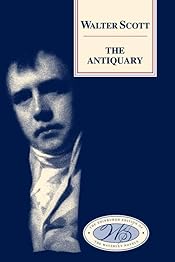
The Antiquary by Walter Scott

The Edinburgh Edition of the Waverley Novels, Edinburgh University Press, 2011, 541 p, plus 37 p Essay on the Text, 48 p Emendation list, 2 p list of end-of-line “hard” hyphens, 7 p Historical Note, 72 p Explanatory Notes, 18 p Glossary, i p Foreword, vi p General Introduction to the Edinburgh Edition, and iii p Acknowledgements. One of the Herald’s “100” best Scottish Fiction Books.

See my review of The Heart of Mid-Lothian for the intent behind the Edinburgh Edition of the Waverley Novels.

The Antiquary cover

We start in Edinburgh where the titular antiquary, Mr Oldenbuck, known as Oldbuck of Monkbarns, is awaiting the arrival of a coach to take him to South Queensferry to catch the tide there. He makes the acquaintance of a Mr Lovel, also to be travelling on the coach and on to the same final destination, the town of Fairport, near which lies Oldbuck’s estate of Monkbarns. Oldbuck is forever animadverting on the derivations of place names and the like and seeking out antiquarian antecedents for objects – and is often mistaken in his attributions. The usual longueurs and prolixity which beset Scott’s novels are again present, here exacerbated by the novel taking a long time to get into its stride. Different plot strands are set off and pursued and these appear at first to be almost occurring at random. Only about two thirds of the way through do the connections between several of the characters become apparent and that in a way which is immediately obvious to the modern reader but may well have been more of a novelty in Scott’s time. As with The Heart of Mid-Lothian the strands are eventually tied together a bit too neatly and in this case perfunctorily.

Scott here rather over-indulges in nominative descriptivism. We have mention of a Dr Dryasdust, the local minister is Mr Blattergowl, the bailiff Mr Cleansweep, Mrs Mailsetter deals with the post, the butcher’s wife is Mrs Heukbane, Mrs Shortcake is married to the baker, and there is a German con-man, Herman Dousterswivel.

Despite its title the book focuses more on the gaberlunzie (i.e. licenced beggar) Edie Ochiltree, than on Oldbuck. We first meet Ochiltree when he contradicts Oldbuck’s views about the presence of remains of a Roman camp on the latter’s estate by saying, “I mind the bigging o’t,” (in other words the structure’s origins lie within living memory) but thereafter he is the active force in many of the scenes. He also speaks in very broad Scots. This surely must have been disconcerting to Scott’s English readers on first publication, but it is of course the marker of his importance to Scottish literature.

Pedant’s corner:- on the inside cover flap; Lovell (the text always has Lovel.) The usual Scott renderings, sprung, sunk, sung, etc as per the Scottish usage of the time but here also run for ran. Similarly we have the usual stupified, but then, surprisingly, stupefaction. In one case a new speaker’s new paragraph is not indented. “‘He had had the pleasure,’ Lovel answered, ‘to see her at Mrs Wilmot’s, in Yorkshire.’” (Since it is Lovel who is speaking – about himself – should that “he” not be “I”? Or else remove the quote marks.) “No. I.,” (Scott’s punctuation?) At least three different spellings of ecstasy (two of them with an x,) invaasion (an explanatory note says this is the spelling in Scott’s manuscript. I can only think this indicates an idiosyncratic pronunciation by Ochiltree.) In the explanatory notes; “(who gave his name both to the Cameronian sect)” (????) Hary (Harry, as in Blind Harry, author of the poem The Wallace,) tansfer (transfer,) marriage marriage (unnecessary repeat of marriage.)

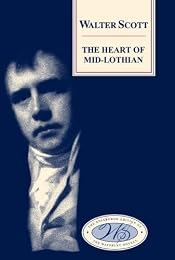
The Heart of Mid-Lothian by Walter Scott

The Edinburgh Edition of the Waverley Novels, Edinburgh University Press, 2011, 470 p plus 59 p Essay on the Text, 50 p Emendation list, 2 p list of end-of-line “hard” hyphens, 40 p Historical Note, 120 p Explanatory Notes, 50 p Glossary, 2p maps of Edinburgh, iv p General Introduction to the Edinburgh Edition, and iii p Acknowledgements. One of the Herald’s “100” best Scottish Fiction Books.

The Edinburgh Edition has sought to produce the nearest approximation to what Scott intended by using as base texts the first publications and Scott’s manuscripts of the relevant novels. The Heart of Mid-Lothian – the novel which, by way of a dance hall, provided the name for a Scottish Football Club – was seemingly the work which suffered most in the hands of such intermediaries as copyists, typesetters and editors. The length of the emendation list here attests to this. In this edition the explanatory notes work out at an average of four for every page of text! To consult them with this frequency would have interrupted the flow of reading so for the most part I left them till I had finished the novel, only consulting them during its course when absolutely necessary.

The Heart of Mid-Lothian cover

The story is supposedly set down by one Jedidiah Cleishbotham as one of his Tales of My Landlord, Peter Pattieson, only he had it from conversations in an inn with three gentlemen he had helped rescue from deposition in a river by an upturned coach, two of whom were lawyers and the other once jailed through indebtedness. This is of course merely a framing device to introduce a story whose beginnings lie in the Edinburgh tolbooth (the gaol situated at the Heart of Mid-Lothian) and the Porteous riots of 1736 where a commander of the city guard was lynched after being pardoned for killing innocent civilians during a disturbance at an earlier public hanging. The story places in the tolbooth at the time Effie Deans, awaiting trial for concealment of her pregnancy, a crime taken to be evidence of intent to murder the child when it was born. Her lover, it turns out, was involved with instigating the riots and had immediately before the birth placed Effie and hence their son into the hands of old acquaintances of his who were less than reliable. Effie’s post-partum indisposition due to puerperal fever renders her incapable of accounting for her son’s whereabouts.

Effie is the daughter of David Deans, a staunch Presbyterian of the old school, a former Covenanter still unreconciled to the modern practices of the Church of Scotland and its accommodation with the State. Effie’s half-sister, Jeanie, has it in her power to prevent Effie’s conviction but due to her conscience and strict upbringing will not swear falsely that Effie informed her of her condition. As a result, Effie is found guilty and sentenced to death. Jeanie resolves to walk to London to enlist the help of the Duke of Argyle to petition the King for a pardon. While her encounters en route make for a novel whose parts are an interconnected artistic whole they do seem a little implausible. However, if you like loose ends to be successfully tied up you won’t be disappointed.

As with Rob Roy Scott’s wordiness can be wearing at first, but I soon accommodated myself to it.

While Jeanie is the undoubted heroine of the book the whole may also be seen as an exploration of the ramifications of an unjust law. From the perspective of two hundred years on Effie’s predicament exemplifies a pronounced tendency among religions to make women the gatekeepers to male sexuality and to punish them rather than their equally (in many cases more) culpable partner for any transgressions. I suppose women were and are easier to identify as culprits since the evidence of “sin” becomes all too readily apparent. It nevertheless reflects the not yet eradicated widespread misogyny (itself an expression of fear of women’s capabilities and of rejection; a manifestation of deep seated insecurity) prevalent throughout history.

There is, though, a reading in which The Heart of Mid-Lothian is actually a chronicle of the life of David Deans, his steadfastness and surety, and also a marking of the beginnings of the long, slow fading of the Covenanting mindset, still not quite extinguished.

Pedant’s corner:- As in Rob Roy; stupified, plus sunk, shrunk, sprung, sung, rung, run for sank, shrank, sprang, sang, rang, ran. These are Scottish usages at the time Scott was writing and still survive in some everyday speech. We also had wrang for wrung (once, but elsewhere wrung appeared) and flang for flung. The editors do say that Scott would add flourishes to certain instances of the letter “u” which may have led to some of these. Despite the care which the editors have taken we also had whichshould (which should,) ofhabitual (of habitual,) the hangman is designated the Doomster on page 217 (twice) but on page 218 is referred to as the Dempster, whisht (as I noted on Keith Roberts’s The Lordly Ones this is nowadays usually spelled wheesht but obviously Scott did not,) the text has Dumbartonshire – or shires – but the emendation list mentions one instance where Scott’s manuscript has Dunbarton Shires. I believe the spelling has altered through time, reverting to Dunbartonshire for the county by 1914. In the historical note: Presbbytery (Presbytery.) In the explanatory notes: “is a now an obsolete usage” (has one too many indefinite articles,) Galations (Galatians.)

Football and the Bible

There is only one football team named in the bible.

Such is the claim anyway.

The relevant quote comes from Matthew 12.42:-

“The queen of the south shall rise up in the judgment with this generation, and shall condemn it:”

Notch one up for Dumfries’s finest.

In my present reading, Walter Scott’s The Heart of Mid-Lothian (which itself by way of a dance hall provided the name for another football team,) there is much talk of religion and quotation from the Bible. An explanatory note had this reference from Proverbs 17.3 which casts doubt on the declaration in the first paragraph of this post:-

“The fining pot is for silver, and the furnace for gold; but the Lord trieth the hearts.”

Granted the relevant noun would need to be capitalised to make the abbreviation truly apposite but then so does the QoS one. At any rate I’m sure many Jambos (see nicknames in the link’s sidebar) would concur with the sentiment.

The Persistence of Scott

My previous post’s title was of course a reference to the alternative title of Sir Walter Scott’s first novel Waverley otherwise known as Tis Sixty Years Since.

I am of course reading that author’s The Heart of Mid-Lothian at the moment which means he has been on my mind.

Scott’s influence continued to be felt long after his death. Edinburgh’s main railway station is named Waverley in his honour and there is of course the huge monument to his memory on Princes Street.

Scott Monument

On seeing this Belgian author George Simenon is supposed to have asked, “You mean they erected that for one of us?” then added, “Well, why not. He invented us all.”

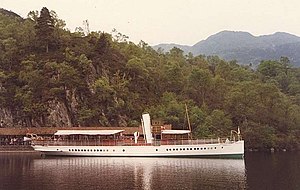
Also named after him is the main steamer on Loch Katrine in the Trossachs, the SS Sir Walter Scott, which was built by Denny’s of Dumbarton, dismantled, its pieces numbered, then the whole transported by horse cart to Stronachlachar on Loch Katrine where it was reassembled.

SS Sir Walter Scott
SS Sir Walter Scott

She is by no means the only ship with a Scott connection which I have sailed on.

The Heart of Mid-Lothian‘s main female character is named Jeanie Deans, a name previously familiar to me – at least in her second steamship incarnation – from several of those trips “Doon the Watter” that used to be so much a part of a West of Scotland childhood.

PS Jeanie Deans
PS Jeanie Deans

There was a short branch line (now long gone) off the main-line station at Craigendoran (about 8 miles from Dumbarton) which took trains right up to a platform on the pier where the ship would be waiting for its passengers to detrain and embark – usually for Rothesay. I believe something similar pertained at Wemyss Bay.

One of the delights of the trip was to descend into the lower parts of the ship to see the engines; mesmerising visions of gleaming, oiled steel and brass, powerful flywheels spinning, pistons thundering, regulators twirling. “Taking a look at the engines” was also used as a euphemism by those suitably aged gentlemen patrons who wished to avail themselves of the licensed facilities on board.

There was also an earlier PS Jeanie Deans. Indeed the North British Packet Steam Company and North British Railway seem to have named their ships almost exclusively after Scott characters. Have a look at this list of their ships, some of which were transferred to later operators.

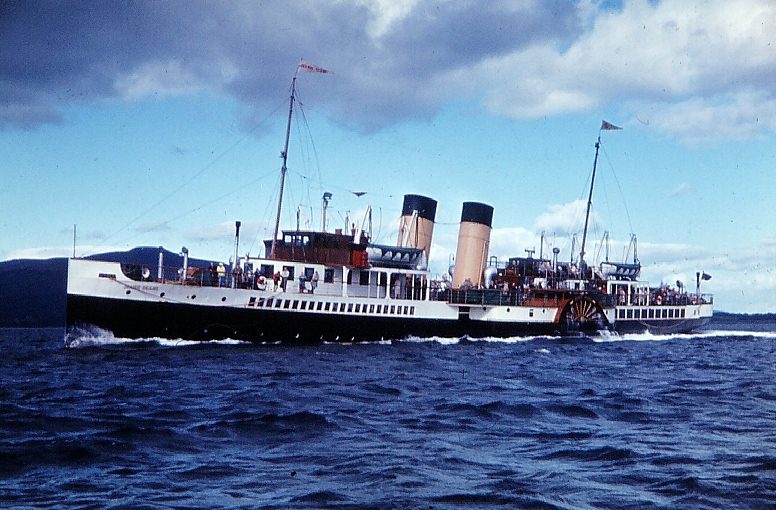
Only one of these floating mini-palaces still exists. The second PS Waverley (built in 1949) is now the sole ocean-going paddle steamer left in the world and still carries out excursions from its base on the Clyde near Glasgow Science Centre, in the Bristol Channel, from London, the South Coast and Wales under the auspices of the Paddle Steamer Preservation Society.

PS Waverley at Ilfracombe

Waverley at Ilfracombe

If you can avail yourself of the opportunity to take a trip on the Waverley (or indeed the SS Sir Walter Scott, though she is much smaller and does not quite afford the full experience) I would urge you to do so.

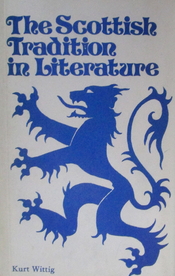
The Scottish Tradition in Literature by Kurt Wittig

The Mercat Press, 1978, 304 p, including ii p preface, ii p contents. A facsimile of the 1958 edition.

The Scottish Tradition in Literature cover

On the surface it seems a little odd that a book on Scottish literature should be written by a German but Wittig’s second sentence begins, “Scottish literature is part of our European heritage.” He goes on to say he does not wish to erect an invisible barrier that would isolate it from “the larger world to which it inseparably belongs,” but nevertheless, “We must do the literature we are studying the honour of recognising that it has both ‘a local habitation and a name.’” He notes, “Deep down in the heart and mind of many Scotsmen there is a kind of schism arising out of the clash of his conflicting loyalties,” but stresses that “someone from outside can distinguish between the typical and the specific.”

Wittig’s starting point for the Scottish tradition is John Barbour’s epic poem The Bruce, which is, he says, without parallel in the Middle Ages, finding its neglect by scholars (of whatever stamp) truly astonishing. The Bruce predates Chaucer’s great poems and its theme that knightly virtues are of no account unless supported by the ideals of “fredome” and “richt” – ‘A! Fredome is a noble thing!’ – sets it apart from its contemporaries. Barbour is the “first of a long series of Scottish writers who seem not only to be on terms of an informal intimacy with God (or the Devil), but even to be disposed, on occasion, to argue with him. No wonder that the Scottish people were later to find the spirit of the Reformation so congenial.”

Since it manifests itself in pre-Reformation works (of which – William Dunbar’s “Lament ‘Quhen he was sek’” (aka “Lament of the Makars”) with its Timor mortis conturbat me refrain apart – to my shame I was mostly unaware) it would seem therefore that the gloomy prognostications and demeanour of Scots (“the mistrust even of happiness”) are not so much derived from Calvinism but are much more deep-rooted, part of the character induced by harsh, dark winters and the sair fecht of scratching a living from the land. It’s almost as if Scots were marking time till a belief system to embody their experience came along; and thereupon embraced it with masochistic fervour.

Barbour also employs what Wittig identifies as a typical Scottish trait; understatement, particularly in regard to the emotions, and he possessed a keen enjoyment of sense impressions. In Robert Henryson he notes, “genuine emotions of the soul are rather suggested than expressed, but the airs men give themselves are heightened to grotesquerie.” Such sense impressions, personification, or animism – visualisation – is another thread that Wittig discerns in the Scottish tradition. Others include alliteration, an intense economy of expression. He notes that much Scottish poetry is interlinked with music, using traditional metres, often very complicated, internal rhymes, frequent refrain on a thematic word.

After Gavin Douglas – the last of the Makars – and David Lyndsay this spring tide, as Wittig puts it, of the tradition begins to ebb and Scots as a language began to diminish in importance and scope. While the Union of the Crowns meant the old cultural ties with France were cut, more significantly the printing presses were in London and, perhaps crucially, the Bible, and therefore the word of God – in Church and elsewhere – was in English and so English came to be associated with serious, dignified subjects. As a result “‘guid hamelie Scots’ seemed unfit for higher and more intellectual purposes.” In the meantime the Scottish Ballads – “A Treasure-trove” – helped to keep the language alive.

A resurgence came in the eighteenth century with once again as in the Makars an expansion of the language and its uses. This reached a “High Water Mark” with Robert Burns and Walter Scott before tailing off again. In the twentieth century “Another Spring” had its highlights in Hugh McDiarmid, Lewis Grassic Gibbon and Wittig’s prime exemplar Neil M Gunn.

Wittig emphasises the cross fertilisation of Scots with Gaelic. The two languages existed side by side for centuries, even at court. Many Scots sentence constructions have their roots in Gaelic which, according to Alexander MacDonald, is supreme over all other languages, “strong, fluent, copious, resonant, and so forth” but in the main “it is the one language in which, since the Tower of Babel, bard or satirist can scold best. Modern Scottish speech, too, is often said to be unsurpassed for deflating an opponent.” It is especially apparent in poetry, “The chief respects in which Scots differs from English poetry are that it shows a stronger feeling for colour (and for other sense impressions); imagery is sharper and more detailed, it is capable of greater metrical complexity, is apter to personify inanimate objects, takes a keener interest in nature, is full of the spirit of clannishness, and makes a speciality of flyting and extravaganza,” all features, Wittig says, even more strikingly characteristic of Scottish Gaelic poetry.

Wittig states that, “Perhaps no other European literature is so dramatic” yet contrasts that with the lack of Scottish drama, a delicate, developing flower at the time he was writing. Nevertheless quoting James Bridie (Dr O H Mavor) “we cannot perceive the Universe except as a pattern of reciprocating opposites.”

The Scot displays “sometimes an aggressive spirit of independence or egalitarianism,” and is adept at the art of flyting, a contest consisting of the exchange of insults, often conducted in verse, between two parties. Then again the mediaeval Scots proverb has it that, “nippin and scartin’s Scots fowk’s wooin.” “The Scots as a nation are passionately addicted to argument.” “The Scots argue not to find a compromise but in order to disagree, to make their point, to assert their rugged independence and individuality. It is an innate tendency to challenge blind acceptance.” Disputatious for the sake of it, “the fervid Scottish delight in arguing – with themselves if no other opponent is available – ” is prevalent in the works of Scott, the first Scottish writer who endowed landscape with a life of its own to the extent of making it one of the protagonists in his novels. (Wittig’s italics.) Landscape in Scott is much more than mere background, it is a formative influence.

James Thomson the younger wrestled with sin and guilt, and repeatedly saw himself as two separate personalities: “I was twain,/Two selves distinct that cannot join again;/One stood apart and knew but could not stir” typical of the emotional and intellectual dualism of Scots – the “Caledonian Antisyzygy” – which may have arisen due to coming to use one language to express thought, another to express feeling.

In the context of why a Scots tale seems to need a sharply portrayed character to tell it Wittig quotes Robert Louis Stevenson as saying, “the English speak with less interest and conviction, while the Scot puts his whole personality into it” and asks, “Is there any such thing as an absolute detached prose in Scots? Is it indeed, possible?”

Wittig occasionally casts aspersions. He calls William McGonagall the “shabbiest of public-house rhymesters” and says that here it is “not rock-bottom that we touch…. that would suggest something solid; with him, poetry is irretrievably sunk in mire,” while John Buchan’s English verse “reads like exercises in a foreign language.”

He notes how many Scots poets do not mention the sea at all. Neither do most writers of prose. (This may well, though, be related to the lack of fishing till well on in the eighteenth century.)

Drink is “a gateway to a new kind of world that provides distortion, new perspectives, and surprising insights.” Wittig says, “I do not know of any other country in which is found a similar attitude to drink: but when Magnus Merriman speaks of this violent Scotland with its hard drinking as a country worth living in and refashioning it reminds me at once of several Scottish acquaintances, poets and others.”

J Leslie Mitchell (Lewis Grassic Gibbon) produces the effect of a “reality that is both subjective and communal. This is the culmination of the inherently dramatic character of Scots, for all the time somebody is imagined to be speaking – or letting his thinking become audible – though his identity may not be specified.” A person can view himself as “you.”

This is a magnificent book. Wittig’s knowledge of his subject appears encyclopaedic, his insights are sharp, his advocacy of the existence of such a thing as a Scottish tradition in literature and his demonstration of its importance and enduring relevance a stirring redress to those who would claim otherwise.

Pedant’s corner:- Reflexion (reflection,) connexion (connection,) medieval, irreverance (irreverence, which appears four lines later!) simplyc alled (simply called,) for convenience’ sake (convenience’s sake,) sublter (subtler,) Blaweary (Blawearie.)

Surviving by Allan Massie

Vagabond Voices, 2009, 208p.

Surviving cover

This is the second book I’ve read this year eligible for the Read Scotland 2014 Challenge and the second not set in Scotland. The author has a large back catalogue some of them set in Scotland in various historical eras up to the present but he has also delved into the lives of ex-Nazis in South America, the legacy of the Vichy regime and later twentieth century Italian politics in addition to writing a series of very good novels on the lives of Roman Emperors.

Surviving takes place in modern(ish) Rome. It is undated but the currency being used is the lira which would set it before Italy adopted the Euro in 2002. The story unfolds over fifty short chapters, though since each is indicated by a Roman numeral in bold that should be L chapters.

A group of ex-pat Britons is just about surviving being alcoholics – with a few lapses – via their attendance at AA meetings. A new member, writer Tom Durward, – whose surname surely signals a Walter Scott connection – has guilty feelings due to his orphaned nephew, Jamie (entrusted to his care,) having drowned himself at boarding school years ago. Stephen Mallany spectacularly drops off the wagon just after the meeting where Durward introduces himself.

The web of relationships becomes further disturbed when Gary Kelly, a man acquitted of murder back in Britain, is taken into her home by Kate Sturzo. The book takes a strange turn indeed when the barrister who defended him, Reynard Yallett, also arrives in Rome. The consequences involve murder but the novel reads nothing like a detective story.

There are multifarous characters, perhaps too many. That there should be such neat connections between some of them stretches believability a bit but Massie’s writing is smooth and accomplished even if he puts into the mouth of one of them the sentence, “We make for ourselves impressions of people and if they act in a way that doesn’t fit that impression we say they’re acting out of character as if they were actors condemned to be typecast,” which is a wonderful get out of jail free card for any author to trot out. He also gives us a piece of metafictional trickery towards the end as Durward muses about writing the whole story up as a novel.

What kind of novel Surviving is, is not easy to pigeonhole. It’s worth a look though.

free hit counter script