Archives » Vonda N McIntyre

The Bride by Vonda N McIntyre

Star, 1985, 188 p. Based on the screenplay by Lloyd Fonvielle.

Film tie-in novelisations are not my usual reading matter but this was written by Vonda N McIntyre, whose back catalogue I have been trying to catch up with.

The premise is that Charles Frankenstein has promised to create a companion for his creature – a female companion. The book begins on the night when Frankenstein and his assistant await the arrival of the electrical storm which will animate her. She is of course beautiful, her only flaw a slight discolouration at the wrists. She is brought to life ignorant of the world and its ways. When introduced to Frankenstein’s earlier creation she instinctively shies from it though. (I shrink from that ‘it’. The “monster” is never less than a creature worthy of sympathy – even empathy.) The creature is angered but not totally surprised by this. He is used to being reviled.

It is here that McIntyre made an authorial decision which elevates the narrative above where it might have lain. Most of the text is related in third person (this is of course how a viewer experiences cinema) but the creature’s thoughts are given to us in his first-person viewpoint. That night, the creature’s rage results in a fire in Frankenstein’s castle and the creature resolves to flee. Later in the book, once he has taken up with a dwarf called Rinaldo, with whom he forms an effective pair, Rinaldo decides to call him Viktor. (I also wondered why, here, Frankenstein the creator had been given the name Charles rather than Victor.)

Charles calls his new ward Eva, after the biblical first woman, and sets out to educate her, not only in the normal sense but in the ways of society. She at first scandalises the housekeeper Mrs Baumann by her feral habits, especially where food is concerned, but soon more considerate behaviour becomes her hallmark. She notices the different attitude Charles has to her and his social equals as compared to the servants and takes one of them, Hannah, from the kitchen to be her personal maid. She is also confused by the manners and customs of Charles’s acquaintances.

In the meantime after various ignominies suffered on the road, Viktor and Rinaldo become a great success as a circus act (Rinaldo is particularly adept on the trapeze.)  This leads to jealousy on the part of the circus owner and his chief employee and a tragedy, whereupon Viktor is left to his own resources again.

Gradually Eva becomes aware that the tale Charles told her of her origin is false and she seeks to find her true self elsewhere. He has of course come to consider she is his alone and is unwilling to let her go.

This all written in a much better way than the rather corny premise itself merits. Not great literature but enjoyable enough.

Pedant’s corner:-  delibertely (deliberately,) “lingered on her body longer than they need” (longer than they needed,) an unindented new paragraph (x 2,) “on the try” (on the tray,) “snatched t a third piece” (snatched at,) “who’ll heave to clean it up” (who’ll have to,) “in the underbush” (underbrush?) “and let myself dissolved back” (dissolve back,) “put one handon” (hand on,) a missing full stop between two sentences (x 2,) creature (creature,) Thucidides (Thucydides,) “‘Is that you idea of’” (your idea,) Rinald (elsewhere always Rinaldo,) a missing opening quote mark before a piece of direct speech (x 2,) “Rinaldo siad” (said,) a capital letter on a word in the middle of a sentence, “‘hat you’ve got the feel of it’” (that you’ve got,) “‘If you trust mer’” (trust me,) ounging (lounging,) “and showed Magar and straps” (showed Magar the straps,) glard (glared,) “make them laughed at me” (laugh at me,) “‘get out of her’” (of here,) emtpy (empty,) peddler (pedlar.) Wht (What,) cuatiously (cautiously,) “the serving women” (woman,) “but be more more could have climbed down thatn he could fly” (but he no more could have climbed down than he could fly.) Evan (elsewhere always Eva,) “it was no unpleasant” (not unpleasant.) “‘You must take note to town for me’” (take a note,) rached (reached.) “She slide her hands up his back” (slid her hands.) “‘Make you own way’” (your own,) “pocked the key” (pocketed,) “the last dangling plan from its hinges” (plank.) Frankenstin (Frankenstein.)
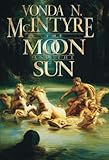
The Moon and the Sun by Vonda N McIntyre

Pocket Books, 1997, 422 p, plus ii p Major Characters and v p Afterword

I’m not quite sure how to categorise this. I’ve seen it described as Alternate/Alternative History (what I prefer to call Altered History) but I can’t see any change in actual history in it. It has no discernible Jonbar Point, no ramifications for its future. Yes, it’s set in the reign of the Sun King, Louis XIV of France, but it’s not a purely historical novel either, though that aspect of the novel is very well executed. What it does have – and what tends to make it more of a fantasy than anything else – is a “sea monster,” a mermaid-like creature which turns out to be near human, brought to Louis’s court to provide him with immortality by eating a part of its flesh. (The first part of this premise – the human-like sea creature – is not really too far-fetched. There has been scientific speculation that humans spent part of their evolutionary history as aquatic creatures.)

Our viewpoint character is Marie-Josèphe de la Croix, lady in waiting to Mademoiselle Elisabeth Charlotte d’Orleans, Louis XIV’s niece. Marie-Josèphe was brought up in Martinique and her relationship to the court is, to begin with, opaque. She is an innocent, (she has not heard the word ‘whore,’ has never drunk wine, nor encountered the idea of homosexuality,) sent to a convent when her parents died and subjected to its repressive strictures. Her brother Yves is the Jesuit priest and enthusiast for scientific enquiry who was instrumental in capturing two sea-monsters and bringing them to Versailles. One of the monsters is dead and Yves is to carry out an autopsy on it. Questions of protocol and the need for the king’s presence tend to delay this though.

Marie-Josèphe finds herself sensitive to the creature. She can hear it sing, feel its pain, discern its meaning, and ends up relating its stories of persecution by humans to the court.

Coincidentally, Pope Innocent XII is on a diplomatic mission to Versailles (as a kind of rapprochement with the King) but he is keen for the live sea creature – which due to its tale-telling soon comes to be called Sherzad – to be taken back to Rome for study.

Other historical notables to appear in the text include Philippe, Duc d’Orléans, (Louis’s brother and Mademoiselle’s father,) Charlotte (Philippe’s Duchess,) the Chevalier de Lorraine (Philippe’s male lover,) James VII (II of England) and his wife Mary of Modena (in exile due to the so-called “Glorious Revolution.”)

Marie-Josèphe is talented, not only does she sketch the dissection of the dead sea-creature, she also composes music. This latter outrages the Pope, who insists – using Biblical references – that women ought to be silent. She is not short of enemies at the court but also forms friendships. Her relationship with her slave Odolette is complicated and develops in a way more attuned to modern sensibilities than those of the seventeenth century.

The writing is accomplished throughout and the interpersonal relationships depicted tend to strike true.

Pedant’s corner:- Yves’ (Yves’s. Since the ‘s’ of Yves is not pronounced then without an ‘s’ after the apostrophe then the possessive’s sound is not signalled by the spelling. All the possessives of names ending in ‘s’ are treated like this, Chartres’, Louis’, etc) “the duke and duchess d’Orleans” (these are specific titled people, not merely an unspecified member of a class. Their titles are proper nouns. So, “the Duke and Duchess d’Orleans. McIntyre generally tended to adopt a similar practice of using lower case whenever specific titles were used, even for mademoiselle de la Croix. Note in English she would be Miss de la Croix, not miss de la Croix,) perruke (innumerable times, peruke,) “His Holiness’ route” (His Holiness is singular, so, ‘His Holiness’s route’,) “she kept her own council” (counsel, is council a US usage in this context?) “her royal mistress’ ridicule” (mistress’s,) “Father de la Croix’ medal” (again, no ‘s’ is sounded at the end of Croix, it needs an ‘s’ to render the possessive accurately, ‘de la Croix’s medal’,) “her left aureole” (areola,) “and has sense of humour failed him” (and his sense of humour,) “a hareem” (x 2, usually spelled ‘harem’.)

Transition by Vonda N McIntyre

Bantam, 1994, 300 p.

This is the second in McIntyre’s Starfarer series the first of which I reviewed here.

The spaceship Starfarer has ridden a line of cosmic string to the solar system of Tau Ceti. Unfortunately the nuclear bomb sent after it by the US Government to prevent the voyage has gone off partly damaging the ship but also scaring off the inhabitants at Tau Ceti II. In addition something, probably sabotage, has crashed the Starfarer>’s operating system, Arachne, so that the crew and passengers can no longer interact with it.

The survey team sent down to Tau Ceti II’s moon to investigate the dome there is disappointed when the dome collapses as soon as they try to enter it. Only one small artifact is salvaged. Unlike our solar system Tau Ceti is inundated with cosmic string but these are beginning to drift away and no further exploration of the apparently hospitable Tau Ceti II is possible. The choice is between meekly returning to Earth or following the tantalising glimpse of an alien ship fleeing their arrival.

A jump to Sirius is undertaken where they are pursued by a small blue replica of Earth. This turns out to be the ship which had fled Tau Ceti but Starfarer has somehow outpaced it. The aliens on it transpire to be descendants of humans plucked from Earth millennia ago and frustratingly unforthcoming about galactic civilisation.

Also in the mix here is the internal politics on board Starfarer, the search for the saboteur and the unusual relationships structures to be found in this future. (See my review of Starfarers in the link above.)

Transition is interesting but is the second in a four book series so not much is resolved.

Pedant’s corner:- “it’s surface set” (its,) “‘somebody you absolutely loath’” (loathe,) “powers haven fallen” (have fallen,) “‘Jesus christ’” (usually both parts of the name are capitalised.) “The planet passed, beyond J.D.’s reach” (passed beyond,) a missing comma at the end of a piece of direct speech, “version of an omnipotent goddesses from ancient India” (goddess,) “the hoi polloi” (‘hoi’ is Greek for ‘the’ so it ought to be just ‘hoi polloi’,) nonplused (nonplussed,) “‘that we’ve cause them nothing but trouble’” (caused,) “petrie dish” (x 2, Petri dish,) “but could to keep from laughing” (garbled, the sense is ‘couldn’t keep from laughing’.) “A rippled passed through” (A ripple.)

Women of Wonder, Edited by Pamela Sargent

THE CLASSIC YEARS. Science Fiction by women from the 1940 to the 1970s
A Harvest Original, Harcourt Brace, 1995, 446 p, including 20 p Introduction by Pamela Sargent, 14 p “About the Authors”, 1 p “About the Editor”, 13 p Recommended Reading: Science Fiction by Women 1818-1978, and 2 p Permission Acknowledgements.

 Women of Wonder: The Classic Years cover

Since it covers some of the same ground it was odd reading this at the same time as All that Outer Space Allows. (I tend to read short fiction during the day and novels in the evening.)
In the Introduction Pamela Sargent traces the history of women writing SF which goes back a long way even if you discount Mary Shelley. It is true, though, that the profile of female SF writers certainly became more prominent in the 1970s. The stories in the book are listed on the contents page by the date when they were first published. I have included those dates below.
No Woman Born by C L Moore (1944) explicitly riffs on the Frankenstein story. Here a female dancer who died in a theatre fire has had her brain preserved and placed in a wonderfully supple metallic body so that she (it?) can continue performing. “‘The whole idea was to re-create what I’d lost so that it could be proved that beauty and talent need not be sacrificed by the estruction of parts or all of the body.’” The usual philosophical considerations apply.
In the war-ridden, radiation-raddled world of That Only a Mother by Judith Merril (1948) there has been an increase in the mutation rate, but the worst cases can be predicted and prevented. Infanticide committed by fathers is also on the rise. Margaret gives birth to a daughter while her husband is away on war service. The child is precociously gifted as regards cognitive development and speech. The father does not realise anything else might be amiss till he returns.
Contagion by Katherine McLean (1950) is set on a planet where a newly touched down expedition discovers previous settlers, who it turns out were severely affected by a disease they called melting sickness. Only certain genetic strains are able to survive.
In The Woman from Altair by Leigh Brackett (1951) the title character has been brought back from Altair as his wife by, David, one of the famous spacefaring MacQuarrie family. His brother Rafe, never eager to go into space, and his girl-friend Marthe begin to have suspicions when odd things start happening in the MacQuarrie household.
In a time of cold-war stress Short in the Chest by Margaret St Clair (1954) features the curious military custom of dighting, sexual encounters between members of the various armed services in order to relieve inter-service tension. Marine Major Sonya Briggs takes her problems with it to a huxley – a philosophic robot.
The box of Zenna Henderson’s The Anything Box (1956) is the invisible possession of Sue-lynn, a pupil in the narrator’s class. It nevertheless has weight and is where she goes to retreat from the world and find herself.
Death Between the Stars by Marion Zimmer Bradley (1956) is the tale of Helen Vargas, forced by circumstance and against all Terran norms and expectations to occupy the same cabin as a telepathic alien on her way back to Earth to avoid the outbreak of a war. The treatment of the alien by the prejudiced crew dismays her but its telepathic intrusions are equally disturbing. In death – brought on by its inhumane treatment – the alien finds a way to prolong its life, and study humans in secret.
The Ship Who Sang 1 by Anne McCaffrey (1961) is the story of the brain of a child malformed at birth but taken and grown inside a metal case eventually to become the controlling entity of a spaceship. She finds she can sing at any pitch and register.
The aliens in When I Was Miss Dow by Sonya Dorman Hess (1961) – who started her writing career as plain Sonya Dorman – can take various shapes at will and are able to be reconstituted in tanks. However, some of them are dependent on sulfadiazole which they can earn by working for humans. Our narrator reconstitutes as Miss Dow (recquiring her to have two brain lobes) and finds she is attracted to Dr Proctor, the human colony’s head biologist, whose assistant she becomes.
The Food Farm by Kit Reed (1966) is where our narrator is now in charge. Sent there by her parents to get over her addiction to binge-eating, a habit encouraged by hearing the singing of Tommy Fango on the radio, she rebelled when Fango visited and she was not allowed to see him, sought him out and discovered his main predilection, which she now seeks to fulfill.
The Heat Death of the Universe by Pamela Zoline (1967). “Sarah Boyle is a vivacious and witty young wife and mother, educated at a fine Eastern college, proud of her growing family, which keeps her happy and busy around the house, involved in many hobbies and community activities, and only occasionally given to obsessions concerning Time/Entropy/Chaos and Death.” Yeah, right. More like, “a woman’s work is never done” – and sometimes undoes her.
The Power of Time by Josephine Saxton (1971) uses the word Negro, likely to be frowned upon nowadays. It reverses the usual way of cross-Atlantic transactions. An English woman buys the whole of Manhattan island (previously owned by a descendant of native Americans) and transfers it to Leicestershire.
False Dawn by Chelsea Quinn Yarbro (1972) is set after an environmental apocalypse. A woman armed with a crossbow makes her way across the devastated landscape, trying to avoid the Pirates and mutant hunters. This contains the usual violent scenes accompanying such tales.
Nobody’s Home by Joanna Russ (1972) posits a future time of resource plenitude where people can travel the world at whim via transmission booths and hold parties willy-nilly. Leslie Smith turns up at one of these and puts a downer on it.
In The Funeral by Kate Wilhelm (1972) all non-citizens are the property of the state. This is a dystopia, with pre-echoes of The Handmaid’s Tale, where Carla has been brought up under the educational tenets of Madame Westfall. The funeral of the title is Westfall’s. She had hidden some secret knowledge the powers that be want to uncover. Carla finds the hiding place.
Vonda N McIntyre’s justly award-winning Of Mist and Grass and Sand (1973) tells of an incident in the life of a healer whose medicines are incubated by snakes before they bite the sufferer to “inject” the cure. Her clients of course fear her reptilian companions.
Another celebrated piece of feminist SF is The Women Men Don’t See2 (1973) published by Alice Sheldon under her pen name of James Tiptree Jr. Given that at the time of publication many thought “Tiptree” was a man, the story’s title is deliciously ironic. In it a plane with three passengers, our narrator Don plus a mother and daughter, goes down off the Yucatán peninsula. Don’s fantasies about female abilities are soon disabused as Ruth Parsons turns out to be very capable indeed. Also when he mentions women’s rights she tells him, “Women have no rights, Don, except what men allow us. Men are more aggressive and powerful, and they run the world. When the next real crisis upsets them, our so-called rights will vanish like … smoke. We’ll be back where we always were. Property. And whatever has gone wrong will be blamed on our freedom, like the fall of Rome was. You’ll see.” Sadly, probably only too true. However, the intrusion of aliens near the end into felt like it came from another story altogether.
The Warlord of Saturn’s Moons by Eleanor Arnason (1974) tells how a cigar-smoking, tea-drinking, silver-haired maiden of thirty-five in a world where the usual bad stuff is on the news writes the story of the title, a somewhat schlocky enterprise which will read as bad as it sounds.
In Ursula K Le Guin’s The Day Before the Revolution (1974) an old anarchist, inspiration to her followers remembers her life of struggle and ruminates on what it all means. “Favouritism, elitism, leader-worship, they crept back and cropped out everywhere. But she had never hoped to see them eradicated in her lifetime, in one generation; only Time works the great changes.” She also comments on how people see her. “How brave of you to go on, to work, to write, in prison, after such a defeat for the Movement, after your partner’s death, people had used to say. Damn fools. What else had there been to do? Bravery, courage – What was courage? She had never figured it out. Not fearing, some said. Fearing going on, others said. But what could one do but go on? Had one any real choice, ever?” Human and humane.
The Family Monkey by Lisa Tuttle (1977) is an oddly constructed tale told from four different viewpoints of the adoption by a couple in Texas of an alien who crashlands in their graveyard. He is effectively part of the family down several generations. The concept of sleep is alien to him but when he finally achieves that state he experiences the humans’ dreams – and some of them experience his. The story contains the word “nigger,” reflecting the time and place in which that scene was set.
A totally immune-compromised woman is the ideal choice for the first interstellar human traveller in View from a Height by Joan D Vinge (1978.) Her trip gives her a perspective on life.

Pedant’s corner:- 1“When they were forced to, Central Worlds shrugged its shoulders” (either ‘it was forced to’ or, ‘their shoulders”,) “sound issued through microphones rather than mouths” (microphones take in, they do not emit sound. Loudspeaker is the appropriate word,) “her throat microphone” (her throat loudspeaker,) “spoke to Jennan only through her central mike” (through her central speaker.) 2“A flock of ibis are circling us” (a flock of ibis is circling us.)

Vonda N McIntyre

I was sad to read today of the death of Vonda N McIntyre.

She first came to my attention with the short story Of Mist, and Grass, and Sand – a Nebula Award winner in 1974 and which formed the first part of her later novel Dreamsnake which won the Hugo and Nebula for best novel in 1979. The story was unusual in that its protagonist was a healer rather than a fighter. It was immediately obvious McIntyre’s writing was up there with the best the genre had to offer.

Looking at my records I find I have six of her books (including one short story collection.) One of the novels, The Entropy Effect, was in the Star Trek franchise, and much better written than it probably needed to be.

I reviewed her 1986 novel Superluminal here.

In all she won three Nebulas and that Hugo.

She may not have been prolific as a writer and not so prominent latterly as she was at the turn of the 1970s/80s but she is undoubtedly one of the most noteworthy SF authors of the late twentieth century.

Vonda Neel McIntyre: 28/8/1948 – 1/4/2019. So it goes.

Superluminal by Vonda N McIntyre

New English Library, 1986

McIntyre was the author of the 1974 Nebula Award winning novelette Of Mist, and Grass, and Sand quickly novelised as Dreamsnake in which form it picked up the Nebula and Hugo Awards in 1979. She has also written other award nominated or winning SF and has Star Trek and Star Wars novelisations to her name but more recently has slipped off the SF radar. I missed this one at the time it was published.

Superluminal is another multi stranded narrative.

Laenea Trevelyan, a former ordinary crew member, has just become an interstellar pilot. Only major surgical alterations allow pilots to survive transit at above light speed without being in suspended animation like other crew members. Pilots are nicknamed Aztecs because their hearts have been removed. Instead machines pump blood and pilots have the ability to control what are in normal humans autonomic functions.

Radu Dracul (yes, McIntyre does make the obvious joke) is the sole member of his family to survive a plague on his planet Twilight and has travelled to Earth to earn money for his cash strapped home world.

Orca is, for no truly compelling reason, a member of a family of humans adapted to ocean swimming and has the ability to communicate with dolphins, whales etc.

Despite the usual lack of interaction between pilots and normal humans Laenea and Radu become lovers in the interval between Laenea’s operation and her first training trip as a pilot but there is something about their close contact that their bodies find too stressful.

All the above is merely scene setting, and takes up almost 100 pages before the real plot gets into gear.

Laenea sets off on her training flight while Radu and Orca form part of the crew on a routine trans-light speed trip elsewhere. On their return leg Radu falls out of hibernation several times (forcing the ship to jump out of transit automatically and threatening its loss.) Eventually the pilot flies it home with Radu still awake yet Radu suffers no ill effects.

Once home, the pilots’ “guild” threaten Radu as he represents a danger to their monopoly. But Orca comes to his aid. They then discover Laenea’s ship has not returned.

The remainder of the book is concerned with the search for Laenea and the ramifications of Radu’s unusual tolerance for unhibernated transit.

McIntyre finesses the problem of depicting the superluminal experience by saying early on that it “has never been described.” Neat, I suppose, but a bit of a cop out.

She also describes something that sounds remarkably like a spam (or, since it’s for adverts, pop-up) filter. This book was first published in 1983 – so not a bad piece of prescience.

Though not telegraphed by McIntyre, the way the hinge of the plot would reveal itself was, I’m afraid, relatively obvious long before the characters realised it.

Perhaps it’s just that I’m older – I remember Dreamsnake and The Exile Waiting with affection – but there did not seem to be the spark in this one with which McIntyre invested those books.

free hit counter script