Cold Winter in Bordeaux by Allan Massie
Posted in Allan Massie, Reading Reviewed, Scottish Fiction at 12:00 on 2 December 2020
Quartet, 2014, 237 p.
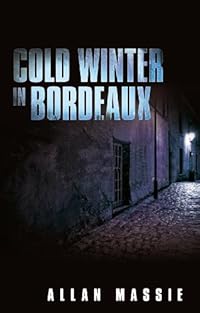
This is the third of Massie’s Bordeaux series, set in that city during World War 2. The first, Death in Bordeaux, I reviewed here, the second, Dark Summer in Bordeaux, here.
In this one Police Superintendent Jean Lannes is called in to investigate the death of Gabrielle Peniel whose body was found strangled and sordidly arranged. It looks like a crime of passion as in pre-war times – which Lannes would welcome as a relief from having to juggle French law with German oversight – but he senses something amiss. Peniel was a piano teacher to young girls and it is soon revealed she was a procuress for men who had such a taste.
In terms of the book’s thrust the murder is something of a red herring. Massie is really only using the crimes Lannes investigates as hooks to hang his series on. As Cold Winter in Bordeaux unfolds it is more obvious that he is illustrating the exigencies of living under occupation, the compromises that must be made, the care that has to be exercised. At one point he has Lannes reflect, “conversations all over France went round in circles, and said nothing.” In his home life Lannes’s wife Marguerite has withdrawn from him as she blames him for letting their younger son Alain go to join the Free French in London (where he has been found suitable to be recruited by the SOE and parachuted back into France,) his elder son Dominique is still employed by the Government in Vichy, his daughter Clothilde fallen in love with the Michel whom Lannes always thought unsuitable for her but she is unhappy that due to the influence of his cousin Sigi, Michel has joined the Legion of French volunteers against Bolshevism, so looks set for the Russian Front. However, news of the US landings in French North Africa, the possibility that they promise of a positive outcome to the war, gives a new charge to those longing for exactly that.
It may be a means to underline the claustrophobia of life under occupation but the circles in which the novel works itself out again feel too small, the connections between the characters and Lannes’s own life and problems too close. The last chapter mentions one François Mitterand as setting up a group of ex-POWs, probably for resistance purposes. This feels like too much of a wink to the reader with knowledge of subsequent French history.
It is though all very readable and well enough written. It is also a reminder that in bad times people may be forced to accede to acts they would in other circumstances shun.
Pedant’s corner:- In response to an allusion, Lannes says he’s never read Dickens and that, “My English novelists are Walter Scott and Stevenson.” Both were of course Scottish, not English, which Massie could not be unaware of, but would his protagonist Lannes be unaware? Surely not. I suppose, though, he could argue he was speaking of English language novelists. Otherwise; “when they had first met – at the time of …….., himself now dead, Lannes – had” (has that second hyphen misplaced: ‘when they had first met – at the time of …….., himself now dead – Lannes had’,) Michael (Michel,) Travaux Ruraux’ (Travaux Ruraux’s,) a missing end quote mark after a piece of dialogue, a missing comma before one (x 3,) “his copy book spotless” (copybook,) a missing full stop, “more than couple of hours a night” (more than a couple.) “He wore only a singlet despite the freezing weather and a pair of blue cotton trousers” (syntax, syntax; ‘He wore only a singlet despite a pair of blue cotton trousers?’ Put ‘Despite the freezing weather’ at the beginning of the sentence.)
