Archives » Transition

Transition by Vonda N McIntyre

Bantam, 1994, 300 p.

This is the second in McIntyre’s Starfarer series the first of which I reviewed here.

The spaceship Starfarer has ridden a line of cosmic string to the solar system of Tau Ceti. Unfortunately the nuclear bomb sent after it by the US Government to prevent the voyage has gone off partly damaging the ship but also scaring off the inhabitants at Tau Ceti II. In addition something, probably sabotage, has crashed the Starfarer>’s operating system, Arachne, so that the crew and passengers can no longer interact with it.

The survey team sent down to Tau Ceti II’s moon to investigate the dome there is disappointed when the dome collapses as soon as they try to enter it. Only one small artifact is salvaged. Unlike our solar system Tau Ceti is inundated with cosmic string but these are beginning to drift away and no further exploration of the apparently hospitable Tau Ceti II is possible. The choice is between meekly returning to Earth or following the tantalising glimpse of an alien ship fleeing their arrival.

A jump to Sirius is undertaken where they are pursued by a small blue replica of Earth. This turns out to be the ship which had fled Tau Ceti but Starfarer has somehow outpaced it. The aliens on it transpire to be descendants of humans plucked from Earth millennia ago and frustratingly unforthcoming about galactic civilisation.

Also in the mix here is the internal politics on board Starfarer, the search for the saboteur and the unusual relationships structures to be found in this future. (See my review of Starfarers in the link above.)

Transition is interesting but is the second in a four book series so not much is resolved.

Pedant’s corner:- “it’s surface set” (its,) “‘somebody you absolutely loath’” (loathe,) “powers haven fallen” (have fallen,) “‘Jesus christ’” (usually both parts of the name are capitalised.) “The planet passed, beyond J.D.’s reach” (passed beyond,) a missing comma at the end of a piece of direct speech, “version of an omnipotent goddesses from ancient India” (goddess,) “the hoi polloi” (‘hoi’ is Greek for ‘the’ so it ought to be just ‘hoi polloi’,) nonplused (nonplussed,) “‘that we’ve cause them nothing but trouble’” (caused,) “petrie dish” (x 2, Petri dish,) “but could to keep from laughing” (garbled, the sense is ‘couldn’t keep from laughing’.) “A rippled passed through” (A ripple.)
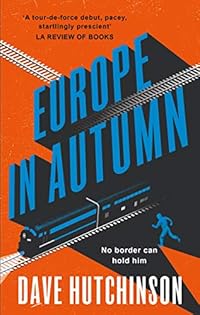
Europe in Autumn by Dave Hutchinson

The latest from the BSFA Awards list – 6 out of 8 read now – but probably the last.

Solaris, 2014, 384 p.

 Europe in Autumn cover

For a long time there was a dearth of detective stories in SF. This may have been because of the necessity that such a story work as both SF and crime novel, creating a gap which writers couldn’t seem to bridge. However any such lack has long since been filled. I don’t recall, though, many outright spy story/SF crossovers. Thrillers, yes (but they are a different beast again.) Yet here we have Europe in Autumn, reminiscent of nothing so much as a Cold War era spy story. This may be due to the fact that, a brief excursion to London apart, it is set mainly in Eastern Europe, areas which were formerly in Warsaw Pact countries. There is too a constant hint of menace, of surveillance, of people with hidden agendas, pervading it. All of which Hutchinson handles with aplomb.

After the devastation of the Xian Flu Europe has fissured into innumerable small statelets, “Sanjaks. Margravates. Principalities. Länder.” One of these polities is a trans-European railway line running from Portugal to Siberia, but never more than ten kilometres wide. In this Europe borders, razor wire, visas and bureaucracy abound; travelling is not simple. Rudi is an Estonian chef working in Kraków who is one day “invited” to join Les Coureurs des Bois, an organisation dedicated to smuggling mail, packages and sometimes people across the numerous borders. His training ends in a disastrous foray into the railway’s territory. Later “situations” also turn out less than well and he begins to wonder why.

This set-up is intriguing. A Europe returned to a pre-Napoleonic patchwork – only much worse; some of the polities extend to no more than a couple of blocks of flats. It’s certainly surprising. One thing I never expected to read was a piece of SF explicitly discussing the merits or otherwise of the Schengen Agreement. How all this sticks together, plus the relevance of maps of non-existent places, is all revealed in a tightly plotted, highly readable thriller style narrative. In parts Europe in Autumn reminded me of The First Fifteen Lives of Harry August – was there something in the air the year before last? – there are extremely faint echoes, growing stronger towards the book’s end, of Transition, plus parallels with The City and the City and similarities with PƒITZ.

Europe in Autumn is a good book – even a very good book – but I’m not entirely sure about its place on the BSFA Award ballot. It has SF trappings to be sure, invisibility suits amongst them, but, in essence, it’s a spy novel.

The phrase “he wardrove around the city” was a new one on me but I’m grateful for it.

Pedant’s corner:- Hutchinson has too much of a fondness for the phrase “tipped his/her/my head to one side,” to indicate a character’s desire for more information, clarification or knowledge of evasion. Also: we had “a raise” (but elsewhere Hutchison also uses the British formulation a pay “rise,”) “I don’t think anybody understands the offside trap any more,” (OK this was a piece of spy speak but shouldn’t it still have been offside law? The offside trap is an effort to employ the law in a team’s favour,) tokomaks (tokamaks,) “for the first time in many years feeling anything approaching sympathy for his father,” (shouldn’t that be something rather than anything?) watched them them go, “Here he was, sitting here quite comfortably,” Minster for Minister.

free hit counter script