Archives » Tory

Tendentious Nonsense

There have been three more General Election leaflets put through my door.

Another from the SNP – no literacy errors.

There was one such error in the Tory leaflet. (Their candidate’s main aim is listed as to stop another independence referendum. The local economy, schools, public services and young people’s employment prospects are apparently of lesser concern.)

The error was contained in a bar graph purporting to show the Tories are in a position to win in my local constituency. Its y-axis was labelled “% increase/decrease in vote GE here in Glenrothes” which is simply gibberish. “% increase/decrease in GE vote here in Glenrothes” would have been more sensible.

The overall graph was a huge attempt to mislead though. Its bars showed the % increase or decrease in the parties’ votes in 2017 compared to 2015. The Tories 11.8% increase appears huge while Labour’s 4.1% and the Lib Dems 1.1% look tiny. On it is emblazoned the words “Labour and the Lib Dems are just too weak to beat the SNP here,” with an arrow from those pointing to the bars, as if % increase is the actual % of total votes.

This is, of course an utter distortion. In 2017 the Tories had 7,876 votes, the Lib Dems 1,208 and Labour 14,027. In other words the Tories had half the votes Labour did. The SNP meanwhile had 17,291 votes.

Assuming everything else stayed the same, in the somewhat unlikely event of the Tories doubling their vote (a 50% increase – about five times the one they achieved last time) they would still only just beat Labour into second place and not come near the SNP total.

The graph (or rather the words describing it) is tendentious nonsense and a deliberate attempt to mislead. Its use and depiction in this way is a piece of mathematical illiteracy, albeit cunningly deployed. Even without all the other stuff about the Tories which I dislike that would have been enough to put me off them.

I’ve ranted too long. Lib Dems another time.

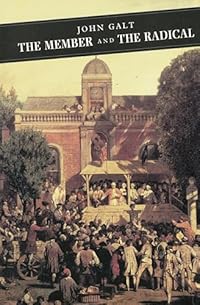
The Member and The Radical by John Galt

Canongate Classics, 1996, 263 p, including 2 p glossary, 6 p notes (The Member) and 4 p notes (The Radical) plus 8 p Introduction.

The Member and The Radical cover

Galt was a Scot born in Ayrshire whose novels mainly dealt with the impact of the industrial revolution and has been called the first political novelist in the English language. The Member was the first example of the Parliamentary political novel, The Radical deals with Parliamentary matters only towards its end. These two works of fiction were first published in 1832 (in January and May respectively) and subsequently in one volume as The Reform that November but apparently not republished till 1975 (The Member) and this edition (The Radical.) The two hundred year old idioms do take some getting used to but it is worth persevering.

The Member: An Autobiography.
This is prefaced by a “Dedication” to one William Holmes, wherein Scot Archibald Jobbry laments the imminent passing of the Great Reform Act and the inevitable depredations which it will bring in its train. Many years before Jobbry had returned from India where he had made his fortune and decided to purchase a seat in the House of Commons despite it being technically illegal to do so. He shows himself a sly and acute bargainer. During this process he opines, “a Tory is but a Whig in office, and a Whig but a Tory in opposition.” Some things don’t change. In this regard Jobbry later says MPs have been, “inveterate to retain the distribution of places and pensions – the natural perquisites of Members of Parliament” and, “The democratical think state salaries always exorbitant, and the aristocratical never think wages low enough.”

The shenanigans accompanying elections in those days are amusingly described. On this point Jobbry tells us, “It is by no means plain why paying for an individual vote should be so much more heinous than paying for a whole borough.” These vices are still with us, if in altered form. To my mind selling off state assets is an even higher category of bribe than either of those Jobbry mentions, promising lower taxes only slightly less so.

Galt often uses the utterly obsolete form “quo’ I” for “I said” when Jobbry is relating his own direct speech.

In talking to fellow Parliamentarian Sir John Bulky, Jobbry – despite being a Tory (even if of a restrained sort) – says, “It is not a time to reduce public appointments when there is a national distress; the proper season is when all is green and flourishing.” (Tell that to the present UK coalition!) Sir John replies, “lessening expenditure during a period of general hardship – is paving the way to revolution.” Fat chance.

We also have, “a wild and growing notion prevails that governments … are of less use than had always been supposed; a doctrine (in) which the most civilised and refined communities will be driven to the wall.”

The Radical: An Autobiography.
The life story of one Nathan Butt (try saying it in a Scottish accent,) an individual poles apart from Alexander Jobbry in outlook and here presented in a much less favourable light than Jobbry was in The Member – though he is much disturbed by his Radical friends indulging in bribery to get him elected. Again there is a dedication, this time to Baron Brougham and Vaux, late Lord High Chancellor. Butt’s enthusiasm for Napoleon turns to a feeling of betrayal by “that very bad man.” The narrator refers to his “friend” John Galt and quotes one of his poems. Metafiction in the 1830s. There is a harsh schoolmaster called Mr Skelper* – no doubt inspired by Mr Thwackum.

Several phrases resonate with the present day. “The age required that men who had large private properties should have resigned what they withdrew from the public purse.” (For this nowadays read Amazon, Google, Starbucks evading tax?) “The newspapers now and then tell us of this gentleman, who on his audit-day remitted so many per cents to his tenantry; but I doubt if the fashion has yet become common.” Quite! “There is something in their” – priests and clerics – “office which leads them to imagine themselves superior to the commonalty of mankind.” One of the characters has “a prophetic vista of the time when the English language, by the American States, and the Oriental colonies, would be universal all over the Earth.”

There is a glossary in the final pages which strangely only goes up to the letter “l” – at least in my copy.

*See skelp in the Dictionary of the Scots Language. Type in “skelp” in the search box and then click “skelp,v”.
Ruth Davidson

For those of you who don’t know of her Ms Davidson is the Conservative Party’s Scottish leader. She has the distinction of being the first leader of a political party in the United Kingdom to be openly gay. Not bad going for a Tory.

Something about her demeanour has always nagged at me, though. She carries herself with a certain swagger, almost an arrogance. While watching Sunday Politics Scotland on BBC 1 one week I got it. The way she moves is exactly like Benito Mussolini.

I now keep expecting her to cross her arms over her chest and begin to nod as if sagely.

Interesting Times

I’ve been puzzling over the quite stunning result of the Scottish Parliamentary Election yesterday. How to explain the sudden deluge of votes for the SNP? An overall majority which the structure of the parliament was expressly designed to forestall?

Partly of course it’s the uninspiring nature of Labour’s Scotish leader, Iain Gray, a man with little charisma or presence. Also the lack of big Labour names on the ballot papers – though this did not prevent them taking the usual swathe of seats at the last such election four years ago. There may too this time have been a feeling that Labour took its vote for granted. The minority SNP administration also made a reasonable fist of its past four years in power, with not too many cock-ups.

The major difference, though, might, for the first Election since the Scottish Parliament was set up, be the fact of a Conservative led government at Westminster (which Scots by and large voted against – as did most of the rest of the UK, to be fair.) The Labour vote in Scotland at the UK General Election last year, as in all General Elections since the 1970s, was about attempting to protect Scotland from the effect of Tory depredations. In this it signally failed – as did the “safe” option of voting Lib-Dem – whose MSPs (and English local councillors) paid the first price for the deal with the devil their UK Parliamentary Party made on going into coalition with those loathed Tories.

At least until the next UK General Election (due in 2015) Labour will be unable to fulfill that protecting role as their UK Parliamentary presence is an irrelevance; and so too could their Scottish hegemony be ignored.

An SNP majority in the Scottish Parliament, an unfettered SNP administration, is a statement of another kind. The calculation may have been that the SNP will fight for Scotland more, or better, than Labour – or that it will be able to secure more concessions from the Westminster coalition than Labour could ever hope to achieve.

Whatever else the vote was, it wasn’t a vote for independence. Most Scots do not wish to be separated from their neighbours and friends – in many cases families – and are happy to remain part of the UK so long as said friends and neighbours don’t shaft us too much.

There is a warning there for the Westminster coalition – but also for the new Scottish Government.

Election Bumph

More than several fliers with respect to the Scottish Parliament election (upcoming on May 5th) have landed on the doormat recently.

The usual suspects; Labour, Tory, Lib Dem, SNP, Green, UKIP. The last two of these were for the list vote only.

The UKIP one mentions their Scottish team; Donald, Brian, Mark, Mitch, Anthony, Otto, Bill.

Wait a minute. Otto? Otto?

Fine old British name; as the Pub Landlord might not have said.

free hit counter script