Archives » Tolstoy

Purple Hibiscus by Chimamanda Ngozi Adichie

Fourth Estate, 2013, 311 p, (plus various addenda; author profile, an essay about the author’s return to Nigeria, about the book etc.) First published 2004.
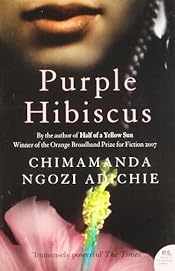
Tolstoy famously had it that happy families were all alike but unhappy ones were unhappy in different ways. This does not seem to be the case for those unhappy families dominated by a religious fanatic, which – from my experience of literature – are very similar  The first sentence of Purple Hibiscus (which also incorporates a reference to Chinua Achebe’s first novel) makes it clear that our narrator Kambili’s father, Eugene, is prone to sudden outbursts of violence and the first two pages that he is a strict Catholic, performative in his observances, contemptuous of his Igbo background, intolerant of those who would not have things done “properly.” This intolerance extends to his own father, known to Kambili and her brother Jaja as Papa Nnukwu, but whom they are only allowed to visit for fifteen minutes at a time. Nnukwu himself insists he is not a pagan, that he is merely a traditionalist.

Any transgression of Eugene’s strict rules – or of those he believes his church ordains – suffers harsh punishment. Even Kambili coming second in her class at the end of one term is met with chastisement crossing the border of abuse, during which Eugene tells Kambili he didn’t spend all his time making good in order that his children be useless creatures. Her mother, Beatrice, puts up with all this – and more – more or less uncomplainingly, seeking only to comfort her children as best she can.

Yet Eugene is charitable, dispensing “crisp naira notes” to beggars, a benefactor to worthy causes, financial backer of The Standard, an anti-government newspaper and a steadfast supporter of its editor, Ade Coker. All this generosity is enabled because Eugene is a very successful self-made business man.

Eugene’s strict control of his children’s lives is in contrast to the much freer attitude of his sister Ifeoma, to whose house in Nsukka, Jaja and Kambili are allowed to go for a few weeks. The easy-going atmosphere in her Aunty Ifeoma’s house, the openness of her cousins, at first confuses Kambili – to the point of being tongue-tied.

In Nsukka she again comes across Father Amadi who had once stood in at their usual church and given a sermon of which Eugene had profoundly disapproved due to his use of Igbo speech and songs, a stark contrast to the white Father Benedict. The fifteen-year-old Kambili develops an attraction for Father Amadi, an attraction which may be mutual but on which of course Father Amadi, though he befriends her, cannot act.

In the background tolls the political situation where the authoritarian government acts to suppress opposition which leads to the closing down of The Standard.

Adichie’s portrayal of a young girl growing into adulthood and awareness of self in the midst of a multitude of challenges is affecting and believable. That the centre of her life cannot hold, that something has to give is the crux of the novel. The agent of change is, perhaps, not quite the character we might have thought.


Pedant’s corner:- Written in USian; “the eighteen-yard box” (known in footballing countries as ‘the penalty box’.)
Novel Misconceptions

In a piece in Saturday’s Guardian Review on how he wrote The Buddha of Suburbia, Hanif Kureishi echoes Tolstoy’s (in my opinion contentious) dictum about happy families. Kureishi claims that, “All first novels are letters to one’s parents, telling them how it was for you, an account of things they didn’t understand or didn’t want to hear.”

Speak for yourself, mate.

This sort of statement can only encourage the lazy view some readers have that everything in a novel – especially a novel written in the first person – is somehow autobiographical. It leaves no space for invention, nor for imagination; only craft. And it belittles that craft. The recent vogue for autofiction of the Karl Ove Knausgård type is for that reason an unwelcome development as far as I’m concerned.

Of course aspects of a writer’s life may seep into her or his work – perhaps even subconsciously – and autobiographical incidents may appear there, in altered form or otherwise, but that is not to say that everything in a work emanates from that source. Inspiration can strike from anywhere, not merely the author’s own life and experiences.

Your first novel may have been written as a letter to your parents, Mr Kureishi. However, that is not true of everyone’s.

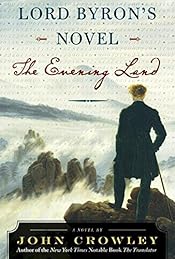
Lord Byron’s Novel: The Evening Land by John Crowley

William Morrow, 2005, 472 p

Lord Byron's Novel: The Evening Land

Lord Byron, of course, never wrote a novel – except perhaps the beginnings of one. Or, if he did, it is lost to the mists of time. Crowley’s conceit here is that Byron completed it, and that his daughter, Ada Lovelace, “the first computer programmer,” burned it due to her batty mother’s insistence, but, before she did so, encrypted it in a series of numbers. Those numbers have turned up in papers belonging to Viscount Ockham, Ada’s son. A website called strongwomanstory has gained access to these and sent a reporter to look them over. This aspect of Crowley’s novel is related in a series of emails and letters between the reporter “Smith” and her mother “Thea” but expands to include her father. Smith’s relationship with her father is much the same as Ada Lovelace’s with hers – sexual indiscretions resulting in estrangement – except the modern story holds the promise of reconciliation. Included in these exchanges is the observation that Ada’s story contains ‘a monster parent, but it’s not her father-it’s her mother’ and the observation about Byron’s notorious lack of punctuation, “Printers in those days could punctuate. Imagine. Now hardly anybody can.”

It would of course be impossible to proceed with this scenario were the “novel” by Lord Byron not to appear in these pages and it does take up by far the largest part of the book. Crowley has done an impressive job in ventriloquising the poet’s voice even if at one point he does have Byron pre-echo Tolstoy with the thought, “Happy endings are all alike; disasters may be unique.” Its protagonist, Ali, born in Albania as the result of a liaison with a wandering British aristocrat, Lord Sane, is in young adulthood sought out by his father to become heir to the Sane estate, somewhere in Scotland. This tale, The Evening Land, is as Gothic as you could wish, involving a gruesome death, misplaced accusations, possible amnesia, an impersonator, a clandestine seduction – everything you would expect from a book with such supposed origins and complete with the verisimilitudinal inclusion of archaic spellings such as dropt for dropped, segar for cigar and soar’d for soared. We are also given Ada’s commentary on the text of The Evening Land, in the form of “her” notes on each chapter, wherein she wonders if her father could ever have imagined a family not riven by disputes. (There is, too, a respect in which, notwithstanding the fact that The Evening Land’s contents bear resemblances to incidents in Byron’s life, this overall endeavour might be said to be more about Ada than Byron.)

Then we have the wonderful cover illustration featuring Caspar David Friedrich’s painting Wanderer Above the Sea of Fog,) and the rough-cut page edges making the book resemble one from the early 19th century show a pleasing attention to detail.

Crowley came to my attention back in the 1970s with books such as Little, Big, Aegypt (I note here the appearance in the text of The Evening Land of the spelling Æschylus,) and Engine Summer but dropped off my reading register till I noticed this book. I’ll be looking for more of him now though.

Pedant’s corner:-
In the back cover flap blurb: “Wanderer Above a Sea of Fog” (Wanderer Above the Sea of Fog.) Otherwise: “‘into whose recognizance’” (recognisance – I doubt Byron would have used USian spellings, others, such as honour, are rendered in the British way. Plus recognizance is a US legal formulation rather than a Scottish one,) “‘these lands and goods was truly yours’” (were,) “Kendals drops” (Kendal drops,) Bachus’ (Bachus’s.)

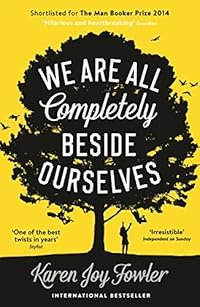
We Are All Completely Beside Ourselves by Karen Joy Fowler

Serpent’s Tail, 2014, 341 p. Borrowed from a threatened library.

 We Are All Completely Beside Ourselves cover

Firstly, this is a very good book indeed; and a consciously literary endeavour. Fowler’s first person narrator, Rosemary Cooke, frequently addresses the reader, digresses, makes asides, approaches her story obliquely, moves it forward and backward in time. She tells us in the prologue what she is about to do. Start in the middle. And later, in a cell, awaiting interrogation by the FBI she reflects on what she will say, “I would not only tell the tale but also comment on it.” Quite. By the end, though, she has decided that stories can begin and end anywhere.

When she was young Rosemary never stopped speaking. The reasons why, and why she gradually stopped doing so, are revealed over the course of the novel. Up until she was five years old Rose had lived with her mother, father, brother and sister. On returning from what she perceived as a banishment to her grandparents’ house she discovers her own family has moved house but it is her sister who has been sent away. This central circumstance is so essential to the novel that any discussion of it beyond generalities would reveal too much but it is its ramifications, the nature of her sister, Fern, and the effects both of these have on Rosemary and her brother, Lowell, which drive Fowler’s story.

Unsurprisingly, tensions abound. Rose tells us, “Antagonism in my family comes wrapped in layers of code, sideways feints, full deniability. I believe the same can be said of many families.” This is most likely a nod to Tolstoy’s similar phraseology. Through Rosemary, Fowler tells us elsewhere, “In most families, there is a favourite child. Parents deny it and maybe they truly don’t see it, but it’s obvious to the children. Unfairness bothers children greatly.” Incidentally, the Cooke family had a dog called Tamara Press. Quite why Fowler chose the name of a 1960s Russian shot-putter for this is obscure (to me at least.)

Much play is made of the unreliability of memory. Rose recalls an incident from her childhood where she remembers her father deliberately driving over a cat but he was not the sort of person to do such a thing. She both believes it happened and also that it didn’t and refers to it as her own personal Schrödinger’s cat. She also says that language “simplifies, solidifies, codifies, mummifies” memories and remembers her father telling Lowell that language and communication are two different things. In a neat line connecting Rose’s use of contact lenses with her sister’s disappearance she says, “It’s what you do with disposables; you get rid of them.”

Rose twice emphasises her experience that, “Where you succeed will never matter so much as where you fail” and refers to the rift in the family as “A monkey on my back….” but in what seems an authorial interpolation, “When I run the world, librarians will be exempt from tragedy.” Her father was a researcher into animal behaviour and the book is run through with references to such research. “‘You can train any animal into any behaviour on cue if it’s a natural behaviour to begin with. Racism, sexism, speciesism – all natural human behaviours… triggered any time by any unscrupulous yahoo with a pulpit… Mobbing…Bullying. Empathy.’” The book is very much Rose’s story, her umwelt (the world as it is experienced by a particular organism.) Humans it seems are much more imitative than other apes.

For various (and different) reasons I was reminded of both William Boyd’s Brazzaville Beach and Kate Atkinson’s Behind the Scenes at the Museum.

There are not many novels which go into detail on the concept of theory of mind or discourse on embedded mental states and imputation. Yet these discursions seem a natural part of the narrative making for a tremendously well worked out and impressively rendered novel.

Pedant’s corner:- A flock of seagulls were grazing (a flock was grazing,) hieroglyphic (hieroglyph.) Fowler does, however, receive plus points for culs-de-sac.

The Last Station

It’€™s a long time since I’ve been to see a film. Partly this is because Kirkcaldy for some years now has no longer had a commercial cinema – the nearest one is on the outskirts of Dunfermline -€“ but also I have kind of lost interest in the medium.

However the local theatre (the Adam Smith) does put on films when it is not presenting stage productions -€“ December and January are particular deserts for this due to the annual pantomime – and I have attended there in the past.

Only about one film on their list has vaguely enthused me since I went to see Wall-E in Dunfermline – it was set in the 1930s and had David Tennant in it; I forget the title – and the one night it was on I was tired and it was raining so I gave it a miss.

However, the good lady perused the forthcoming attractions and thought The Last Station might be interesting. I was quite willing as I had read a short story a couple of years ago (sadly I can remember neither the title nor the author) which featured the peculiar circumstances of Leo Tolstoy’€™s death. We duly saw the film last night.

It tells the tale of Tolstoy’€™s last years through the viewpoint of a literary secretary, Valentin Bulgakov, played by James McAvoy, who is taken on by the head of the Tolstoyan Movement, Vladimir Chertkov (Paul Giamatti,) mainly to monitor Tolstoy‒s wife, the Countess Sonya, wonderfully played (as you would expect) by Helen Mirren.

The focus of the film is on the Countess’€™s struggle to prevent the royalties from Tolstoy‒s work being taken from the family and given to the Russian people (as Chertkov puts it) ie more or less to the Movement. As such the Countess’€™s motivation was easy to grasp, as was Chertkov’s – the classic hanger-on and leech to great celebrity. That of Tolstoy himself, though -€“ played by Christopher Plummer – was not at all well established and seemed unfathomable. The reasons for his actions remained wrapped in mystery – or in the mist that seemed to hang over Tolstoy’s estate of a morning.

Chertkov at one point stated to the Countess that —if I had a wife like you I’d blow my brains out: or go to America” (are the two equivalent?) but the relationship between Tolstoy and Sonya was still portrayed as affectionate. Certainly in the film the Countess’€™s stance was perfectly reasonable.

Bulgakov starts out as an ardent Tolstoyan, a movement whose tenets included pacifism and celibacy. We probably did not need the depiction of the relationship between Bulgakov and Masha, a schoolteacher in the Movement’s settlement at Telyatinki, hard by the Tolstoy estate – an affair whose trajectory is inevitable from our first glimpse of her – to underscore for us the shortcomings of the latter part of that philosophy.

The Movement came over as incipiently religious with Chertkov as a kind of St Paul figure in relation to Tolstoy’€™s Jesus.

A nice touch was the inclusion of real archive footage of the characters beside the end credits as they were running.

Despite any caveats above, I enjoyed it.

free hit counter script