Posted in Altered History, Events dear boy. Events, Other fiction, Philip Roth at 23:17 on 23 May 2018
I heard on the radio news this morning that Philip Roth has died.
I must confess I have not read much of his work, apart from the (ahem) seminal Portnoy’s Complaint – which I was moved to sample partly because of the attention it received – and My Life as a Man which covered much the same ground. Anything you ever wanted know about living as a young(ish) male Jew in the USA was here.
I do remember being intrigued by a long ago television programme about him which featured, as I recall, his creation Nathan Zuckerman fantasising about Anne Frank surviving the Holocaust and making a new anonymous life for herself in (I think) the US, which may have been another spur to reading him.
I can’t say I much took to what seemed from the evidence of those two books to be his perennial subject matter but he was obviously an important US novelist of the second half of the twentieth century whether I favoured his work or not and his ability as a writer shone through in any case.
Much later I read his Altered History novel The Plot Against America which I reviewed on this blog here. The impulse behind his decision to write it was admirable – and arguably necessary – but I felt that overall it was an opportunity missed, that the punches the book threw were somewhat pulled.
Sadly that impulse might be even more necessary in today’s political climate than it was when he published it thirteen years ago.
Philip Milton Roth: 19/3/1933 – 22/5/2018. So it goes.
No Comments »
Posted in Altered History, Philip Roth, Science Fiction at 18:00 on 2 April 2012
They give with one hand and take away with the other….
Also in Saturday’s guardian review was the first part of the Guardian Book Club feature on Robert Harris’s Fatherland, wherein John Mullan says “Speculative fiction” might once have been synonymous with SF but now more strictly refers to an alternative, but plausible, historical scenario.
More strictly? There is a definition of speculative fiction which excludes SF?
This seems to me to be a dismissal of the more explicitly SF altered histories. Is Mullan attempting to distance his preferred examples from what he sees as less worthy; or am I too sensitive?
Nevertheless I had to laugh when Mullan immediately wrote that a modern classic of speculative fiction is Philip Roth’s The Plot Against America. That book not only failed as a novel, it failed as an Altered History (for my review see here). Can a story where history is restored swiftly to the “right” path really be considered speculative? Is it not then an author’s ill-thought out musings, onanistic even?
I’ve not read Fatherland but from the description it seems to invest more into its scenario than Roth ever did in his.
In that extent Fatherland is SF, and Roth’s book isn’t.
No Comments »
Posted in Altered History, Andrew Crumey, Other fiction, Philip Roth, Reading Reviewed, Science Fiction at 14:00 on 18 April 2011
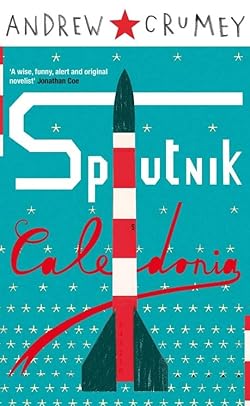
Picador, 2008. 553 p.
In the first part of the novel a shy boy called Robbie Coyle is growing up in a village called Kenzie in 1960s Scotland with the ambition of going into space. Since his father is an ardent socialist and anti-American Robbie therefore wants to be a cosmonaut. A frequent attender at his local library, he devours knowledge about the Soviet Union and discovers that “Russian is a language where some letters are written back to front and others are completely made up.” Quotes such as this display Crumey’s excellent ability to inhabit the world of a pre-adolescent. As he matures he starts to hear a voice in his head. The section ends with that voice saying, “I guess we’re not in Kenzie any more.”
The story then flips into a scenario of a Soviet-style Britain where a young adult Robert Coyle has been recruited into a space project to reach, before the wicked capitalists do so, what is possibly a black hole travelling through the solar system. The secret “Installation” where Robert is in training is suitably grim, the illustrations of the many compromises people have to make in such a society convincing, though whether dissidents could flourish there is another question. Perhaps this exists in the same British Democratic Republic which featured in the author’s Mobius Dick.
This central section could be considered an Altered History novel where the Jonbar Hinge lies in whether or not a man named Deuchar died while trying to rescue twins from drowning many years before the time the action is set. Yet its juxtaposition with the preceding and following parts, set in the “real” world, argues against this. And Crumey’s treatment of his subject matter does not have the feel of SF. The Soviet section can be read to be implicitly a figment of Robbie’s imagination. The subtlety of the point of divergence also marks this out from SF treatments of Altered Worlds. While Crumey pushes credibility a little by having characters in the central section behave and speak, or have the same names as, those in the book-end segments he does certainly avoid the trap into which Philip Roth fell in The Plot Against America of restoring the altered world to normal by the end.
The coda, a (present day?) exploration of the situation of Robbie’s ageing parents and a young boy who meets a mysterious stranger on a mission (which he is unwilling to explain) provides counterpoint and a resolution of sorts.
Sputnik Caledonia is excellently written and engaging, with convincing characters, but not quite as full of verve as Mobius Dick. I will look out for more Crumey, though.
No Comments »