Archives » Susanna Clarke

Piranesi by Susanna Clarke

Bloomsbury, 2020, 257 p.

Narrator Piranesi lives in a set of Halls decorated with Statues and subject to sometimes disruptive sea-tides. He describes his life to us through a series of journal entries with headings such as Entry for the First Day of the Fifth Month in the Year the Albatross came to the South-Western Halls. The Lower Halls provide food such as fish, crustaceans and vegetation. As far as he knows the Halls have only ever been home to fifteen people and thirteen of those are dead, their bones lying in various places among the Halls. One of these he has named Biscuit-Box Man since his (though we are not told so, it could actually be a her, Piranesi has no way of knowing for sure) smaller bones are contained in a red box bearing the words Huntley and Palmers and Family Circle. One of the others’ remains are wedged in a narrow space between a Plinth and a Wall, ten skeletons are in an Alcove and the one he calls the Folded-up Child, Piranesi thinks is a female. That leaves one person, The Other, a fifty to sixty year-old man who is Piranesi’s only live companion. He appears, usually to a schedule, speaks in obscurities and deflections and believes there is a Great and Secret Knowledge hidden in the World of the Halls which can give him enormous powers if it can be found. Occasionally the Other supplies Piranesi with items such as shoes.

Piranesi’s journal describes his journeys through the Halls in some detail, an otherwise deserted environment he has come to know intimately. His use of English and familiarity with notions like biscuit-boxes, though, immediately invite questions. How does he have knowledge and memories of these things, none of which are found in the Halls? What are we – and he – missing?

The obvious literary comparison of a story set in a huge building like this is with Mervyn Peake’s Gormenghast but this is not truly like. Something about the writing rang a distant bell but it wasn’t till the Other’s reference to a projected ceremony to discover the Great and Secret Knowledge that I thought of Iain Banks’s The Wasp Factory, which again isn’t an apt comparison. However, given the vastness of the Halls, Walking on Glass might be the more pertinent – or even parts of The Bridge.

Piranesi’s diary entries are full of capitalised nouns – a flavour of which dapples my paragraphs above. This long out of date practice for all but proper nouns helps to emphasise the otherness of Piranesi’s existence – and that of the Halls.

Jeopardy introduces itself when a confluence of tides is set to deluge all but the uppermost parts of the Halls but also when a mysterious (to begin with) number sixteen is mentioned by the Other who claims sixteen wants to harm Piranesi or will send him mad. One day Piranesi hears sixteen calling out (the voice is a woman’s,) leaves a message for her to keep away and tries to avoid reading the reply she chalks on a Hall’s floor. He then meets an old man whose speech confuses him by saying that the Halls exist in a Distributary world which could not exist had the other world it flowed from not existed first, causing Piranesi to look back at his journal entries, which he realises contain gaps but also references to another world and people such as Laurence Arne-Sayles and Valentine Ketterley. How this is all connected is revealed only when Piranesi finally speaks with sixteen, who is named Raphael. Reflecting on this talk and the reassessment he has to make about his life he ruminates, “Perhaps even people you like and admire immensely can make you see the World in ways you would rather not.”

Clarke conjures the sense of otherness of the Halls admirably and her approach is distinctive from other descriptions of parallel worlds but there was something underwhelming about the resolution. Clarke is an accomplished writer but for me the worlds she invents fail to convince completely.

Pedant’s corner:- enormity (used in the sense of huge rather than its true meaning of monstrous,) “I tried hard not complain” (not to complain,) “‘I thought that you were to unlikely to’” (no need for that first ‘to’,) at one point there was no new paragraph when a second person spoke, focussed (several times, focused,) “the fish that abounds in every vestibule” (the fish that abound,) “using the name the Other called her” (he had not done so in any of the conversations Piranesi had previously related to us.)
Hugo Awards 2021

The short lists for this year’s Hugo Awards have been announced.

The fiction nominees are:-

Novel-

Black Sun Rebecca Roanhorse (Gallery/Saga Press/Solaris)
The City We Became N.K. Jemisin (Orbit)
Harrow The Ninth Tamsyn Muir (Tor.com)
Network Effect, Martha Wells (Tor.com)
Piranesi Susanna Clarke (Bloomsbury)
The Relentless Moon Mary Robinette Kowal (Tor Books/Solaris)

I note here the crossover with the BSFA Award list as regards N K Jemisin (which I reviewed for Interzone 287 but have not yet published here) and Susanna Clarke.

Novella-

Come Tumbling Down Seanan McGuire (Tor.com)
The Empress of Salt and Fortune Nghi Vo (Tor.com)
Finna Nino Cipri (Tor.com)
Ring Shout P. Djèlí Clark (Tor.com)
Riot Baby Tochi Onyebuchi (Tor.com)
Upright Women Wanted Sarah Gailey (Tor.com)

I have read none of these.

Novelette-

Burn, or the Episodic Life of Sam Wells as a Super A T Greenblatt (Uncanny Magazine, May/June 2020)
Helicopter Story Isabel Fall (Clarkesworld, January 2020)
The Inaccessibility of Heaven Aliette de Bodard (Uncanny Magazine, July/August 2020)
Monster Naomi Kritzer (Clarkesworld, January 2020)
The Pill Meg Elison (from Big Girl, (PM Press))
Two Truths and a Lie Sarah Pinsker (Tor.com)

Ditto.

Short story-

Badass Moms in the Zombie Apocalypse Rae Carson (Uncanny Magazine, January/February 2020)
A Guide for Working Breeds Vina Jie-Min Prasad (Made to Order: Robots and Revolution, ed. Jonathan Strahan (Solaris))
Little Free Library Naomi Kritzer (Tor.com)
The Mermaid Astronaut Yoon Ha Lee (Beneath Ceaseless Skies, February 2020)
Metal Like Blood in the Dark T Kingfisher (Uncanny Magazine, September/October 2020)
Open House on Haunted Hill John Wiswell (Diabolical Plots – 2020, ed. David Steffen)

Ditto.

Series-

The Daevabad Trilogy S A Chakraborty (Harper Voyager)
The Interdependency John Scalzi (Tor Books)
The Lady Astronaut Universe Mary Robinette Kowal (Tor Books/Audible/Magazine of Fantasy and Science Fiction/Solaris)
The Murderbot Diaries Martha Wells (Tor.com)
October Daye Seanan McGuire (DAW)
The Poppy War R.F. Kuang (Harper Voyager)

Ditto.

I’m obviously not keeping up with SF from the US. (Mind you the stuff from there I have read recently hasn’t been too inspiring.)

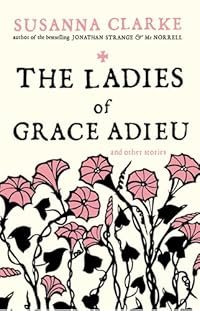
The Ladies of Grace Adieu and other stories by Susanna Clarke

Bloomsbury, 2007, 242 p.

 The Ladies of Grace Adieu cover

This is not my natural habitat. A book of short stories about Faery – in cod early nineteenth century English complete with “antique” spellings? The same author’s novel, Jonathan Strange and Mr Norrell, covered much the same ground and was interesting as a one-off, presenting fairies as less fey creatures than their normal portrayal (and also an everyday part of history) but this collection doesn’t really take us any more beyond that. There are introductions and footnotes by “Professor James Sutherland, Director of Sidhe Studies, University of Aberdeen,” as if the whole thing was to be taken as more than a jeu d’esprit. I can recognise the artifice of it all, the craft, but it doesn’t quite hit the spot for me.

The Ladies of Grace Adieu
Three ladies in the town of Grace Adieu practice magic. A tale “full of all kinds of nonsense that Mr Norrell will not like – Raven Kings and the magic of wild creatures and the magic of women.” In it Mr Strange reads a book which “contained a spell for turning Members of Parliament into useful members of society.” If only.

On Lickerish Hill
Before the marriage Miranda Sowerson’s mother had told her daughter’s prospective husband she could spin five skeins of flax in a day for a month. One year after the wedding he expects Miranda to accomplish this feat and shuts her up in a room. She contrives to conjure up a fairy to help her. A more or less straightforward retelling of a familiar fairy tale.

Mrs Mabb
Miss Venetia Moore’s intended, Captain Fox, has been enticed away from her by the mysterious Mrs Mabb (who never appears directly in the tale.) Strange things happen to Venetia when she tries to find Mabb’s house. She is determined, though.

The Duke of Wellington Misplaces his Horse
The Duke’s horse goes into fairyland. He follows, and discovers his fate embroidered onto tapestry. Luckily he has been provided with a pair of scissors.

Mr Simonelli or The Fair Widow
Mr Simonelli tries to prevent any of the five Gathercole sisters from being induced to marry John Hollyshoes, the fairy widower. (This employs the plural “Miss Gathercoles” rather than “Misses Gathercole” – though I accept this may be 19th century usage. However, the possessive of John Hollyshoes continually shifts from s’s to s’ and back again.)

Tom Brightwind or How the Fairy Bridge Was Built at Thoresby
How Tom Brightwind came to build the fairy bridge at Thoresby. Contains the immortal sentence, “There was, after all, nothing in the world so natural as people wishing to be English.”

Antickes and Frets
In her captivity in England, Mary Queen of Scots embroiders all sorts of garments to try to kill Queen Elizabeth and gain the English throne.

John Uskglass and the Cumbrian Charcoal Burner
While out hunting, John Uskglass, the Raven King, damages the livelihood of a Cumbrian charcoal burner, who then petitions various Saints to gain him revenge. They demur but take the king down a peg.

One of “Professor Sutherland”’s introductions contains the observation that the story following “suffers from all the usual defects of second-rate nineteenth-century writing,” – something of a hostage to fortune in a book such as this.

free hit counter script