Archives » Shusaku Endo

Scandal by Shūsaku Endō

Penguin, 1989, 235 p. Translated from the Japanese (スキャンダル) by Van C Gessel

At an award ceremony, famous writer Suguro, known for his Christianity and clean living, is accosted by a woman who claims to recognise him from his sojourns in Sakura Street in Shinjuku – an area known for its peep-shows and porn shops. Suguro indignantly denies such behaviour, any wider revelation of which would undoubtedly lead to a scandal.

A reporter named Kobari, who was present at the accusation, instinctively believes the woman and, shocked at Suguro’s apparent double standards (at one time frequenting vice dens, at the other portraying the exact opposite in his fiction,) makes it his mission to uncover what he sees as Suguro’s duplicity. The discovery of a portrait apparently of Suguro, painted by one of the women of Sakura Street, confirms Kobari in his pursuit. In one of Kubari’s interviews there a sex-worker tells him, “Sex is awfully deep, sir. All kinds of sensations come bubbling up from the bottom-most part of your body. It’s like a strange new music.” She reveals to him the bizarre enthusiasms and fetishes of the clients of the establishments in Sakura Street, by which Kobari is appalled.

In the meantime Suguro engages a young girl, Mitsu, whose family is in straitened circumstances, to help his (like Suguro himself, ageing) wife with the housework. Mitsu eventually turns out to be untrustworthy but Suguro has by this time, in a first intimation that he may have a darker side, dreamt of her half-naked.

As an exploration of the dark recesses of sexuality the novel is heightened when Suguro strikes up a conversational relationship with Madame Naruse. Her stories of her late husband’s complicity in, indeed instigation of, a wartime atrocity and the erotic charge it gave her trouble Suguro in its contrast with his own staid (it is strongly implied now non-existent) sex life.

The book’s emphasis on human frailty is at times tempered by reflections on writing. In a conversation Suguro is told writers can be divided into two groups, the biophilous (life-loving) and the necrophilous (self-destructive, degenerate, decadent.) Suguro’s work lies in the former category.

Suguro’s certainty that he must be being impersonated (even though he reflects that “Deep in the hearts of men lay a blackness they themselves knew nothing about”) leads him to try to confront his double.

Madame Naruse sets up a meeting in Sakura Street so that Suguro might meet the impostor, during which she tells him people delight in inflicting pain, that perhaps Jesus was murdered because he was too innocent. As he carried his cross the crowd reviled him and threw stones because of the pleasure it gave them. She adds, “… all you’ve written about are men who have betrayed Jesus but then weep tears of regret after the cock crows three times. You’ve always avoided writing about the mob, intoxicated with pleasure as they hurled stones at him.” The only other person present in the love hotel, however, is a comatose Mitsu, upon whom Suguro spies through a peep-hole.

The döppelganger/split personality has long been a wellspring of Scottish fiction. To see the dichotomy examined in a Japanese context was unusual but Endō treats it subtly and convincingly.

Pedant’s corner:- “A magazine reported named Kubari” (reporter.) “He was assigned to a regiment in Chiba” (China, I assume,) a missing comma before a piece of direct speech, “a silver rhinestone broach” (brooch,) “Madame Nearuse” (Naruse.)
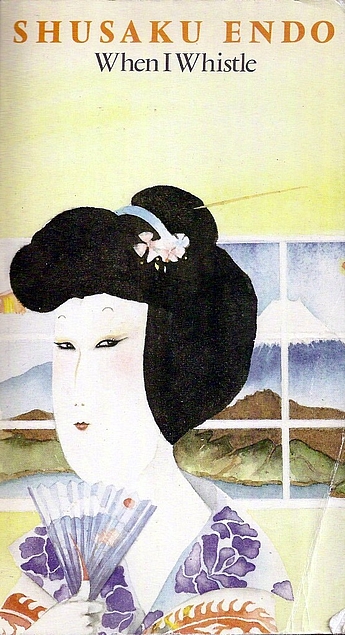
When I Whistle by Shūsaku Endō

Quartet, 1979, 275 p, including iv p Preface. Translated from the Japanese, 口笛をふく時, (Kuchibue wo Fuku Toki,) by Van C Gessel.

 When I Whistle cover

A chance encounter on a train with a former schoolmate forces a man called Ozu (I can’t remember being told his first name) to think about a boy at school who was dubbed Flatfish. Flatfish, a new arrival in Ozu’s class (not the top set by any means,) unfortunately had an odour but, because he was seated next to Ozu, by default became his best friend. Ozu had to explain to him all the unwritten rules but Flatfish continually managed to get himself in trouble both by accident and by being himself. The defining moment of Flatfish’s life was an encounter the pair had with two girls from the local girls’ school – with whom they ought not to have had any contact by the strict rules of the time – on the way home one day. Flatfish formed a lasting but doomed attraction to Aiko, the girl who, in an act of compassion, bandaged his injured hand. These schooldays were in the 1930s, Japan was embroiled in China and militaristic attitudes abounded but the nature of schooling (harsh) and the trials of dealing with the opposite sex come over as being not too dissimilar to Western experiences of the time.

In the novel’s present day, Ozu’s son Eiichi is a practitioner at the dispensary of the local hospital and eager to climb the greasy pole of the medical profession so does not demur from the outmoded prescribing and treatment practices of his superiors. He notes, in particular, the habit of telling soothing platitudes to patients. Despite his liaison with a nurse, Keiko, he sets his designs on his boss’s daughter, but has a rival in Doctor Kurihara who also has a nurse on a string. Relations between the sexes in Japan had clearly also undergone a more liberal change post-war. Eiichi then is complicit in administering a new, otherwise untried, cancer treatment devised by a firm owned by Kurihara’s father.

Flatfish not being academic quit school and got a poorly paid job but when war with the Western powers came (the feeling was that Japan would easily defeat them, of course, and at first it seemed so) was swiftly drafted into the miltary and sent to Korea. Nevertheless, he inveigled Ozu to seek out Aiko and give her a pen as a token of his esteem. She in the meantime had married a young naval officer. The reader suspects, rightly, that none of this will come out well. This thread between Aiko, Flatfish and Ozu is what binds the book together.

When I Whistle isn’t one of Endo’s better novels even if it is one of his later ones. There is something about the writing that is sketchy or ill-considered (which doesn’t seem to be because of translation) and more than once information or characters’ thoughts are repeated that have no need to be.

Still, the reflection, “People often wonder when they will die but they rarely wonder where they will die,” is original but, “Now, when all was lost, he felt he understood the meaning they had given to his life,” is a novelistic thought if there ever was one.

The Preface tells us that the author was himself in hospital for a considerable time with various complaints and during one operation his heart stopped. But he survived and continued smoking. It is noticeable that the doctors in this novel all smoke. Then again, it was first published in 1974.

Pedant’s corner:- “if worse came to worst” (if the worst came to the worst,) “None … were” (several times. ‘None …was’.) Opthamology (x 3, Ophthalmology,) knit (knitted, please. Okay the translation is into USian, but still,) “his voice rising to a crescendo” (to a climax; the crescendo is the rise.)

Deep River by Shusaku Endo

Peter Owen, 1994, 220 p. Translated from Japanese by Van C Gessel.

Deep River cover

I read Endo’s Silence (published 1966) and The Samurai (1980) years ago now but this is the first book of his I have read since. Endo’s writing is unlike most Japanese authors in that it is coloured by his Christianity, specifically Roman Catholicism. Silence dealt directly with the missionary times in Japan, The Samurai with the cultural differences between Japan and “the West.”

Deep River engages with yet another culture, that of India, mainly following a group of Japanese tourists there ostensibly to visit Buddhist sites but each of whom has his or her own concerns. Isobe has lost his wife to cancer but on her deathbed she whispered she was convinced she would reincarnate; he has learned of a possible candidate in India. Mitsuko has a connection to Ōtsu, a man she tormented in her college days who is now doing good works in Varanasi (the book spells this city’s name as Vārānasī throughout.) Numada is a children’s writer who wants to set free a myna bird as an act of restitution. Kiguchi is haunted by his experience on the Highway of Death in the retreat from Burma and wishes to have a reconciliatory memorial service to the fallen of both sides.

(Aside:- It is perhaps understandable that little of the hideousnesses that Kiguchi remembers from the retreat is remarked on in non-Japanese writings. In the aftermath of an ill-advised offensive which duly went wrong the soldiers were left to their own devices and suffered accordingly. But then even in their good times Japanese soldiers were notoriously ill-served by their superiors. In retreat they were just forgotten.)

While the first part of the book chronicles the back-stories of the four main characters it is India that is the true centre of the novel. All four encounter the overpowering nature of that country. The deep river is not only the Ganges at Varanasi but the mass of humanity. Yet even here Endo’s Catholicism makes itself felt. Ōtsu has his own particular take on theology, failing his seminary education by being unable to accept European views and seeing God in all religions not exclusively in one. Nevertheless he clings to what he sees as his Christian beliefs.

The trip coincides with Indira Gandhi’s assassination. This coupled with his experiences on the Highway of Death makes Kiguchi come to the somewhat jaundiced conclusion that, “It was not love but the formation of mutual enmities that made a bonding between human beings possible.”

While the manifestations of Japanese, and indeed Indian, culture may appear odd to western eyes, reading books like this shows that at their hearts people really do not vary much the world over. Here it is religion that is the biggest estranging factor.

Refreshingly the translation is into British English but there were some entries for Pedant’s Corner:- négligé (négligée,) when he laid (lay) in wait, her name in Rajini (is,) when… gets me alone this (like this,) resembling that of his dead wife’s (a possessive too far,) we’d better just lay low (lie,) of the the taxi, “a harmonium, an instrument resembling a harmonica” (it isn’t clear whether this is supposed to mean two different instruments or if a harmonium resembles a harmonica – which it doesn’t,) to eat they daily bread (their.)

free hit counter script