The Legacy of Elizabeth Pringle by Kirsty Wark
Posted in Reading Reviewed, Scottish Fiction at 12:00 on 31 December 2020
Two Roads, 2014, 445 p.
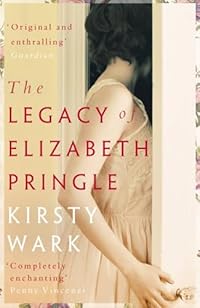
Like Sally Magnusson, Wark is a female Scottish journalist who has turned her hand to writing novels – though Wark is probably more widely known and her novel was published first.
The titular legacy here (though its nature makes the reader suspect it may have a double meaning) is of a house in Arran – an island of which we are provided a map between the title page and the story proper – in response to a written request Elizabeth Pringle received from Anna Morrison, a summer visitor to the island in her daughters’ youth, that if she ever wished to sell, Anna would be interested in buying. Years later Pringle remembered this and almost on her death bed and with no close relatives to consider made the bequest. By this time Anna is developing dementia and it falls to her daughter Martha to accept the offer on her behalf and occupy the house. Chapters dealing with Martha’s experiences are interspersed with extracts from a journal Pringle made shortly before her death at the behest of a US citizen, Saul, now a Buddhist on the off- (Arran’s) shore Holy Isle, wherein her life story is unfolded.
Martha is troubled by the bequest, not least due to the presence of a Cadell ink-and-watercolour painting on one of the walls. (Cadell was one of the Scottish Colourists and his work is valuable.) The solicitor assures her Pringle was in her right mind and surely wished the painting to be included. She forms a friendship with Catriona, proprietrix of a hotel where she stays while setting the house to rights. Catriona’s brother Niall was Pringle’s gardener and very attractive. Martha’s problems with her mother’s ongoing dementia are exacerbated by the absence of her younger sister, Sue, working in Copenhagen, with whom her relationship is strained.
Pringle had on the surface an uneventful life, marred by the death of her father and subsequent loss of the farm he worked, which necessitated the move of her mother and herself to the house she would leave in her will. Her fiancé Robert had ambitions, and, given a chance of running a sheep station in Australia took it, but Martha was too attached to Arran and distressed by the recent death of her mother to go with him. She enjoyed walking in the Arran hills and during the Second World War helped with the parties searching for the many aircraft downed in fog or other unfortunate circumstances. Her only other liaison apart from Robert was with a US airman in his brief spell on the island. It is Pringle’s recollections which form the most interesting strand of the book even if Martha’s difficulties with her mother and sister are well enough handled. An entry in Pringle’s journal tells us one of her “favourite books was Sunset Song….. I would like to have met someone like Chris Guthrie…. If I had a heroine, it was her.” However, neither of the lead female characters here approaches Chris Guthrie’s stature. The journal also comments on the repressions endemic in a Scots upbringing before recent times. “It had always been a mystery to me why ministers would encourage children to believe they were sinners.”
The modern sections are more heavy going. There is something about the prose that is plodding, leaden, adjective-laden, with too much description of interiors. Despite Wark’s knowledge of Arran the occasional forays into its landscape do not fully spring to the mind’s eye and her handling of Martha’s romantic attachment to Niall verges on the Mills and Boon. The central event of the tale, Martha’s main discovery about Pringle’s life, is not adequately foreshadowed. We are told Martha feels apprehension about opening the door into the eaves which had been wallpapered over but have been given no prior reason for her to feel any such thing. Wark has written a second novel: I’m not in any great hurry to read it.
Pedant’s corner:- “Time interval later” count: 8. Otherwise; St Clements (St Clement’s,) “wiled away the years” (whiled away,) missing commas before and after pieces of direct speech, “aren’t I?” “Aargh!! Wark is Scottish, the speaker was Scottish. The phrase is, ‘amn’t I?’,) “the Botanical Gardens” (Usually referred to as the Botanic Gardens,) “before” (appears three times in the space of two lines, twice in succession at the end one sentence and the start of the next; a might excessive, I would submit,) “to go the graveside” (to go to the graveside,) Yeats’ (Yeats’s,) crafts (of ships, the plural then is ‘craft’,) a reversed double quotatiom mark at the beginning of ‘”splinter filled…”’, “since she’d had been” (either ‘she’d’ or ‘she had’,) “‘I looked it up the imternet’” (up on the internet,) Mrs Beetons’s (Mrs Beeton’s,) twin-engine (usually twin-engined,) airplane (aeroplane, please,) “the Waverly paddle steamer” (Waverley,) artemesia (artemisia,) soflty (softly,) clam (calm.)


