Posted in My Interzone Reviews, Reading Reviewed, Reviews published in Interzone, Science Fiction, Scottish Fiction at 10:00 on 29 December 2016
TTA Press
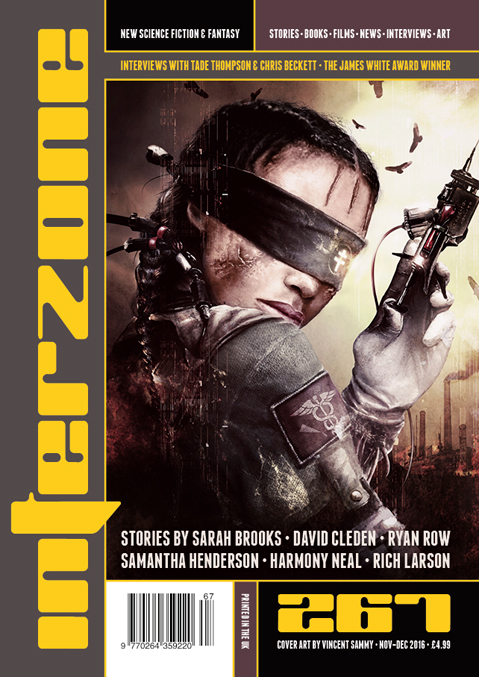
The Editorial is by Martin McGrath and discusses the continuing importance of the James White Award, whose latest winner* is published in this issue, Jonathan McCalmont’s column1 bemoans the recent trend towards magical policemen solving crimes in old London town as having a reactionary effect while Nina Allan praises Scottish Science Fiction’s engagement with political themes. In the Book Zone I review Dave Hutchinson’s Winter in Europe and there are interviews with Tade Thompson and Chris Beckett.
Alts2 by Harmony Neal is a tale of humans genetically modified by StateCorp into a kind of slavery.
The narrator of Ryan Row’s Dogfights in Olympus and Other Absences3 is a mercenary pilot involved in a multi-party conflict over a planet called Olympus which has a desirable hyper potential energy dense matter core. The relativistic aspects of his 0.2 light year separation from his family affect the relationship.
The Hunger of Auntie Tiger by Sarah Brook is set on a planet where people of Chinese origin, left more or less to their own devices by “the Company” relive myths.
Rich Larson’s You Make Payata4 suggests there is really only a small number of tales that can be written as this one of an attempted scam has a familiar template but is nevertheless well executed and full of Science-fictional gloss.
*Rock, Paper, Scissors5 by David Cleden literalises the game alluded to in its title vinto a contest between the bodily-transformed representatives of two tribes for the annual rights to the hunting grounds.
In My Generations Shall Praise6 by Samantha Henderson a woman on death row is persuaded to have her mind overwritten so that someone else can use her body.
Pedant’s corner:- 1Morris’ (Morris’s,) use of they and them as pronouns for an individual. 2Written in USian. “She wasn’t sure the exact details of his alteration” (of the exact details,) “everyone holding their breath (their; so breaths,) sunk (sank.) 3 Written in USian. “Curealian and silver beams” (Cerulean?) “where his family makes their home” (“makes” is the singular; so “makes its home”,) “above him the naked stars lay out in the dark” (lie out; the narration is present tense,) dying her hair (dyeing.) 4 Written in USian, pretenses (pretences,) “‘when you get the hotel’” (to the hotel,) florescent (is this USian? – fluorescent.) A collection were (a collection was.) 5mold (mould,) vocal chords x 2 (cords,) “growing soft and downy my back” (on my back?) “the Tribe grow quiet” (grows; several more instances of Tribe as plural,) “‘Your foe will keep their distance’” (his distance; his is used later,) “‘when they tire’” (when he tires,) “‘though they beg you’” (though he begs you,) the attack is borne of frustration (born of.) 6Written in USian. “‘Will they let her in short notice?’” (At short notice? On short notice? With short notice?)
No Comments »
Posted in My Interzone Reviews, Reading Reviewed, Reviews published in Interzone, Science Fiction at 12:00 on 27 September 2016

Jonathan McAlmont1 discusses Claire Vaye Watkins’s Good Fame Citrus on the way to concluding that capitalism is similar to a cult. Nina Allan examines film adaptations of J G Ballard novels. In the Bookzone I review Ken Liu’s collection The Paper Menagerie and City of Blades by Robert Jackson Bennett.
In the fiction:-
Starlings2 by Tyler Keevil is couched in the form of a recorded message from a mother to her child, Colum, who is one of the special children designed to leave an Earth doomed to a runaway greenhouse effect by the malfunction of the supposed remedy, the Hadron-Karensky Reactor, for a new start on another planet. Elegiac and
From the (almost) sublime to the hard to credit. Breadcrumbs3 by Malcolm Devlin posits an apartment block and a city suddenly overwhelmed by plant outgrowths and people beginning to change into animals. All of these could merely be the imaginings of viewpoint character Ellie, though.
James van Pelt’s Mars, Aphids, and Your Cheating Heart4 is told from the perspective of a God, who is addressed as “you.” Otherwise the only science-fictional elements it contains are mentions of an ice sheet on Pluto and the movement of a dust grain on Mars (with subsequent avalanche). The story is about a private eye who warms to the subject of his investigation.
Lifeboat5 by Rich Larson. Like many others before it the planet Lazy Susan is threatened with destruction by “synthetics”. A man who helps “rescue” inhabitants from these situations (for money) is faced with a dilemma over rescuing a woman carrying an unusual hybrid fœtus.
The Tower Princesses6 by Gwendolyn Kiste. The titular princesses – whose means of selection are obscure, the process is said to happen overnight – are caged (in materials of various sorts) and have to negotiate life within their restriction. Narrator Mary falls for one of them. The metaphor here is a little overstrained.
Pedant’s corner:- 1Watkins’ (Watkins’s,) “a group of activists are trying to convince” (is trying,) “the group positions itself on the edge of the dune sea and rearrange their vehicles” (“group” agrees with the first verb and not the second, “itself” is not in agreement with “their” so; rearranges its vehicles.) 2birth is used as a verb, anaesthiologist (that would be an anaesthetist, then.) Less respiratory problems (fewer,) “He told me ‘It doesn’t matter now’.” (That should be “He told me, ‘It doesn’t matter now.’”,) phased (fazed.) “He had not wept or showed any sign of emotions (nor shown.) 3”from the where she had lain” (no “the” required,) jimmy open (jemmy,) 4Written in USian – ladybug, sidewalk, skeptical, on the weekends, check (for cheque,) behavior – plus a “soundless avalanche” on Mars (Mars has an atmosphere; there will be sound,) “He must been shot” (must have been,) Tiggs’ (Tiggs’s,) cracks the entire length (cracks [along] its entire length.) 5Written in USian; “poofy” in the sense of voluminous (a usage I had never come across before. It’s not the first meaning that occurs to a Briton.) “That thing is not going to breach right.” (In the context of a birth; so “breech”?) ‘I’m smelling alkaline and vomit’ (alkaline is an adjective [cf acidic,] the noun is alkali.) 6Written in USian.
No Comments »
Posted in Reading Reviewed, Robert Silverberg, Science Fiction at 12:00 on 19 September 2016
Dell Magazines

Sheila Williams’s editorial1 discusses past and present winners of the Dell Magazines Award for Undergraduate Excellence in Science Fiction and Fantasy Writing. Robert Silverberg’s Reflections2 muses on Persons from Porlock and how he always took great care to allow no distractions when he was working but that Coleridge’s experience did provide him with the inspiration for his first ever sale (for $5) at the age of fifteen. Paul di Filippo’s “On Books” reviews retrospective collections from Nancy Kress and Gregory Benford, a contemporary one from Finnish writer Leena Krohn and novels by Christopher Fowler and Gene Wolfe.
In the fiction we have Suzanne Palmer’s Ten Poems for the Mossums, One for the Man3 which is narrated by a poet set down alone on an alien planet where he discovers the nature of some of its alien life.
Both Filtered4 by Leah Cypess andMasked5 by Rich Larson are typical ‘push current trends to their logical conclusion’ SF stories. In the former a journalist tries to get his story about the manipulation of everyone’s communication feeds by filter programmes through the filters. The latter has teenagers constantly surrounded by a cloud of appearance created to enhance their real selves. One of them, Vera, has been affected by a virus which turned the “cover” off.
Project Entropy5, the latest of the series of stories in Asimov’s by Dominica Phetteplace, explores the ramifications of Angelina having had her Watcher chip removed and the implications of such AIs. Curiously flat in execution.
In Jack Skillingstead’s The Savior Virus6 a biologist who lost his legs in a terrorist bombing engineers a virus to remove the notion of God from people’s minds.
In Nobody Like Josh7 by Robert Thurston Josh is a town’s secret alien whose spaceship crashed before the narrator was born. This story is curiously similar in premise to I married a Monster from Outer Space which appeared in Asimov’s March 2016 issue, but isn’t anything like as affective or effective.
Webs by Mary Anne Mohanraj is set around the prejudice of ordinary humans on a colony world towards those with adaptations.
In Lost: Mind by Will McIntosh a man has to search for the missing parts of his wife’s downloaded mind after they are stolen. The story is marred by a continuity error in the last quarter page which totally undermines verisimilitude.
1 graduating with a duel major (dual,) Joan Sloncewski (the correct spelling, Slonczewski, is used later in the piece.) 2 Samuel Purchas’ (Purchas’s,) 3 beside (besides,) to not spend (not to spend,) “how good he has always been about putting off things” (about putting things off.) 4matrixes (matrices.) 5Lawless’ (Lawless’s.) 5 canvasses (canvases.) 6 symptoms would manifest in mild cold-like symptoms. 7 crashed-landed (crash-landed.)
No Comments »
Posted in Reading Reviewed, Science Fiction at 12:00 on 27 August 2016
In his column Jonathan McCalmont extols the value of experimental narrative while in hers Nina Allan argues that there is such a thing as a daunting book and they may even be necessary. However is it possible that James Smythe’s position on “difficult” books can be interpreted more favourably? His Twitter quote, “Saying that patience is needed to read those books both demeans the books, and suggests that you’re not mentally able to read them … Here’s a novel thought: stop acting like a book is a mountain. Start acting like they’re a thing people read for fun, in their free time,” might mean that people ought to be encouraged to read them rather than discouraged from doing so. In the Book Zone Jo L Walton praises Catherynne M Valente’s Radiance and Ian Hunter suggests Adam Roberts’s The Thing Itself is already one of the books of the year. As to the fiction:-
Alexander Marsh Freed’s Ten Confessions of Blue Mercury Addicts, by Anna Spencer examines the effects of blue mercury, a drug that slows down time – or speeds you up, the experience is the same – but is addictive.
In Spine1 by Christopher Fowler, as an outbreak of deaths by sting occurs in Terrance Bay it seems as if jellyfish have become intelligent pack animals.
Not Recommended for Guests of a Philosophically Uncertain Disposition by Michelle Ann King features two workers at a tourist attraction known as the Fracture, a place where physical laws have broken down. This was neatly done and reminded me of the Eagles’ Hotel California.
In Motherboard: a tale from somewhere2 by Jeffrey Thomas the rather programmatically named Leep seeks refuge from his life by imagining himself into the world he perceives in the circuit boards he works on.
Lotto3 by Rich Larson is set in a transit camp where applicants wait for their number to come up for a slot on a colony ship.
Andromeda of the Skies4 by E Catherine Tobbler has a seven-year old girl fall through ice into a lake and travel two million light years to a cavern by a strange sea.
Pedant’s corner:- 1a missing “start quote” mark. 2Written in USian – except for the spelling “dialogue”, Down syndrome (Down’s syndrome,) space crafts (space craft,) held the circuit board it both hands (in both hands,) 3would make only the whole thing more exotic (would only make the whole thing more exotic,) stared up at quickcrete ceiling (the quickcrete ceiling.) 4the caves darknesses (the caves’ darknesses?)
No Comments »
Posted in Fantasy, Reading Reviewed, Science Fiction at 12:00 on 10 September 2015

We kick off with Alastair Reynolds and A Murmuration1 wherein a researcher into the flocking behaviour of starlings begins to be able to control their movements. This leads to conflict with the referee of the scientific paper on the research. Moreover, the birds start to behave contrarily.
In Songbird2 by Fadzlishah Johanabas, due to addiction to electronic devices people can no longer process emotions apart from a few women who can synthesise the emotions when they sing.
Brainwhales Are Stoners, Too3 by Rich Larson sees a teenage girl and the boy she fancies break into the ThinkTank where a brainwhale is confined, wired up, drugged to do computations.
The Worshipful Company of Milliners4 by Tendai Huchu. In a dilapidated factory in Harare a group of half-human, half-cat milliners – invisible to true humans – make equally invisible hats for authors to wear. Full membership of the sisterhood is only granted when the author becomes successful.
Aliya Whiteley’s Blossoms Falling Down is set on a generation starship where different cultures are housed on different decks with occasional tourism between them. The navigator is struck by his visit to a Japanese “Haiku Room”.
1 “The cameras should be aimed into the middle of the perimeter, and elevated sufficiently to catch the murmuration’s epicentre.” (Epicentre used, apparently correctly, as meaning “off-centre”. Remarkable.)
2 written in USian, lay (lie,) the liquid in the cylinders in front of me glow green (glows,) staunch (stanch.) Clear seems to be used as a synonym for colourless.
3 less (fewer,) snuck (sneaked,) a “I’m fine” look (an “I’m fine” look.)
4 sprung (sprang,) epaulets (epaulettes,) “‘almost as though you’re recycled no reincarnated,’” is surely missing punctuation of some sort.
No Comments »