Archives » Rebecca

Two Days in Aragon by M J Farrell

In Virago Omnibus II, Virago, 1987, 279 p, plus xi p Introduction by Polly Devlin. First published in 1941.

Last night I dreamt I went to Aragon again.

Oops. Sorry. Wrong book.

Yet, despite being not like it at all (well, apart from the fire,) there was something about this which kept reminding me of Daphne Du Maurier’s Rebecca.

Maybe it was the looming presence of the house itself – the author is lavish in her descriptions of it and its grounds – or the emotional investment in it the characters have, especially its housekeeper Nan O’Neill, who feels herself its custodian all the more strongly since her intimate connection to it came from her sire (on the wrong side of the blanket) being from the present owner’s previous generation but one.

Aragon is what in Scotland used to called a big house, that is where the local landowner lived and lorded it over the general populace. The novel is an illustration of how the Anglo-Irish gentry (who thought of themselves as Irish) considered their Catholic servants and employees as being somehow empathetic with them. It is 1920, though, and events, dear boy, events, will be inevitable, though the gear change when this manifests itself is a little jarring since the story starts off as looking to be one of unsuitable love across the class divide.

Aragon has belonged to the Foxes for centuries. Like many such houses it has its secrets – not least a long neglected, indeed all but forgotten, room full of S&M paraphernalia.

Its head is Mrs Viola Fox, whose husband is long dead, but it is Nan O’Neill who runs things. Of Viola’s two daughters, Sylvia, the eldest, is level-headed but Grania, barely sixteen, is a deluded naïve, imagining herself to be in love with Nan O’Neill’s son, Foley, the local horse master – and sometimes dodgy horse trader. Foley is, of course, not even toying with Grania’s affections but, instead, exploiting her inexperience.

Symptom of Nan’s control is her treatment of Miss Pigeon, an elderly Fox aunt, whom she all but starves and occasionally locks in her room. Yet Nan is in many ways the heroine of the book when, in order to exonerate Foley, who stands accused of complicity in the abduction, she steps in to confront the IRA men who have kidnapped two British officers, one of whom is the object of Sylvia’s affections.

Sensitivity notes; “a black plaster nigger,” “that cup of tea in moments of crisis, whether disastrous or happy, is to the peasant Irish what his opium is to the Chinaman.”

Pedant’s corner:- in the Introduction “rhymster” (rhymester.) “Startled though she was, to discover” (ought not to have that comma,) “and is therefore a cousin” (not a cousin; an aunt,) devotion (devotion.) In the text: “the Fox’s” (many times employed here as a plural for Fox. This should, of course be ‘Foxes’, which was used once,) “six Miss Foxs” (Foxes, but the phrase ought to be ‘six Misses Fox’, ‘two Misses Fox’ appeared later,) “slipped off her rings and settle down” (settled down,) “unbrindled confidence” (unbridled,) goulish (ghoulish,) “octopus like quality” (octopus-like.) “Everyone on the place” (in the place,) “how would it effect and disgrace her?) (how would it affect and…,) “‘what happened Doatie?’” (what happened to Doatie?) “‘your Sunday afternoon’s off’” (afternoons.) “‘How could you be, poor child.’” (Is a question, so needs a question mark,) “into it’s socket” (its socket,) “some silly christian demur” (Christian,) “‘Captain Purvis’ name on it’” (Purvis’s.) “‘If anything happens them’” (happens to them,) “‘what happens Mr Foley’” (what happens to Mr Foley,) “more awful stalactites reached up” (if they’re reaching up then they’re not stalactites; they’re stalagmites,) “a quite insolence” (quiet insolence,) “meeting each the others branches” (the other’s branches.)
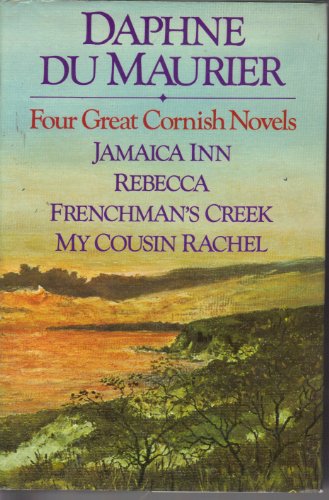


Rebecca by Daphne du Maurier

275 p. In Four Great Cornish Novels, Gollancz, 1984. First published in 1938.

How does the modern reader review an eighty-five year-old book with a large cultural imprint and a story perhaps familiar from TV or film adaptations? And one on which anyone reading the review may already have formed their own opinions? This is the problem with Rebecca, a book I have come to very late. Is there anything new to say about it?

Its first line “Last night I dreamt I went to Manderley again” is of course iconic and astute (or would be to a reader coming to it with no foreknowledge.) The narrator clearly has an attraction to the place but no longer a connection to it. Yet it sets up a mystery. Why is that so? What happened that Manderley is no longer in her life? Why would it be so significant to her? Hence, we read on. I would argue, though, that the rest of that chapter, where we receive the second Mrs de Winter’s memories of its grounds, is a touch too overwritten.

The second chapter begins, “We can never go back again, that much is certain,” once more a promise of revelations to come and perhaps with a more widespread application. Yet such going back, recollections of lives lived from older – maybe wiser – perspectives, is a staple of literature. And so we have the second Mrs de Winter’s account of the early days of her relationship with her now husband, Maxim. Though Maxim de Winter tells her – and us – she has “a lovely and unusual name” we never learn it, which is a bit of a tease and also something of a copout by the author. But it does serve to underline the central thrust of the book. Rebecca, despite its title, is not really her story at all, nor even that of the second Mrs de Winter (except in the fragments we are shown,) but rather of that first wife’s effects on the other characters and of the influence, in an entirely unparanormal way, dead people can exert on the living from beyond the grave.

The mousy, diffident girl Maxim de Winter meets in Monte Carlo due to her paid companionship of Mrs van Hopper (a well-judged portrayal of such a snobby woman and her entitled, selfish behaviour – the blustering Jack Favell, Rebecca’s cousin, who towards the end threatens the promised happy ending, which is itself undone by Manderley’s destruction, is another well-drawn individual) cannot quite believe Maxim’s interest in her – especially since Rebecca’s glamour and allure are all that she hears about. This is perhaps a little disingenuous of du Maurier. Would even the most self-effacing young woman really believe that a man as wealthy as Maxim would marry her solely out of sympathy? And so soon after the death of a woman to whom he was supposedly devoted? That there wasn’t something about her that he found congenial and desirable? That she cannot realise that her difference from Rebecca is the point is much easier to understand. His witholding from her of that information is a mark against him but then without it there would have been no plot. But that leaves our narrator continually holding herself to a standard to which she cannot live up, prey to the machinations of the contemptuous and manipulative housekeeper Mrs Danvers whose devotion to Rebecca survives her mistress’s death. Then again the second Mrs de Winter is largely naïve and too taken up with her own insecurities to see any deeper picture before it is thrust on her.

People have been struck by similarities between Rebecca and Jane Eyre. Both bear characteristics of the Gothic novel, both are the memoirs of a young woman who falls under the spell of an older man with a big house. Yet the comparison is not exact. In Rebecca there is no barrier to marriage, the first Mrs de Winter is dead, in Jane Eyre, Mrs Rochester, the mad woman in the attic, is not – at least until the fire kills her and leaves Mr Rochester blind. However, in Rebecca it is arguable that the mad woman is actually in plain sight in the form of Mrs Danvers. And Jane would not have stood by Mr Rochester if she thought he had got rid of his wife.

No doubt it is due to the book being published in the 1930s but there is a curious lack of passion to the relationship between Maxim and his second wife. Maxim drops into his old habits as soon as he returns to Manderley, leaving his new wife to fend for herself through her long days. There is even a reference to Maxim’s bed being unslept in, their twin beds, then, a clear signal the couple does not sleep together. Love and sex being absent, of the three big novelistic concerns that leaves only death for Rebecca to dwell on.


Pedant’s corner:- Some 1930s usages (to-day, to-night, suit-case.) Otherwise; “reading Bradshaws” (Bradshaw’s,) some commas missing before pieces of direct speech, “lunch I suppose” “the passage was in the past tense” (lunch I supposed,) “Mrs Danvers’ dislike” (Danvers’s,) “the hood” (of a car. That would be the bonnet, then,) the line “pockets. He was staring straight in front of him. He is thinking about Rebecca,” is repeated two lines later and the line it replaces never appears. “‘He was not in a fit to state to undertake anything of the sort” (that first ‘to’ is superfluous.) “It means we had to go” (Again the passage was in past tense; ‘It meant we had to go’,) “Doctor Phillips’ car” (Phillips’s.) “Tired women with crying babies in pram and stared into windows” (is missing something between ‘pram’ and ‘and.’ Or the ‘and’ is superfluous.)

free hit counter script