Poverty Castle by Robin Jenkins
Posted in Alan Warner, Reading Reviewed, Scottish Fiction, Scottish Literature at 12:00 on 6 July 2026
Polygon, 2007, 276 p, plus 7 p Introduction by Alan Warner.
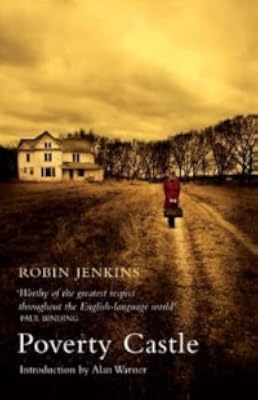
In an interpolated framing device we have here the story of an author trying to write a piece of fiction celebrating goodness, where the characters are happy because they deserve to be, surrounding that same story which he is writing to find out what becomes of them. The author’s wife tells him his desire is impossible since he has always been severe on his characters and she thinks he cannot change. Still less does she believe he can set such a story in Scotland because he thinks the Scots have lost faith in themselves. The novel he is writing is that story; or an attempt at it.
That novel features the Sempill family, already relatively comfortably off – the father was an architect – but at its beginning lately come into a large inheritance. The Mama and Papa Sempill have five children, Diana, Jeanie, Effie, Rowena, Rebecca; all named after Walter Scott heroines. All but Diana are blonde, she is dark-haired and at their story’s beginning old enough to fancy herself guardian of them all, parents included. They are on holiday in Argyll when they come across an abandoned house whose proper name is Ardmore but is known to the locals as Poverty Castle. As a family they resolve to buy it and bring it back to its former glory. This involves irritating the Camptons, inhabitants of the “big” house, on an enclave of whose land Poverty Castle sits, but with access rights. An encounter with the children of the house exemplifies all that can be good or bad about aristocratic attitudes. Their sons Edwin and Nigel (Nigel; enough said) are opposites in their demeanours.
Mr Sempill is an easy-going soul, but his wife is racked by desire for a son though perhaps too old and lacking in vigour for the risk involved. The crisis of the tale is when she becomes pregnant again despite her husband’s stringent efforts to avoid that.
There are several time jumps in the narrative, Diana goes off to University, where she takes digs in a humble establishment, rooming with working class Peggy Gilchrist. Both the blurb and the Introduction describe Peggy as the Sempills’ nemesis but there is really nothing in the text which justifies that. What we do get is the middle- and upper-class perspective of Peggy being a member of “a class lacking culture, education, and money”. Her mother resents her not conforming to what she sees as her station in life (a job in a supermarket) but her father is keen for her to do as well as she can. Then again, as described, Peggy’s brain is her only asset.
The Sempills are, by and large, good, and happy enough, but, in novels as in life, there will always be something to disrupt contentment.
Pedant’s corner:- In the Introduction; Jenkins’ (several times; Jenkins’s.) Otherwise: crème de menthes (crèmes de menthe?) “Mary Queen of Scots’ effeminate secretary” (x 2, Mary Queen of Scots’s.) “Mr Chambers’ tone” (Chambers’s,) “a plebian habit” (plebeian,) plus marks for “the Misses Sempill”, “none of the other girls were keen to have” (none … was keen to have,) “Keats’ room”, “Keats’ country”, “Keats’ poetry” (Keats’s,) Inverary (Inveraray,) “Roslin Chapel” (original spelling of Rosslyn Chapel,) “Burns’ Highland Mary” (Burns’s,) “Cortes’ burning of his boats” (Cortes’s,) “cooker irradiating warmth” (irradiating [to shine light upon] is the opposite of what was meant; radiating.) “The Monn could be seen though it was not yet shining” (if you can see it is shining,) “a racket” (racquet, the reference was to badminton.)
