NewCon Press, 2023, 269 p. Reviewed for ParSec 7.
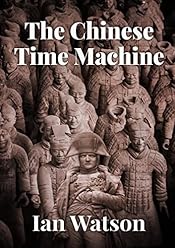 This is the latest collection of stories from Ian Watson, who has been active in the SF field for over fifty years. These were all first published within the last seven.
We start with four stories under the rubric The Chinese Time Machine. Each describes an expedition into the byways of times past. Our travellers, David Mason and Rajit Sharma, set out from a basement lab in Oxford in 2050 on behalf of the Time Institute in Beijing in a Chinese dominated world whose kaleidoscopic and shifting background is elaborated over the four tales. It is obvious that Watson has had huge fun devising and writing these episodes exploring the paradoxes and confusions of timelines in tales where tenses have to be twisted in order to convey the contingencies of “times gone by yet to be.” They are also replete with allusions and jokes. In them there are echoes of John Brunner’s The Society of Time and Connie Willis’s Oxford Time Travel stories. Not the least of their pleasures is that the characters remain blissfully unaware of how their activities change history. Watson’s delight in word-play and allusion also permeates the rest of the collection.
In the 1st Trip: Brave New World by Oscar Wilde, our brave time adventurers, complete with wrist computers and translators worn as necklaces, pluck that author from France in 1897 so that, instead of dying in 1910, he can write his work that will change literature, Brave New World.
The 2nd Trip: The Kidnap of Fibonnaci is made in an attempt to stop that mathematician’s influence inflicting capitalism on the world and makes much of the fact that little is known of Fibonnaci’s life.
3rd Trip: The Emperor’s New Wallpaper is the longest story in the book. Mason and Sharma are accompanied to St Helena by Colonel Maggie Mo, ostensibly to replace the wallpaper made with arsenic dye said to have contributed to Napoleon’s early death so that he will survive for a time. Maggie has ulterior motives and takes them all, Napoleon included, back to the construction of the Terracotta Army as she wishes to establish a world-wide Chinese hegemony well before its time. The tale is somewhat sprawling and even strays to a Lakota Sioux – and Cheyenne – inhabited Mars (which they call Barsoom) before its resolution. Watson’s jocular narration here finds room to comment on the alliteration heavy prose style of these stories.
4th Trip: Sherlock Holmes and the Butterfly Effect (written with Cristina Macía) sees Mason and Sharma travel back to abduct Sherlock Holmes (who claims Dr Watson was an invention by Conan Doyle) so that the United Kingdom of Europe – headquartered in Brussels of course and this future China’s great rival – will not come about. They fail but persuade Maggie Mo to travel back to become Holmes’s chronicler.
The premise of Hot Gates (a literal translation of Thermopylae) is that a process called melting, which erases landscape features – and consequentially kills the people living there – is happening to disputed border regions. Our narrator is a vulcanologist surveying Jerusalem hoping to observe its destruction, which of course occurs – and during which he constructs a hypothesis to explain the phenomenon.
Monkey Business riffs on the monkeys typing Shakespeare trope. Watson makes the most of this chance to include multiple allusions to the bard’s work. The city of Scribe is where thirty-seven robot monkeys (which are more like baboons) are carrying out their task. From the outset it is clear that this world is artificial, or at least not ours. Mixed in with all this is a tale of a pilgrim to the city and a swain she meets on the way, giving the title monkey business added resonance.
When the Aliens Stop to Bottle is an invasion story. Octopus-like aliens calling themselves the Oktagon have appeared on Earth and nullified all the nuclear weapons launched at them. Narrator Jen is on an overcrowded train trying to get home when an alien enters the carriage and asks for her Eye-dentity before displaying an interest in philosophers.
Heinrich Himmler in the Barcelona Hallucination Cell has Himmler on a visit to Spain demand to see the hallucination cell which, to prevent sleep, has a tilted bench and bricks jutting from the floor plus “degenerate art” on its walls when he starts to hear voices from the future in his head. But are they communicating with the real Himmler or one from a different reality?
Clickbeetle is a story regarding an unusual punishment using that tiny insect placed into the ear as an irritant. Its irregular clicks are akin to tinnitus and compared to Chinese water torture (a torment said here to be apocryphal.) The story manages to range widely across the history of such tortures and of Dr Mengele’s experiments.
Journey to the Anomaly explores the differences among the crew of a ship sent out from a star clump containing various sentient races to said anomaly, a solar system whose planets’ orbits are arranged too regularly, in other words our sun’s. Its twenty-one pages contain a plethora of SF ideas.
The Birth of Venus features the coming to awareness of a set of posthuman AIs and their subsequent adventures. It speculates on a universe where Beryllium 8 isn’t unstable and carbon atoms could have formed earlier than they did in ours.
On its own, each one of the above stories is amusing, informative and thought-provoking. Read immediately after each other, with only slight pauses to reflect (as is required for review,) and their cumulative effect can be a touch intense. Take your time, though, and you’ll be fine.
The following did not appear in the published review.
Pedant’s corner:- In the Acknowledgements, The Emperor’s New Clothes (In the Contents and as the story title this was The Emperor’s New Wallpaper. On the contents page “About the Author” is given as starting at page 371 (it’s actually 271.) Otherwise; obsolete (obsolete,) Padddyfields (Paddyfields,) chilis (chillis,) “an annex” (an annexe,) conjouring (conjuring,) times (multiply,) “4 .25” (no space after the 4; ‘4.25’,) “deuxième bureau” (shouldn’t this be capitalised, “Deuxième Bureau”?) schooma’am (schoolma’am,) Sharman (x 1, Sharma,) halfs (as in half-pints of beer. I would have thought it should it be halves,) Surtees’ (Surtees’s,) Porteous’ (Porteous’s,) “as opposed to surrendering to the Russians” (at Waterloo it was the Prussians who fought alongside Wellington. But this may be – is – an altered history,) “outside of” (x 2, no ‘of’, just outside.) “Clouds are whispy” (wispy.) “Gracefully Maggie yields les jumelles just a sentry kneels, sights, and fires a crossbow” (seems to be missing either a few words or punctuation.) “A few more arrows follow suite from crossbows” (follow suit,) “the peasant army charge” (charges,) “to be scraped of its hull” (off,) teepees (tepees,) mathematical (mathematical,) mantlepiece (mantelpiece,) Wells’ (Wells’s,) “inside of” (x 2, just inside, no ‘of’,) Holmes’ (Holmes’s – which did appear earlier,) bacterias (bacteria is already plural; one of them is a bacterium,) “isn’t nice even it’s passably pretty” (even it it’s,) “rains never falls” (fall,) ne’re (ne’er.) “type thorough the hours of night” (through,) accommodate (accommodate,) tressle (usually trestle,) glitch/es (usually glitch/es,) “a chamelion’s tongue” (chameleon’s,) Eye-denity” (Eye-dentity,) “barely 5 mills long” (mills is not an abbreviation for millimetres; that is ‘mm’. I have heard people say ‘mils’ as in ‘10 mils’ but the abbreviation is ml, pronounced ‘mil’ however many there are,) “doubles in numbers” (doubles in number,) “voice with chords” (they may communicate musically but ‘cords’ is more likely,) CO2 (x 3, CO2,) “should not be taken refer to” (taken to refer to,) “two a. m. -ish” (two a.m. -ish,) collapsment (should this perhaps be spelled collapsement?) connexions (x 2. But elsewhere – correctly – connection,) “the imagery of … suggest” (the imagery …. suggests,) “none of these are” (none of these is,) dispensably” (dispensibly.) Syncronisation (Synchronisation.)
 This is set in the alternative future familiar from the author’s sequence of four previous books – each with Europe in its title – where, after the devastation of the Xian flu, the continent’s political structures have fractured into a patchwork of states and statelets. Main viewpoint character Carey Tews has been invited back from retirement by Les Coureurs des Bois, that secretive organisation which conveys packages (and sometimes people) across the multitude of borders now garlanding the continent, to look into the death, near Gliwice in Poland, of her fellow Coureur – and former lover – Maksim Petrauskas. Despite misgivings she agrees, but swiftly realises there are odd inconsistencies at the scene and among the supposed circumstances: patchy police notes, improbable timings, its sheer unlikelihood.