Archives » Paraguay

The War of the End of the World by Maria Vargas Llosa

faber and faber, 2012, 758 p. Translated from the Spanish La guerra del fin del mundo with no translator’s name given, merely a translation copyright notice for the book’s first US publisher. Returned to a threatened library.
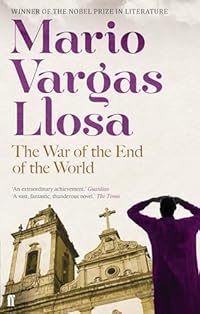
 The War of the End of the World cover

An itinerant mystic, Antonio Conselheiro, called the Counsellor, wanders the Brazilian province of Bahia gathering adherents. He preaches against the recently formed Republic of Brazil as the Antichrist, stuffed with Freemasons. In Llosa’s account he has the ability to transform an assortment of unfortunates, misfits, and the misshapen – not to mention the worst of bandits – into followers of the Blessed Jesus (whose every mention among the Counsellor’s adherents is replied to with “Blessed be he”.) Eventually he sets up a community in the town of Canudos against which a succession of ever larger military expeditions is sent by the Republic as the “rebellion” defeats each in turn. All this is based on a historical event, the War of Canudos, the most bloody civil war in Brazil’s history.

The early part of the novel is taken up with sections relating to how some of the Counsellor’s most important followers come to fall under his spell interspersed with the machinations of local politicians in Bahia – both for and against the Republic. Here we also meet a socialist (and red-haired) Scotsman on the run from authorities in Europe – where he had indulged in seditious activities – who goes by the name of Galileo Gall (but whose real name is never given) and has a belief in phrenology. Gall is framed by the editor of the Jornal de Notícias, Epaminondas Gonçalves, to make it look as though Britain, referred to by most characters as England, is involved in gun-running to, and support of, the rebels of Canudos. (“Gall” does put Gonçalves right, though, when he says, “I’m a Scotsman. I hate the English.”) A near-sighted journalist – again nameless – goes along with the third military force to be sent against the rebels and witnesses most of the later fighting; at least until his spectacles get broken.

Entrants to Canudos were made to swear that they were not Republicans, did not accept the expulsion of the Emperor, nor the separation of Church and State, nor civil marriage, nor the new system of weight and measures, nor the census questions. (The devil is obviously in the way you count the spoons.) Mostly though, the Counsellor was playing on the faith of the poor and their fears that slavery would be reintroduced.

Gall thinks of Canudos as, “A libertarian citadel, without money, without masters, without politics, without priests, without bankers, without landowners, a world built with the faith and the blood of the poorest of the poor,” (though part of that is his own idealism projected onto it) and wonders about the – to him – curious code of “Honour, vengeance, that rigorous religion, those punctilious codes of conduct….. a vow, a man’s word, those luxuries and games of rich, or idlers and parasites – how to understand their existence here?” that so prevailed on the husband of a woman he raped that he pursued Gall there.

About a third of the way through the book we find the nameless journalist has survived the war as he talks to the Baron de Canabrava about his experiences. This has the effect of defusing some of the tension as we readers are still to meet them for ourselves.

In Canudos the near-sighted journalist thought to himself, ‘culture, knowledge were lies, dead weight, blindfolds. All that reading – and it had been of no use whatsoever in helping him to escape.’ The baron is disgusted by the journalist finding amid the chaos of Canudos love and pleasure with a peasant girl. “Did those words not call to mind luxury, refinement, sensibility, elegance, the rites and the ripe wisdom of an imagination nourished by wide reading, travels, education?”

Army doctor Teotônio Leal Cavalcanti’s image of humanity abruptly darkened in his weeks seeing to the wounded during the siege, observing of the able-bodied, “‘It is not what is most sublime, but what is most sordid and abject, the hunger for filthy lucre, greed, that is aroused in the presence of death.’”

The novel feels like it has a cast of thousands. There are multiple viewpoint characters and a narrative which shifts from present to past tense and back in section to section. This makes for a dry and slow start as the life stories of the Counsellor’s adherents prior to their falling in with him and those of the politicians of Bahia are told to us rather than shown. But, as the near-sighted journalist tells Baron de Canabrava, “‘Canudos isn’t a story; it’s a tree of stories.’” In telling his tale, Llosa tries to encompass this world of many branches. Some characters return again and again, others only appear in the scene in which we are given their viewpoint. 758 pages are a lot to fill after all. At times it becomes almost too much; but to recount a tree of stories does require length, a length which adds to the impression that this is a very male book. After all, war and revolution attract a certain kind of attention and are accorded an importance that other aspects of human endeavour are not.

Nearly all human life is in The War of the End of the World. Nearly all.

Aside:- In the scenes dealing with military men there are several references to Brazil’s war with Paraguay, which took place in the days of the Brazilian Empire. In Colin Wilson’s history of the goalkeeper, The Outsider, he stated that Brazil had never fought a war. That would be the Brazilian Republic rather than “Brazil” then.

Pedant’s corner:- The translation is into USian but curiously we had “fitted” once and “trousers” twice. Otherwise there were Jesus’ (Jesus’s,) “the Scotsman thought to himself: ‘The Republic has as little strength in Bahia as the King of England beyond the Aberfoyle Pass in the days of Rob Roy Macgregor.’” (The King of England? At that time the King was King of Scotland too. And it’s MacGregor.) “A host of questions were running riot in his head” (a host was,) laughingstock (laughing stock,) rear guard (the military terminology is usually rearguard,) ipso facto is used in the sense of “immediately” (it actually means “as a result of that fact”,) “a group of servants were” (a group was,) dumfounded (I prefer dumbfounded.) “They finally learn a little about what was gone on” (has gone on,) “he’s just dying little little, second by second” (little by little,) sunk (sank,) in a cross fire (crossfire,) chasseurs were mowed down (mowed down appeared at least twice; is this USian? In English it’s mown down.) Quite a few instances of “time interval” later.
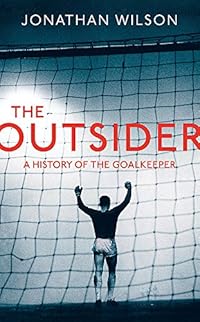
The Outsider: A History of the Goalkeeper by Jonathan Wilson

Orion, 2012, 351 p

If football is symbolic, if the ball is a substitute sun requiring to be buried (in the goal) to ensure fertility, what then are we to make of the one player in the team whose primary object is to prevent that desirable consummation? Such is the question with which Wilson starts his history of the goalkeeper, who in this context can be seen as the outsider, an anti-footballer.

While not denying the goalkeeper’s essential difference I immediately started thinking, what about the stopper centre half, the holding midfielder, the midfield destroyer? Aren’t their roles equally anti-football in that sense? Of course these players may advance into the opponents’ half, even score the odd goal or two, but the goalkeeper generally isn’t expected/permitted even to do that. Except what, then, to make of the Paraguayan great, Jose Luis Chilavert, who took penalties and free-kicks and scored 62 goals, 8 of them for Paraguay and all while playing as a goalkeeper? (Brazil’s Rogério Ceni has since overtaken Chilavert as the highest scoring keeper.) The South American attitude to goalkeepers has tended to be less restrictive, though. In Europe keepers generally only charge upfield in desperate circumstances.

In any case Wilson’s title partly goes against the thrust of the history. When football was first codified it started with all players able to handle the ball in certain circumstances. That dispensation quickly became restricted to the designated one, who was detached from the team – and made to stand out by virtue of wearing a different coloured jersey/shirt. A gradual process of goalkeepers playing beyond the penalty area – the change of rules in 1912 which forbade handling outside the box (up till then they had been allowed to anywhere in their own half) delayed this process – by intervening with their feet or initiating attacks has reduced this difference. Arguably the keeper’s reintegration into the team was finally more or less institutionalised by the back pass rule. (Even before that, though, the custodian was not totally estranged, was a vital component of retaining possession. I remember reading elsewhere that Liverpool’s long domination of the European Cup was predicated on passing the ball back to Bruce Grobbelaar as much as possible during away legs. The sweeper-keeper had evolved even prior to this, though.) In Jose Luis Chilavert’s case the reintegration of keeper with team was surely at its most complete.

Wilson mentions that the first ‘Prince of Goalkeepers’ was Dumbarton’s James McAulay. Another Sons keeper to be mentioned in the text is Joshua Wilkinson, whose father was convinced his death from peritonitis in 1921 was due to a blow he’d received in a game against Rangers the previous Saturday.

In the very early days it had been almost open season on goalkeepers. The famous William ‘Fatty’ Foulke – reputedly 28st (179 kilograms) when he played for Chelsea – often took his revenge on physical forwards, turning them upside down and depositing them on their heads. Despite the obvious dangers – Celtic’s John Thomson (to whom a section of Kirkcaldy’s newly refurbished museum is dedicated – he came from nearby Cardenden – there was also a tribute to him there before the modernisation) received an accidental but fatal knee to the head in 1931 also against Rangers; Sunderland’s Jim Thorpe died in 1936 after several blows in a physical game in 1936 prompted a reccurence of a diabetic condition – it was not until after Bert Trautman’s broken neck and several other injuries to keepers in FA Cup finals in the 1950s, though, that British goalkeepers began to receive extended protection from referees.

Goalkeeping is not, in the end, a simple business. He/she is not necessarily only a shot stopper; there is a difference between the reactive keeper and the proactive. The former expects to make saves (spectacular or mundane) the latter’s best game is the one in which she/he has no saves to make at all, because the way he/she has organised the defence ensures, in an ideal world, that no danger occurs.

There are even national differences in approach. Both Brazilian and Italian defences tend to play deeply and so breed reactive keepers. In other countries a higher line is adopted, a goalkeeper’s play has to be more attuned to that. In Russia, Soviet Russia in particular, goalkeepers have been the subject of a reverence that borders on love.

Africa is represented here by the Cameroonians Tommy Nkono (who inspired Gianluigi Buffon) and Joseph-Antoine Bell, the Spanish, German, Italian, English, Brazilian, Scottish and US traditions are covered in detail. From Asia only Ali Al-Habsi gets a mention and that in passing. Oceanian custodians escape Wilson’s purview completely. Maybe no notable keepers have as yet been bred there.

So many great goalkeepers seem to have had unfortunate debuts, on the end of drubbings of various sorts. What distinguishes them all is that they are liable to be remembered, their careers defined, not for their great performances but for one, or – in the case of David Seaman – two mistakes. (My abiding memory of Ray Clemence is of him allowing a soft one from Kenny Dalglish to evade him in a Scotland-England game at Hampden. Proof if any were needed that there is no national tendency to persistently outstanding goalkeeping.) Poor Moacyr Barbosa of Brazil was forever blighted by conceding the winning goal in the 1950 World Cup final. In 1970 a woman in a shop said to her young son, “Look! There’s the man who made all Brazil cry.” Barbosa himself later complained that in Brazil, “the maximum sentence is 30 years. My imprisonment has been for 50.” That loss to Uruguay was perhaps, though, the single most traumatic moment in Brazil’s history as a nation. It was only founded in 1889 and has never fought a war.* Brazilians apparently are not really football fans. It is winning they like.

Wilson makes the point that the existence of a highly proficient one or two goalkeepers from one country at one time is not evidence of strength in depth, nor any guarantee of continued excellence. The apparent decline of English goalkeeping is a case in point.

The author certainly knows his football history – there is even a digression into the treatments of the sport in literature and film, most of which lean heavily on the goalkeeper; a further nice touch is that the book’s back cover is decorated with a “1” – and he thinks deeply about the game. Having read the book I’ll observe goalkeeping in a different light.

One final note. Even if a book is about football it might be thought a touch insensitive to describe the Spanish Civil War as “perhaps the clásico to end them all” – even more insensitive when Wilson observes that Real Madrid didn’t become Franco’s team till the 1940s.

*Edited to add. I have since found out that this is only true of the Brazilian Republic and not of the Empire which preceded it.

Paraguay 0-1 Spain

Ellis Park Stadium, Johannesburg, 3/7/10.

World Cup history was going to be made whoever won this match. In the end it was Spain who got to their first ever semi-final.

For all they played quite well tonight (and might have won but for the penalty save) I couldn’t keep from reminding myself that Paraguay had got this far by virtue of only one victory in the whole tournament – against Slovakia. Spain now have four; but have looked far from convincing. Once again, and like Argentina earlier in the day, their players continually took wrong options, held on to the ball when they should have passed and generally kept running into defensive walls.

The first half was dire, the second (pacé the assertions of Hansen and Dixon) not much better – though we had the mad three minutes with three penalty attempts and a third award denied.

Four South American sides in the quarters but only one survives to the semis; and that the team that came fifth in the Conmebol qualifiers, and had to beat Costa Rica in a play off, to wit Uruguay.

Puyol again looked vulnerable, as did Piqué. Germany could mince them.

Italy 1-1 Paraguay

Green Point Stadium, Cape Town, 14/6/10

Contrary to the TV panellists I thought Paraguay were worth their lead at half time as a couple of times their front two looked on the verge of opening up a ponderous looking Italian central defence.

Yet had Italy gone about the game in the first half as they did in the second they would surely have won it. Why do they only start playing when they are a goal down?

Both goals showed up the truth of the assertion that a team scores only when their opponents make a mistake.

Poor Italian marking at a corner is a phrase I never thought I’d type.

And another goalkeeping howler. Again not due to the ball.

If the ball is having an effect it’s that players are over-hitting it – especially on long passes or crosses.

There hasn’t been a classic so far; but first games in a group rarely produce one.

free hit counter script