Posted in Art, Empire Exhibition, Scotland, 1938, Exhibitions at 20:21 on 23 October 2017
A couple of weeks age we revisited the True to Life Exhibition at Modern Two, (Scottish National Gallery Of Modern Art,) Edinburgh.
I’ve left this a bit late as the exhibition is only on for a few more days now. Its full title is True to Life, British Realist Painting in the 1920s and 1930s.
I found this to be much more enjoyable than the Beyond Caravaggio exhibition recently finished at the Scottish National Gallery (see also here.)
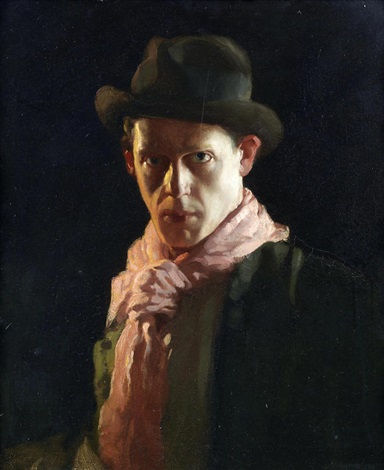
The first picture in True to Life, though, David Jagger’s “Conscientious Objector”, would not have looked out of place at that Beyond Caravaggio exhibition. It exploits light in much the same way as those did. This is apparently a self-portrait:-
“By the Hills” by Gerald Leslie Brockhurst features on the True to Life Exhibition catalogue cover though for me it’s a bit too sharply delineated. The artist was said to have used lipstick to paint the lips here:-

Another such too sharp picture was Meredith Frampton’s “A Game of Patience”:-

As with the David Jagger painting above Edward Baird’s “Dan Cross” also looks as if it could leap off the canvas. I feel as if I know this person:-

Keith Henderson’s The Harbour Crowd is another fine example of the capture of light. As I recall this painting was one of the exhibits in the Palace of Arts at the Empire Exhibition, Scotland, 1938. There was a black and white reproduction in the relevant souvenir booklet.

Some of the paintings in “True to Life” stretched the definition of realist somewhat.
Though it does contain figures (including the artist) “The Deluge” by Winifred Knights seemed to me to be at least influenced by Vorticism:-

Nora Russell by John Downton captures the impatient aspect of the early adolescent schoolgirl very well. I get the impression she didn’t really want to be painted:-

No Comments »
Posted in Art Deco, BBC, Empire Exhibition, Scotland, 1938, Exhibitions at 12:00 on 13 January 2014
Another Brian Gerald drawn art postcard from the Empire Exhibition, Scotland, 1938. This time of the Scottish Avenue. It shows both Scottish Pavilions (the ones with the towers) and the BBC Pavilion in the foreground. At the other end of the avenue is the Palace of Arts, the only building from the Exhibition still standing in Bellahouston Park.

No Comments »
Posted in Architecture, Art Deco, Empire Exhibition, Scotland, 1938, Exhibitions, Glasgow at 09:01 on 3 May 2013
The zenith of Art Deco (or of Moderne if you must) in Scotland came in 1938 with the Empire Exhibition, Scotland, held in Bellahouston Park, Glasgow, and which opened 75 years ago today on 3/5/1938.

Its signature building was the Tower of Empire (seen in the above photograph taken from the link) designed by Thomas Tait whose houses at Silver End I featured eighteen months ago. The tower was erected on the hill in Bellahouston Park and dominated the Exhibition.
Tait was in overall charge of the architecture for the Exhibition – some of whose buildings made extensive use of the new construction material, asbestos cement! – and designed many of the buildings himself.
My favourite is the Atlantic Restaurant, a ship-shaped building cresting the wave of the hill on which it was set, two postcards of which I reproduce below.


Sadly almost none of the buildings remain. (It was a condition of such events that their locations were restored to their original condition soon afterwards. Moreover shortly afterwards the country was involved in the Second World War and conserving architecture became a minor consideration. The Exhibition itself came to an end in the midst of the Munich Crisis.)
Only the Palace of Arts is still standing in Bellahouston Park itself. It was transformed into a sports pavilion. The Palace of Engineering was taken down and re-erected at Prestwick Airport and can still be found there. The South Africa building was in Dutch Barn style rather than deco or moderne and later became a staff canteen at ICI Ardeer. All the rest were demolished.
Think of what a tourist attraction Tait’s Tower, as it was known, could have been! Glasgow’s answer to Eiffel.
As it is, the main tourist draw in the Park today is the House for an Art Lover built to designs of Charles Rennie Mackintosh whose buildings are a sort of bridge between the freer, flowing style of Art Nouveau and the more rigid Art Deco.
You may have noticed that I have added a new category to my list especially for this Exhibition. There is so much more I could, and will, post.
No Comments »
