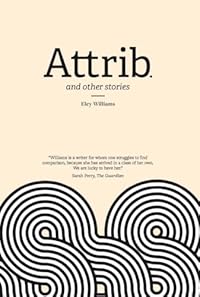
Attrib. and other stories by Eley Williams
Posted in Other fiction, Reading Reviewed at 12:00 on 19 July 2022
Influx Press, 2017, 171 p.
The first impression on reading this collection of short stories is that Williams has an abiding interest in words – see two of the story titles, not to mention aphaeresis* and apocope. That is all to the good, authors ought to have such an interest. So here we find Williams using stark and spectrum as verbs, giving us an unusual meaning for the word ‘boggling’ to do with the movements of rat’s eyes and also the pleasing coinage Timbucktootle. However she doesn’t appear to know that ‘staunch’ is not the spelling used to indicate suppression of blood flow.
*Aphæresis?
The stories themselves are short, none is more than fourteen pages long and the typeface is quite large, but all say what they need to.
The Alphabet (or Love Letters or Writing Love Letters, Before I Forget How To Use Them or These Miserable Loops Look So Much Better On Paper Than in Practice) is narrated by someone who has lost the plot – and her glasses – describing the disintegration of her world after a diagnosis of aphasia. It has a list of the letters of the alphabet and the shapes they each describe.
Swatch features a boy worried about the multi-coloured flecks in his eyes – even after his father has shown him the definition of the Scottish word glaiks (flashes) on his phone screen.
In Attrib. a Foley artist commissioned to provide the sound effects for the audio of an exhibition of huge reproductions of Michael Angelo’s works is annoyed by the sounds she has been asked to add to the description of The Creation of Eve.
Smote (or When I Find I Cannot Kiss You In Front Of A Print By Bridget Riley) is a stream of consciousness of someone in a gallery standing before that artist’s Movement in Squares – “a painting the surface of which itches with vertigo” – being too self-conscious to kiss their companion. The story is shot through with black-and-white images.
Bs are the thoughts of a half-awake woman in her partner’s bed as she is disturbed by the noises of a bird outside and a bee trapped the night before in a used Nutella jar.
Alight at the Next has non-standard typography. It presents the thoughts of someone about to get off a tube train beside their lover, who is standing very close, but a man obstructs them by trying to get on. Our narrator places a finger on the man’s forehead to stop him.
Concision invokes words from Finnish, Bantu and Rapa Nui to describe the feelings of the recipient of a telephone call staring at the dots on the receiver while being unable to respond to the caller, whom we assume is a lover or spouse.
In And Back Again the answer to an easy question about love brings to the responder’s mind a lyric from the musical Oliver! and conjures the fantasy of a trip to Timbuktu to prove the extent of devotion.
Fears and Confessions of an Ortolan Chef is exactly what its title says, an enumeration of the thoughts of a chef who – highly illegally – “drowns ortolan in Armagnac” before cooking them to be eaten by diners who cover their heads in blankets while doing so.
Synaesthete, Would Like to Meet is narrated by someone who had the Yellow Pages dropped on her head aged 8 and ever since suffered from synæsthesia. Until, that is, a reply on a dating service and the subsequent date provides relief. Her therapist is not so happy about that.
Bulk sees a group of people with varied purposes converge on the carcase of a whale washed up on a beach early one morning.
In Platform, someone recalls the moment their friend left them forever via a poster made from a blown-up photograph taken at the time. The photograph reveals details of the scene unnoticed at the time.
Rosette Manufacture: A Catalogue and Spotter’s Guide is exactly what its title says. An employee of a rosette manufacture describing its wares.
Scutiform follows the thoughts of a museum attendant on their habitual route taken on their daily break past three particular statues.
Mischief features the consciousness of someone in charge of rats which have been trained to detect landmines.
Spines describes a small incident involving a hedgehog in a swimming pool on a family holiday to the south of France.
Spins opens with Johnson’s Dictionary definition of the word ‘spider’ complete with the letter ‘s’ rendered in that old style I can only reproduce as f. The fpider concerned is noticed by someone lying on a bed for hours trying to think of what could have been after a lover had slammed the door on their way out following an argument.
Pedant’s corner:- “millions of potentials colours” (potential colours,) Blu-Tack (x 2, Blu-Tak,) “the chew of a maw” (maws do not chew; they are stomachs,) “the Tube doors, doors shut” (the repetition is not needed but may be an attempt at ) “lickerish plastic” (lickerish means dainty, tempting or lecherous. Williams has her spellings confused; she had previously described the plastic as having the colour of liquorice,) “the hotel might provided” (might provide,) Areopagitca (Areopagitica,) “pulled the door close behind me” (closed?) “the woman with the urn ask the group” (asked.) Synaesthete (I’d prefer Synæsthete,) “you are not here any more to remind me that the plural should be croci” (the character has this wrong, the plural of crocus in English is indeed crocuses. In any case, crocus is derived from Greek [krokos] not Latin: the Greek plural would be krokodes.) “‘The bakers was shut’” (baker’s,) staunch (stanch,) “is an ‘an insect’” (has ‘an’ once too many.) In the acknowledgements; skillfully (skilfully.)