Posted in Events dear boy. Events, Fantasy, Science Fiction at 12:00 on 14 April 2014
Due to my house move I missed commemorating at the times the demise of both Margo MacDonald, former SNP MP and independent MSP, and writer Lucius Shepard.
It says a lot for the esteem in which MacDonald was held by the wider public that she was able to gain a seat in the Scottish Parliament on the list system as an independent.
In recent years her campaign for the right to assisted dying (she was suffering from Parkinson’s disease) was carried out with a dignity which ensured that her views and comments commanded respect.
Luius Shepard’s fiction is elusive to pigeonhole, morphing from Science Fiction to fantasy and bordering on magic realism. He was always readable, though, and intelligent.
Margo MacDonald, 19/4/1943 – 4/4/2014, Lucius Shepard, 21/8/1943 – 18/3/2014. So it goes.
No Comments »
Posted in Eric Brown, Fantasy, Horror, Other fiction, Reading Reviewed, Science Fiction at 13:00 on 23 May 2011
Postscripts 22/23, PS Publishing, 2010. 394 p

The book – one of the most recent in the Postscripts series of anthologies – contains short stories encompassing a range of genres from SF, Fantasy and Horror through to mainstream but mostly in the speculative realm. There are too many stories to consider individually but the standard is high. Even if not all are entirely successful the book contains very few duds. One of the most effective tales is the title story, by Lucius Shepard, about a plot by a famous movie star to enravel his associates in the – perhaps simulated – murder of his girlfriend. Eric Brown’s The Human Element works well even if it re-visits one of his early themes, the relationship between an artist and his work. All the contributions are worth reading though I found Bully by Jack Ketchum too predictable. The Forever Forest by Rhys Hughes was curiously old fashioned, as if the author was trying too hard to convey otherness; it reads as if it might have been written in the 1950s. There’s also a story, Osmotic Pressure, by someone called Jack Deighton, which contains a fair bit of (arguably necessary?) information dumping.
No Comments »
Posted in Fantasy, Other fiction, Reading Reviewed, Science Fiction at 14:00 on 12 May 2011
Millenium, 1998. 292p.
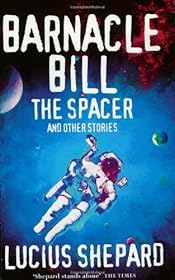 The book contains two novellas and five shorter stories taking in SF, fantasy, thriller and mainstream. The title novella has quite the most unsympathetic narrator I think I’ve ever read. He is supposed to be British and Shepard gets the idioms correct but we use “at night” rather than “nights” and (mostly) don’t call the game “soccer.” Full marks for the effort though. It’s a strange tale set on a space station beyond the orbit of Mars, where the usual human venalities and appetites abound.
A Little Night Music‘s SF gloss features reanimated musicians but is really about a failed marriage.
Human History is set in a post-apocalyptic world where strange creatures known as Captains exert control over the remnants of humanity. Things do not turn out well.
Sports In America is a straightforward tale about a gangland hit that doesn’t quite come off. The characters rattle on unnecessarily about baseball and American Football.
The Sun Spider is a fantasy/SF cross where a theoretical physicist has discovered life in the Sun.
All The Perfumes Of Araby, a story published in 1992 but set in 1992 and which has been somewhat overtaken by events in the real world – the Middle East has not evolved in quite the way depicted, there are as yet no inoculations against AIDS – has a female Desert Storm veteran wishing to recapture some of that experience by taking up with a smuggler based in Cairo. The smuggling goes wrong.
Beast Of The Heartland is about a declining boxer who has a chance of one last big payday. Shepard manages to find a new angle on this hoary old scenario.
Apart from the two non-speculative ones the stories as a whole show a tendency to start in the real, solid world and part way through shift into a more fantastic milieu. Their narrators are also keen to tell rather than show and to philosophise. Betrayals are common. The collection as a whole is really just what you’d want in fiction.
No Comments »
