Archives » Keith Brooke

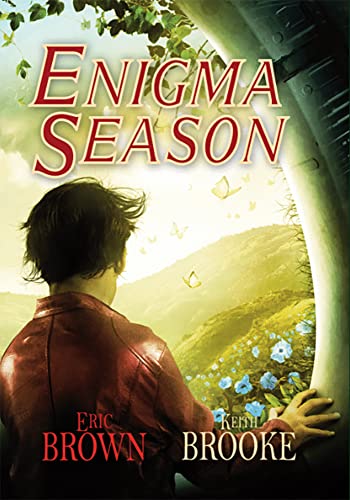
Enigma Season by Keith Brooke and Eric Brown

P&S Publishing, 2022, 92 p.

Humans live in domes and the underground Levels because they are frightened of the outside; of “The rain that burns, the light that blinds, the air that kills, the water that poisons,” as the hymn to Father Bahan sung by Followers of the Eternal Truth has it.

Life in the Domes is restricted, there is a curfew every night, patrolled by Enforcers. Adults have to register with the authorities every year. Employment is within Guilds and runs through families. (Our protagonist Pinto’s father, a sculptor and painter of heads, is unusual in that regard.) Society is stratified. Aliens known as Enigmats seem to be the power behind the human authorities, though. They are said to have saved humans from the savage environment outside, though the Followers of the Eternal Truth attribute that salvation to Father Bahan.

Pinto is one of a group of young friends, which includes Mags, a girl from the Levels and therefore not of his class, who are curious about their surroundings and like to explore the spaces where no-one else usually ventures. One day she sets Pinto to thinking about outside and he decides to find out what it is like.

The story from then on proceeds as it must though there are complications involving Pinto’s parents’ arrangement for him to marry his cousin and her father’s apparently revolutionary activities putting in danger – or at least at risk of arrest – anyone connected to him.

Enigma Season is well written and engaging, exactly what you expect of Brooke and Brown together and individually.

“‘Time interval’” later count – 7.

Pedant’s corner:- “so that you drowned on your own blood” (in your own blood.) “He knew that marriage only with someone of one’s own class or Guild was allowed in the Domes” (He knew that in the Domes marriage was allowed only with someone of own’s own class or Guild.) We are twice told that on reaching adulthood (21) citizens had to register with the authorities and repeat this registration every year, (once would have been enough,) “Sorenson” (x 2, always spelled Sorensen elsewhere.)
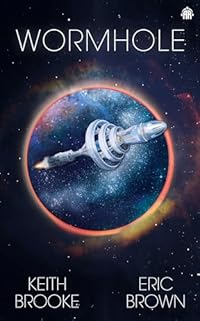
Wormhole by Keith Brooke and Eric Brown

Angry Robot, 2022, 381 p.

Brooke and Brown have usually collaborated only on shorter pieces but this novel shows their partnership also works at longer length. It is an unusual amalgamation of the detective story and the SF trope of first contact in that the police officer, Gordon Kemp, (passed over and relegated to cold case files) travels to another planet, Mu Arae II, to help solve a case.

It is the late 2100s. Eight decades ago the Strasbourg set off to travel to Mu Arae using suspended animation technology to keep its crew alive till it got there. Widely thought to have been destroyed by an explosion shortly after the voyage began, Kemp discovers that the ship is still on course and due for imminent landfall when he is called in to investigate the death of suspended animation technology entrepreneur Sebastian White just before the Strasbourg’s launch. “‘That’s not a cold case. That’s an archaeological dig.’” White’s wife, Rima Cagnac, was suspected but had an alibi. As a prominent scientist she was on the Strasbourg’s crew. Now the quantum lattice, wormhole technology carried on board, will allow instant travel to Mu Arae and Kemp is designated for the job of bringing Cagnac back to Earth. (One of the things the reader has to take on trust here is that its developers would have been able to keep the wormhole technology’s existence secret for 80 years.) Before Kemp goes, his superiors require him to have an update to his imp – an implant that allows access to the net but may also give his bosses control over him. He has a tame tech whizz called Martin give it the once-over. Martin finds anomalies and supplies Kemp with a device to override it. Chekhov’s gun comes to mind.

The narrative viewpoints switch between Kemp, his associate, Danni Bellini, looking into the case’s background on Earth, and Cagnac, as the Strasbourg arrives in the Mu Arae system and the expedition begins to explore Carrasco, Mu Arae II. Tension builds up with the revelation that the Strasbourg contains six extra sleep pods for the wormhole technicians, the necessity for maintaining bio-hazard protocols, the eventual emergence of cloud fever and deaths due to exposure to pathogens in Carrasco’s atmosphere, the appearance through the wormhole of a goon squad under the control of a Major Gellner and hints of first contact. Connections are established between the murderer and the ruthless conduct of those who want to exploit Carrasco at any cost.

In this sort of scenario there is the danger of the author(s) falling between two stools. Brooke and Brown have managed to avoid that particular hazard. There is enough here to satisfy both the SF reader and the crime aficionado. And it is very neatly done. It helps that human nature does not change over time.

“Time interval” or equivalent count; at least forty.
Pedant’s corner:- fit (x 2, fitted,) heaviside layer (usually capitalised; Heaviside,) “‘when I lasted dated’” (when I last dated,) the Gambie (the Gambia.) “‘Great-nephew, or even something more removed’” (is framed as a question, so needs a question mark at the end,) “for all intents and purposes” (usually it’s ‘to all intents and purposes’,) “had not yet knit together” (knitted,) “you could have just laid low” (OK, it was in dialogue; but strictly it’s ‘lain low’.) “She peered at her softscreen unrolled” (as her softscreen,) “an image sprung up” (sprang up.) “‘I don’t now.’” (I don’t know,) “to look in through library window” (through the library window.)

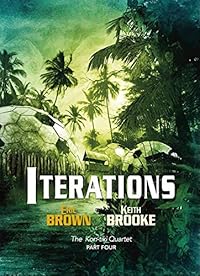
Iterations by Keith Brooke and Eric Brown

The Kon-Tiki Quartet, Part 4. PS Publishing, 2021, 114 p.

The last thing Kat Manning and Travis Denholme can remember is being in an operating theatre on the colony planet of Newhaven where their minds were to be scanned for the secrets they held. Now they have been woken up in new bodies and find themselves back in Earth orbit a century later – and, due to the neurotransmitter they had discovered, with the ability to read minds. They have been sent to Earth to forestall the plans of their old enemy Ward Richards to form society in his own image and also to bring the benefits of the neurotransmitter to the remaining inhabitants of Earth. This brings them back to their old base Lakenheath in East Anglia where the Kon-Tiki project was brought to fruition.

Conditions back on Earth have regressed. Kat and Travis fall into the hands of a group known as Mayflies who are in thrall to an overclass of Longlords. In some respects these correspond to the Eloi and Morlocks of Wells’s The Time Machine. Old antagonist Daniel DeVries helps them into the Longlord compound where they discover that the Longlords in effect prey on the Mayflies in order to extend their own lives. But the technology is imperfect and faults have crept in. A now very decrepit original of Ward Richards is at the head of the Longlords but unknown to him, Paulo Martinez, the version of him printed on Newhaven and whose followers ensured he got back to Earth is fully intent on ruling the roost. Kat, Travis and DeVries conspire to thwart his plans.

Both Brooke and Brown are never less than readable. The Quartet of which this is the final part is more of an action adventure than a cerebral endeavour. It has the usual betrayals, setbacks and triumphs but above all it makes a case for humans being ultimately cooperative creatures and that the ability to read minds will only encourage that in us.

Pedant’s corner:- “Time interval later” count: less than ten.
Otherwise; “She wondered how Travis … Mediterranean lineage?” (Isn’t a question so doesn’t need a question mark,) “comprised of “ (just comprised here; no ‘of’,) “DeVries’s arms” (Travis’s arms makes more sense,) resister (register,) not a typo but as to “like Cortés conquering the Aztecs with Christianity and syphilis” (I don’t think syphilis was involved, and the Christianity was more like an afterthought. [It was actually more that Cortés seemed to fulfil an ancient Aztec prophecy which led to his success.])

Insights by Eric Brown and Keith Brooke

The Kon-Tiki Quartet Part 3. PS Publishing, 2019, 102 p.

Several years on from Parasites, the second in Brown and Brooke’s Kon-Tiki quartet, Kat Manning and Travis Denholme have not revealed the secret of how Daniel DeVries died, nor of Travis’s discovery of the neurotransmitter the geosaurs on the planet of Newhaven produce from their symbiosis with their marmoset companions. This can allow telepathy at short range and for a short period and was instrumental in the circumstances of DeVries’s death. Ever since then, Kat and Travis have been working clandestinely together, he to synthesise the transmitter, she to work out the effects such a drug may have on the attitudes and behaviour of the human population.

Kat arranges a meeting where they can thrash out their problems but it is forestalled when Travis is shot by a stranger. Before the hit can be finished off a man called Meyers saves Travis by wrestling with his attacker, who is seriously injured. Something about the two is odd, there is a new, fresh quality to their skin and a recognisable aspect to their behaviours.

This incident plunges the pair into a plot involving the printing technology which allowed the present colonists to be produced on Newhaven and the question of whether or not the deep-frozen passengers on the Kon-Tiki ought to be resurrected, mixed in with a political dilemma about the direction the colony ought to take – and one reprinted man’s megalomania.

It’s unfortunate that the constraints of the series – plot has to be incorporated into each instalment – do not quite allow a fuller exploration of the implications for the characters of the printing technology. Though it is touched on, how it would feel to have memories of a marriage that the other person involved does not, the dynamics of that skewed relationship are somewhat lost.

Both Brown and Brooke, individually and collectively, are never less than readable though.

‘Time interval later’ count: 9.

Pedant’s corner:- well done for using that excellent Scottish word havering.
Otherwise; whiskey (whisky, please,) “Or ‘We need to’” (Or, ‘We need to’,) “Or ‘Can you imagine’” (Or, ‘Can you imagine’,) “if Travis and I lay low for a while” (is this the conditional? In which case I think it’s okay. Or should it be ‘if Travis and I lie low’? Stick in the ‘were’ and it would certainly be ‘if Travis and I were to lie low’,) “made her wanted to punch him” (want to punch him) “said in a barely a whisper” (remove the first ‘a’) “ful-length” (full-length.)

Parasites by Eric Brown and Keith Brooke

The Kon-Tiki Quartet Part Two, PS Publishing, 2018, 79 p.

At the start of this second part of the authors’ quartet the cloned would-be colonists on the starship Kon-Tiki are waking up from their hundred-year suspended animation in preparation for landing on their destination planet Newhaven. A shock awaits them. A city on the planet. A human city. Psychologist Kat Manning now has more on her plate than she had imagined when the voyage began.

In that one hundred years technology has moved on, faster ships have been developed – along with fabrication abilities. Everything humans have created down on the planet has been manufactured from data sent along with the fast ship. That includes the colonists, printed into being once the infrastructure had been built. Two of them, Travis Denholme and Daniel DeVries, are characters familiar from Book One of the quartet. Travis has reason to be excited and apprehensive about meeting Kat again. In the time between the two ships’ departures from Earth the originals of Travis and Kat back home had got married, living well enough together until one day she had been murdered in the bolt-hole she kept in East Anglia. But the data he was printed from is for a Travis in his fifties, balding, and paunchier than in his younger days. The Kat on the ship is still in her subjective thirties and will have no memory of their marriage. The two’s first meeting on Newhaven is profoundly awkward.

The plot revolves around a native Newhaven creature something like a marmoset, which Travis has been studying and which has an unusual ability – hence Parasites being the title of this instalment. It also concerns the triangle between Kat, Travis and Daniel, the latter of whom has too high an opinion of himself and not high enough of the other two. Through this trio we see some of the vagaries of human relationships, their awkwardnesses, jealousies and resentments.

However, the novella’s conclusion seemed like a natural end and I was left wondering how Brooke and Brown would develop their scenario in the next two books.

Pedant’s corner:- “Time interval” later count: five. Otherwise; “None of them were” (None of them was,) “Daniel’s DeVries’ mind-set” (Daniel DeVries’s mind-set.)

Dislocations by Eric Brown and Keith Brooke

The Kon-Tiki Quartet Part One, PS Publishing, 2018, 100 p

Dislocations cover

The Kon-Tiki is an interstellar colony ship weeks from lift-off with its cargo of cloned humans, soon to be imprinted with their originals’ personalities, originals whose expertise is held to be too valuable to send away from Earth themselves. Our two viewpoint characters Travis Denholme and Kat Manning are part of the crew readying the mission. In this eco-catastrophe-threatened world a group called the Allianz, vehemently opposed to this use of resources which it sees as a waste, pickets the base’s entrance while its foreign associates perpetrate worse actions.

Denholme is attracted to Manning but her affections lean more towards his friend and fellow worker Daniel DeVries. In the eyes of the authorities a past relationship with Ute, now an Allianz activist, hovers over Denholme’s reliability.

Anyone familiar with the work of co-author Brown will recognise aspects of this. There is a certain style to it which bears his stamp. This is not to deny fellow writer Brooke’s input. I could not say for sure which parts were written by Brown and which by Brooke as it reads seamlessly. It is possible they undertook alternate chapters.

After the onset of the imprinting Manning is kidnapped, seemingly by the Allianz. Denholme is questioned about his association with Ute but his lack of involvement is accepted grudgingly. He and DeVries are instrumental in discovering her whereabouts and also what is the real threat to the mission.

The immediate story is satisfactorily resolved within the book’s 100 pages leaving us to wonder what is to come in the succeeding volumes of this quartet.

“Time interval” later count: 10.
Pedant’s corner:- in the blurb; “one of the eighteen specialist” (specialists.) Otherwise; “conduct with last woman he’d dated” (with the last woman,) “was it sooner that that” (sooner than that,) “Richards’” (Richards’s.) “Graphs sprung up” (sprang up,) “until he realised that that” (only one ‘that’ needed,) “‘Don’t looked so surprised’” (‘Don’t look so surprised’,) iced-covered (ice-covered,) “‘Tyres tracks’” (Tyre tracks,) “tyres marks” (tyre marks. I suppose this could be tyres plural but then it should be tyres’ marks.) “‘What if Lauren and Danvers planning to sabotage’” (‘What if Lauren and Danvers are planning to sabotage’,) “but he seems as surprised” (the rest of the story is in past tense; ‘seemed’.)

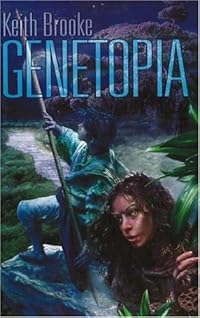
Genetopia by Keith Brooke

Pyr, 2006, 303 p.

 Genetopia cover

We are long in the aftermath of The Fall, in a genetically unstable world. Traits can migrate from species to species, carried by plague and fever, or deliberately induced in the gennering vats. Humans can become Lost, animals be brought up from beasthood to a form of sentience. Those called Mutts have been bred to obey – to love – humans without question and carry out menial tasks; slavery by another name. Technology has regressed to that of muscle power only. In all of this, true humans strive to keep their bloodlines pure. People are judged on what can be divined of their breeding and different clans specialise in different occupations.

While Brooke occasionally uses other viewpoints our main window on this world is through Flintreco Eltarn, whose sister Amber (Amberline Treco) has been sold into Muttdom by their father who (suspicious of his wife Jeschka’s proclivities) has always thought of her as impure, one of the Lost. The book then takes the form of Flint’s quest to find Amber. Along the way Brooke has the opportunity to present various aspects of his imagined world where everything outside the familiar bounds of a person’s knowledge is dangerous, any transformation a frightening thing, all change harmful and corrupting. As well as in the gennering vats changing vectors may occur in unfamiliar plants and fruits – or even in familiar ones. Yet human nature it seems is perennial. Venality, concupiscence, love, fear, hate all make their appearance.

He finally encounters one of the Lost, whose changing he was complicit in bringing about, who tells him, “‘The last trump has wiped out most of True humankind. All of nature (was) engineered to defer to your kind. When you find your judgement, the world will be inherited by those who have embraced change,’” and, “To be human is to be fluid, unfixed. Humanity today is not what it was yesterday, and it is only the start of what it will be tomorrow…. Out here we are truly posthuman. To be changed is to be blessed.”

Genetopia is in some ways an odd book. Within that familiar quest structure (which it partly subverts at the end) it seems to both decry and advocate a change in humanity. Perhaps the biggest problem I had with it was that the profound ability for biological change felt out of place with the regression of other technology. Brooke is good on relationships though, if a little pessimistic here about the possibility of a kinder humanity.

Pedant’s corner:- “When a human baby shows signs of the taint, when it reveals itself as one of the Lost – it was taken and exposed on the Leaving Hill.” (“it was taken”; therefore “showed” and “revealed”,) “a series of wooden rungs were lashed” (a series was,) “they were easier tolerated than enslaved” (they were more easily tolerated,) bouyancy (buoyancy,) Taneyes’ (Taneyes’s,) “and it fit” (fitted, but it was a US publication,) “either side fringed by bamboo and tall rushes” (each side.)

Parallax View by Keith Brooke and Eric Brown

Illustrations by Dominic E Harman. Sarob Science Fiction and Fantasy, 2000, 175 p

Parallax View cover

This is a collection of short stories, one each written by the individual authors, the remaining six in collaboration. Most of them I have read before on their first appearance.

In his introduction Stephen Baxter says “Science Fiction is the literature of our age….. one way of dealing with [future] shock… the only modern literature which deals seriously with the universe… as a protagonist,” but “the best Science Fiction is, was and always will be about the impact of the universe on the human soul.” All the stories herein illustrate that last point admirably.

Appassionata by Keith Brooke and Eric Brown
In a time of little musical innovation a famous but lonely young pianist is contracted to help a composer improve his work. Unknown to her the composer’s personality has been imprinted with a simulation of Beethoven’s.

Sugar and Spice by Keith Brooke and Eric Brown
A very human tale of loss, revenge and betrayal via the connection between two works of art related to each other through the nursery rhyme suggested by the story’s title.

A Prayer for the Dead by Eric Brown
This is possibly the best of Brown’s stories set on Tartarus, a tale of young love, tragedy and loss, and an enigmatic alien.

The Flight of the Oh Carollian by Keith Brooke and Eric Brown
Julius Frayn is an hereditary fluxmaster capable of guiding ships along the Songlines through time and space generated by the callers of Cynthera. His son Sylvian has not inherited the trait. This one has “had rode” for “had ridden.”

Jurassic and the Great Tree by Keith Brooke
Jurassic is a disposable body inhabited by three personalities hired by an entrepreneur to investigate the reclusive humans called Burul’Chasi whose land he wishes to exploit. The Great Tree is the huge interlocking organism which dominates the Burul’Chasi’s territory. Contains the phrase, “The only Terran life…. are….”

Mind’s Eye by Keith Brooke and Eric Brown
In a setting reminiscent of Brown’s Bengal Station but apparently not offshore, a girl from the lower levels comes up to Sundeck where she is befriended by a telepath on a mission.

Under Antares by Keith Brooke and Eric Brown
Mackendrick is a former Planetary Overseer on Shannon’s Break, second planet of Antares. Six and a half years after his wife’s death as result of an entanglement with the local aliens, the Shandikar, he is called in as blood-tied-speaker when his son trespasses on one of the Shandikar’s holy sites. Dealing with both enigmatic aliens and religious practices, this story bears Brown’s hallmarks.

The Denebian Cycle by Keith Brooke and Eric Brown
An exploration group on Deneb 5 is forced to trek north when their lander and food are destroyed in a forest fire caused by a lightning storm. The local vegetation is all but inedible. Eventually they come upon a stash of food left by the semi-sentient natives and then the natives themselves. Those familiar with John Wyndham’s Survival will not be surprised by the ending. Here there were three instances of the seconds/minutes later formulation, a persona non gratis, (which should be grata,) lay instead of laid as a perfect tense, and the authors felt it necessary to qualify “flayed” with the words “- skinned alive.”

Overall, though, a very good, very readable collection.

alt.human by Keith Brooke

Solaris, 2012, 414 p. (Published in the US and Canada as Harmony.)

In the city called Laverne humans are marginalised, subjected to the rule of aliens and their various underlings – chlicks, watchers, headclouds (with their assorted commensals,) grunts and slaves. Movement is restricted by a series of pass controls which can only be negotiated by having identifiers called pids in the bloodstream recognised and verified. Over Laverne hangs a skystation, a kind of spaceport controlled by a starsinger. These beings can manipulate reality (creating by singing or destroying by unsinging) and act as protectors of their cities.

Dodge is a member of the human clan Virtue. He has expertise in fooling the pass system with fake pids and chances upon Hope, a young girl who has no pids, using his ability to help to avoid her being detained at a checkpoint. Hope becomes central to the story’s resolution (rendering the programmatic nature of her name a touch heavy-handed.)

The narration is mainly first person from Dodge’s viewpoint but there are sections where he narrates other characters’ experiences in the third person. One of these is Hope, who has come to Laverne after her city Angiere was destroyed. Other escapees from Angiere warn that competing factions among the aliens mean that Laverne is unsafe and urge travelling on to the semi-mythical city of Harmony. Life in Laverne is shown in detail and depicted very well, the characters and their motivations entirely believable.

After the area of Laverne where Dodge lived has been unsung a small group of humans decides to move out of Laverne before the whole city is destroyed. They set off to try to find Harmony. The travelogue in this second section of the novel has moments which are reminiscent of a Wyndhamesque disaster story but in the end alt.human is not like that at all. For one thing it has a resolution.

The first part of the novel, set mostly in Laverne, the bulk of the book, feels as if Brooke had invested his heart and soul in it, it has characters who seem real and a just about believable setting. The two subsequent sections felt less convincing, but characterisation and its development wasn’t lacking.

The Accord by Keith Brooke

Solaris, 2009

the-accord

Disclaimer:- Keith Brooke is another of my SF acquaintances and I’ve known him for years now. He even got me to review books for his SF site, Infinity Plus.

In this novel people can undergo periodic brain dumps which are then warehoused until the “owner” dies, when they are transferred into the Accord – a virtual heaven, a consensus reality, overwhelmingly real, almost indistinguishable from the true world, assembled from the minds of those who have died and been uploaded into it. Its creator, Noah Barakh, in the run up to the Accord achieving a kind of critical mass where it will become more or less fixed, can negotiate its protocols, run and rerun different realities. In the real world from which the dead came there is increasing chaos making the Accord a more and more attractive proposition to the living.

The book’s chapters are not numbered conventionally but rather as 0.01, 1.08 and 2.06 etc depending on which version of the Accord is being written about; its beginnings, its full consensus, and its final shift into quantum space where there are no Malthusian limits on its growth. This software type numbering is either amusing or irritating depending on your point of view.

As to the bare bones of the plot, Barakh has an affair with Priscilla, the wife of leading politician Jack Burnham, who finds out and kills Priscilla but Barakh gets the blame. Priscilla is reborn in the Accord from a brain dump taken before the affair happened. Barakh sets up offshoots of the Accord where he tries to rekindle the affair.

Very early on both Barakh and Burnham die in the real world. The rest of the novel – nearly all its 442 pages – is concerned with Burnham’s quest (with the help of other protocol adjustors) to track down Barakh in the Accord and eliminate his presence there completely, to prevent his affair with Priscilla.

I wasn’t entirely clear about just how the Accord “knew” when inhabitants of the real world had died and so were allowed to join but that is a minor quibble.

More philosophically, in fiction there is a problem with virtual heavens, with virtual environments of any sort. Their inhabitants are merely strings of ones and zeroes. Why should we care about what happens to them? This problem is greater with the Accord as when people “die” there they are reborn from their final brain dump – though with the memories they have gained in the Accord since their first uploading. In effect they are immortal.

This might have been an opportunity for Brooke to speculate about whether we in what we think of as the real world are ourselves merely numbers whirring around in a mainframe somewhere; but that is not his concern. Instead, he focuses on what such a form of immortality means for human behaviour. What is the nature of love and jealousy and revenge in these circumstances? The cleverness of his Accord idea is that it to its inhabitants it is so real that to all intents and purposes it feels like the actual world and hence the characters in it are also made real for us.

This is a complex, thought provoking book, with multiple narrators and shifts of tense. Literature tends to concern itself with love, sex and death. The Accord is about the possible consequences for “human” behaviour of removing one of that trinity.

free hit counter script