Archives » Kameron Hurley

Arthur C. Clarke Award: This Year’s Nominees

The shortlist for the 34th Arthur C. Clarke Award is:

The City in the Middle of the Night by Charlie Jane Anders
The Light Brigade by Kameron Hurley
A Memory Called Empire by Arkady Martine
The Old Drift by Namwali Serpell
Cage of Souls by Adrian Tchaikovsky
The Last Astronaut by David Wellington

I had been looking for the list for a while but not for the first time discovered it had finally been announced via Ian Sales’s blog.

I reveiwed the Charlie Jane Anders book for Interzone 282 and published that review here on 28/5/20.

The Martine and Serpell I had seen good reviews of. The works of Hurley I have read tend to wallow in violence which I find off-putting. I’ve only read Tchaikovsky’s two Children of Time novels. They were OK but no more. Wellington is new to me (and Ian Sales doesn’t think much of his book.)

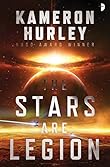
The Stars are Legion by Kameron Hurley

Angry Robot 2017, 397 p Reviewed for Interzone 270, May-Jun 2017.

The Stars Are Legion cover

Lit by an artificial sun, the worlds of the Legion hang in space. Massive orbs, they are living things covered externally by tentacles that simultaneously reach out but also offer protection to their world’s inhabitants. Their interiors are sticky and moist, biology taking the functions of such things as floors, walls and lifts. The worlds, though, are dying, with patches of rot blotching their surfaces. Beyond the misty veil that shrouds the sun lies the Mokshi, the only world to have moved out from the usual orbits of the Legion. As a result the Mokshi is an object of envy and conquest; but it is defended fiercely. Anat, Lord of Katazyrna, has a metal arm whose power is lost and she wishes to conquer the Mokshi in order to restore it and (literally) make a new world.

Each chapter here is prefaced by an aphorism by-lined, “Lord Mokshi, Annals of the Legion”. The narrative viewpoint, though, is shared between Zan and Jayd, once lovers, neither of whom are particularly sympathetic characters. At least twice as many chapters are devoted to Zan, who has lost her memory but is the only one of Katazyrna’s army ever to penetrate the Mokshi and survive. She is told she has made the attempt and returned many times.

The first set piece is a fairly standard piece of military SF as Katazyrna’s latest army attacks the Mokshi. However, the prospect this holds out of endless space battles is misleading. Hurley’s attention is more on the somewhat complicated relationship and backstory between Zan and Jayd.

It doesn’t take very long to work out that there are only women on these worlds. Hurley does not make anything of this – except in her afterword – it is merely a factor of this scenario, the society she has decided to portray. The mechanics of how their inhabitants become pregnant are obscure, though; even the mothers seem in the dark. Also, the birth products may be non-human, “Each world produces what it needs.” But in a strange mix of this magical-seeming biology with hi-tech, womb transfer can be effected surgically. Indeed we find Zan has donated hers and its contents to Jayd.

Neither does Lord Mokshi’s identity remain a mystery to the attentive reader, becoming obvious long before Hurley confirms it.

Interference from the forces of Bhavaja makes the attack fail and Anat decides on an alliance with these erstwhile enemies. To this end she arranges a marriage between Jayd and Rasida, Lord of Bhavaja. Jayd’s pregnancy is an important aspect of the deal. Bhavaja has not had a birth for some while. For a long time, to help Zan penetrate the Mokshi, Jayd has been working secretly towards this end.

The wedding is accompanied by a human sacrifice. This is only one of the many gory incidents in the book exemplified by Rasida’s despairing philosophy expressed later, “There’s no such thing as love in the Legion. There is birth and there is death. That’s all.” By this time Rasida has not kept her word, destroying Ana in the process, while Zan was thrown into Katazyrna’s recycler.

Which is where things begin to get bogged down. As well as what are in effect no more than monsters devouring the material to be recycled (Hurley seems to relish the details but they are oddly uninventive) Zan finds a woman living in the belly of the world, Das Muni, who helps her to escape to the next level.

The main body of the book is taken up with Zan’s journey up through the strata of the living world where the obstacles she meets are overcome perhaps a little too easily and she picks up another two handy companions.

One of Gene Wolfe’s prescriptions for writing fiction is that if your hero(ine) goes on a journey you must describe it. Well, there’s describing and then there’s overdoing it. The journey here is certainly important to the outcome as it provides Zan with clues to both her past (she has done all this before, remember) and future but it reminded me of the seemingly endless trek across the Ringworld in one of Larry Niven’s series of novels; it’s there more to show us the author’s invented world rather than advance the plot. Together with the emphasis on violence here that, for me, reduced engagement. It may be more to others’ taste.

The following did not appear in the published review.

Pedant’s corner:- “I change directions” (direction,) auroras (aurorae.) “The security crosses their arms and puts their backs to me” (its arms, its backs,) “a bevy …. begin” (begins,) “the whole of Katzyrna pour out” (the whole pours out,) in the hopes (in the hope,) maw in sense of mouth (sigh; it’s a stomach,) “a hunger than no meal can satisfy” (that no meal,) “fearful that the council will change their mind” (its mind,) the moths become less and less (fewer and fewer,) a missing start quote when a chapter began with a piece of dialogue, “I motion to Das Muni to lower the litter …… I motion to Das Muni to lower our own load” without the load being picked back up in the meantime, “I … try to see the where it’s fallen from” (no “the” needed,) “lined in row upon row” (by row upon row,) “if it is was my child” (if it was,) “that something had happened to her leg” (the narration is always present tense; so, something has happened to her leg,) “One is full of clear liquid. The other is full of purple liquid.” (clear here is contrasted with a colour; since clear does not mean colourless, the purple liquid could equally have been clear,) “Zan gets up now and wipe her hands” (wipes.)
Two Months on

The Switch cover
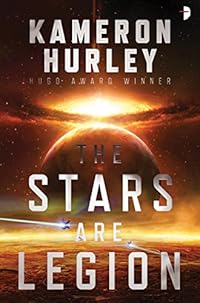
The Stars Are Legion cover

Two months seems to come round very quickly.

Yesterday The Switch by Justina Robson dropped onto my doormat.

It is the latest book for review in Interzone – to appear in issue 271.

Issue 270 arrived earlier in the week. That one features my review of Kameron Hurley’s The Stars Are Legion.

Interzones 269 and 270

 The Stars Are Legion cover
Interzone 269 cover

Interzone 269 arrived today.

It contains my review of The Mountains of Parnassus by Czesław Miłosz.

A few days ago I received The Stars Are Legion by Kameron Hurley.

That review is due soon for Interzone 270.

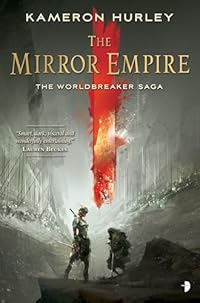
The Mirror Empire by Kameron Hurley

The Worldbreaker Saga Book I. Angry Robot, 2014, 541 p.

 The Mirror Empire cover

In a series of planets with twin hour-glass suns and strange satellites named Para, Sina and Tira from which certain inhabitants can draw power when they are in the ascendant, an invasion from a parallel world is taking place. Transit between the worlds (which have differently coloured skies) is by means of something resembling a mirror but isn’t possible if the companion person is alive on the other side. The most powerful satellite, Oma, has not been ascendant for 2000 years but its influence is being felt more strongly.

Now, this parallel worlds and weird suns scenario could have been an intriguing SF setting but the author lost this reader’s sympathies when it turned out early on that the shedding of blood could also open gates between the worlds. Cue gratuitous bloodshed on a wide scale. I would submit this is laziness on the author’s part. Couldn’t we have had something a bit more inventive, a bit less sanguineous?

Add to this the fact that the characters have very little agency beyond advancing the plot, which itself takes a long time to get going, and you end up with a less than satisfying read. Oh, there is some jiggery-pokery about different gendering and women tend to be in power; but when they behave as powerful men would in our world is there any point?

Plus I really don’t see the point of Fantasy when its characters wield strange powers, even when they do have to endure for a while before growing into them. How does that illuminate the human condition?

It may be that I am committing the error of wishing to read the book that I might have desired Hurley to have written rather than the one she actually has, but when a book revels in so much gratuitous slaughter more or less for its own sake it’s time to call it off. I won’t be taking The Worldbreaker Saga any further.

Pedant’s corner:- Admittedly mine was an advance reading copy – I have my sources – but it was so full of typos, verb/noun disagreements, misspellings, missing words, repeated words, malapropisms (or near malapropisms which are perhaps better described as dyslexisms – scarified for sacrificed anyone?) awry punctuation and errors in lay-out etc that I gave up counting them after page 63. It may be she was under pressure to hand this in quickly but to my mind Hurley’s manuscript hasn’t been looked over critically enough before submission. And did no-one at Angry Robot seek to check it? Such things make the whole more difficult to read you know. I’m left harbouring a sense of disappointment with all concerned. And there was the use of drug as a past tense of drag which may be a niche USian habit but reads absolutely horribly.

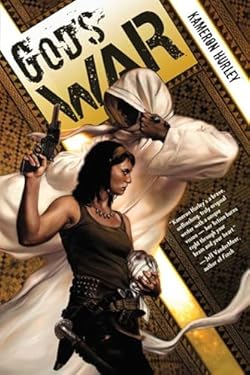
God’€™s War by Kameron Hurley

Night Shade Books, 2011, 288 p.

 God’s War cover

God’€™s War is set on an isolated theocratic world named Umayma which has few off-world connections and four main countries, Chenja, Nasheen, Ras Tiega and Mhoria. These are all Islamic type theocracies but with varying degrees of rigour, especially in their attitudes towards women, and alcohol is freely available, at least in Nasheen.

The environment of the planet has altered humans’ make up. Ras Tiegans, for example, can shift shape, though there seems to be no consequence attending this ability, neither energy deficiency nor any other debilitation. Technology is mediated by insects (Hurley usually calls them bugs) controlled by people called magicians.

Chenja and Nasheen have been at war for centuries -€“ most men are at the front (though women are sent there too) and society is dominated by females. A few bitter old men, former soldiers of course, add a touch of background. Nasheen is a monarchy – the current ruler is Queen Zainab – but an organisation whose members are known as bel dames is a rival power in the land.

The protagonist, Nixnyssa, is a former bel dame, disgraced and now turned bounty hunter -€“ she kills deserters and the like and cuts off their heads. The Queen engages Nyx and her team to find and retrieve – or kill – an off-worlder called Nikodem who may be able to provide one side or the other in the war with the crucial advantage to win it. Opposed to Nyx are factions within the bel dames, trying to find Nikodem for their own reasons. Bizarrely, boxing – yes, pugilism – is one of the aspects of the plot.

Hurley has invested a lot in her scenario but less in her characters who frequently amount to no more than one attribute. In addition, at the level of the prose, authorial care can break down. Several times Hurley employs one phrase or other in consecutive sentences, a trait which, to my mind, is clumsy at best and better avoided. Towards the climax typos begin to escalate, as if she was rushing to her conclusion. The novel is also slow to develop.

God’€™s War is a deliberate attempt to reverse the usual gender stereotypes -€“ the profoundly unsympathetic Nyxnissa is said to be a sexual omnivore (but we actually see very little, if any, sex in the novel) and relishes violence while Rhys, one of her male companions, is a God fearing prude and a crap magician to boot. The novel panders to the usual blood-and-guts hungry audience though.

BSFA Awards Short Stories

Over the past few weeks I have read the short stories nominated for this year’€™s BSFA Awards. I am assuming that, as in the past couple of years, the BSFA will be producing a booklet containing them but since each has been posted on the internet (there is a link from the BSFA’s Awards page to the online versions which is how I managed to read them – though I found off a screen is not the most comfortable of ways to do so) perhaps that might not happen.

The Silver Wind by Nina Allan, from Interzone issue 233, is a kind of time-travel story mixed with parallel worlds. It tells of the encounter of a man from a fascistic future Britain with a genius who makes clocks (which he refers to as time machines.) To begin with there is too much info dumping and throughout a lot is told rather than shown. Perhaps the story needed more space to breathe but I felt the sureness of touch of an accomplished story teller was missing. There is a use of words that is not quite precise -€“ eg ‘hoping one soldier would not see me’ rather than ‘€œhoping none of the soldiers would see me’€ – and twice we are treated to the peculiar phrase, ‘€œIt was growing dusk,’€ but at least Allan knows the use of ‘€œnor’ as in, ‘€œnot for love nor money nor any of these new-fangled gadgets.’

The Copenhagen Interpretation by Paul Cornell, from Asimov’s, July2011, is set in an altered future where European monarchies strive to keep the balance of power throughout the Solar System, souls have weight that is aligned to dark matter and Newton came up with a kind of relativity theory which allows space to be folded – all amenable to a tale of espionage and derring-do admixed with betrayals of various sorts. This stretches suspension of disbelief at times but overflows with ideas and is excellently written.

Afterbirth by Kameron Hurley, from Kameron Hurley’€™s website, is about a woman in a backward-leaning religious society which is engaged in a never-ending war, whose rulers have deliberately cut it off from the stars – originally as an escape from whatever’€™s out there but now to prosecute the war better. In her forbidden astronomical observations she finds God in a torn filter laid across the night sky. Again there is a fair bit of info dumping -€“ perhaps inevitable in stories of short length.

Covehithe by China Miéville, from The Guardian, 20/4/11, features sunken oil-rigs returning to land to drill into the earth and lay – eggs? seeds? – from which smaller rigs later emerge. Atmospheric, but again info-dumpy. The human involvement in Covehithe – a father and his daughter observing one such landing -€“ doesn’€™t really overlap with the SF background. Another scenario where society has suffered extreme breakdown and the military has a strong presence.

Of Dawn by Al Robertson, from Interzone 235, has a woman whose soldier brother has been killed being inspired by his poetry, the music of a long neglected composer, an all but forgotten TV documentary and a figure from Greek myth to produce a synthesis of poetry and music by bringing all those strands together. The final part of the jigsaw is provided by a shadowy figure in a village commandeered by the army long ago, but which had inspired both poet and musician. The story contains echoes of the Green Man myth and illustrates that English fascination with the pastoral. The info dumping here is well embedded.

The futures shown by the five stories are all bleak, having in common repressive regimes of either military or religious stamp. SF is never about the future, though. These stories tell us a lot about where we are now.

As stories though, rounded works of fiction, I found most of them unsatisfying. The only truly successful one was Paul Cornell’s. If these represent the best of last year the SF short story is in a bad way.

BSFA Awards Shortlist

It’s that time of year again. The BSFA Award nominations are out.

The full lists can be found here.

The fiction nominees are:-

Best Novel:-

Cyber Circus by Kim Lakin-Smith (Newcon Press)

Embassytown by China Miéville (Macmillan)

The Islanders by Christopher Priest (Gollancz)

By Light Alone by Adam Roberts (Gollancz)

Osama by Lavie Tidhar (PS Publishing)

Of which I have (so far) read one.

Best Short Fiction:-

The Silver Wind by Nina Allan (Interzone 233, TTA Press)

The Copenhagen Interpretation by Paul Cornell (Asimov’s, July)

Afterbirth by Kameron Hurley (Kameron Hurley’s own website)

Covehithe by China Miéville (The Guardian)

Of Dawn by Al Robertson (Interzone 235, TTA Press)

I have read none of these as yet but only The Copenhagen Interpretation is not available online via the BSFA page linked to above. Presumably the booklet of nominated stories that the BSFA has produced for the past two years will be repeated this time around, too.

free hit counter script