The Thirty-Nine Steps by John Buchan
Posted in Reading Reviewed, Scottish Fiction, Scottish Literature at 20:00 on 30 October 2015
Penguin, 2007, 159 p. One of the 100 best Scottish books. Borrowed from a threatened library.
This is another story which, like Stevenson’s “Jekyll and Hyde” being familiar from film and television, people perhaps think they know.
In it, Richard Hannay begins as a bored ex-patriate in London who perhaps should have been careful what he wished for. His upstairs neighbour, who calls himself Franklin P Scudder, a man who refers to “the Jew” being behind the conspiracy he regales Hannay with, begs for shelter in Hannay’s flat for a few days till he can thwart said conspiracy. But of course Hannay returns to the flat one day to find Scudder dead and so has to flee under suspicion of murder. The majority of the novel then consists in Hannay being chased around southern Scotland in what is now Dumfries and Galloway getting into and out of various scrapes and predicaments which are sometimes evaded too handily, meanwhile solving the puzzle of the thirty-nine steps and disrupting the plans of his adversaries of the Black Stone. It all rattles along at a glorious pace without much pause for thought and incidentally allows descriptions of the landscape he flees through; a common Scottish authorial trait.
Unlike all three film adaptations I have seen – and the most recent TV one – there is not a woman companion in sight. Barring a wifie who provides shelter to Hannay one night there aren’t any women at all. It does, though, have the merit of being able to be read quickly.
I can only think that this creeps into that 100 best list for historical reasons. It has no literary pretensions. Buchan himself, in his preface (addressed to Thomas Arthur Nelson) refers to it as “the type of tale which Americans call the ‘dime novel,’ and which we know as the ‘shocker’”.
Once again the prose shows itself to be of its time: as in John Macnab, there are several unflattering mentions of Jews not in particular but as a type, and a “you’re a white man”, plus also here a Greek is referred to as a dago.
I note, too, a “minutes later” count of six or seven.
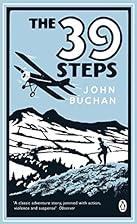
Pedant’s corner:- There were several editions at the library (they’re running a Buchan competition.) I chose this one because I liked the 1930s style of its cover. Yet the book was first published in 1915. Moreover the biplane is wrong. The text several times emphasises that Hannay is being chased by a monoplane. Buluwayo (Bulawayo,) Liepsic (context suggested Liepzig,) jiffey (jiffy,) – were these words spelled that way in the 1910s? – rung (rang,) whiskys (whiskies,) Karolides’ (Karolides’s.)