Archives » Isaac Asimov

The Magazine of Fantasy and Science Fiction Vol 34, no 2, February 1968

Edited by Edward L Ferman. Mercury Press, 130 p.
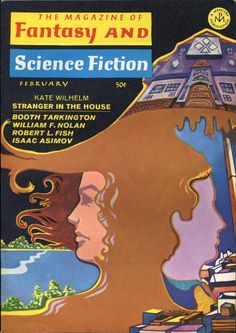
Stranger in the House by Kate Wilhelm is perhaps typical of its time. The house in question has a history of spooked occupants, not haunted as such but off-putting in the extreme. It turns out that underneath it is a vlen, a refuge for an alien called a Groth sent to Earth to report back on its suitability to join wider galactic society. The mission has been a failure as the Groth’s companion died years before and contact is all but impossible. The Groth’s mental emanations are a cause of extreme distress to humans. Engaging with their minds induces uncontrollable fear and hatred. Still, Wilhelm manages to convey sympathy for the creature.

The Lucky People by Chet Arthur. The people concerned live in a curfewed neighbourhood where strange creatures come out at night in a show that’s better than television.

The Stars Know by Mose Mallette. A graduate of a handwriting analysis course interprets the letters he receives – without paying any attention to what they actually say.

He Kilt it With a Stick by William F Nolan. A man with a morbid hatred of cats since childhood takes every opportunity to do them harm. Until one night they gang up on him. The spelling mistake in the title is deliberate.

In Wednesday Noon by Ted White the song Dancing in the Street is being played non-stop on the radio and by a truck outside. Except for our viewpoint character people are swept up in the enthusiasm and led away, as in the Pied Piper. But his ordeal still has a way to go.

The protagonist of The Locator by Robert Lory plots all UFO sightings in an effort to predict where the next landing will be so that he can witness it. He gets it all too right.

I Have My Vigil by Harry Harrison is narrated by a robot, the sole survivor of a trip to Alpha Centauri since viewing no-space turned the three human occupants of the ship mad.

To Hell with the Odds by Robert L Fish is a ‘Deal with the Devil’ tale, this time with an almost washed-up golf pro.

The Veiled Feminists of Atlantis by Booth Tarkington. (This is the same Booth Tarkington who wrote The Magnificent Ambersons and is a reprint from 1926.) The story relates to the Kabyle people of Algeria, known as “White Arabs,” whose women go unveiled. The narrator of the legend has it that their origins were in the lost land of Atlantis, where women and men had an equal footing.

Judith Merril’s Books column introduced me to an author of whom I’d never heard, Hortense Calisher. Unfortunately her books are now vanishingly rare.  Isaac Asimov’s Science column relates the discovery of The Predicted Metal (gallium; Mendeleev’s vindication and triumph.)

Pedant’s corner:- “of the acid and alkaline” (alkaline is an adjective – compare ‘acidic’ vs ‘acid’ – the noun is ‘alkali’,) gayety (gaiety,) “at loose ends” (at a loose end,) Bufus’ (Bufus’s,) olefactory (olfactory,) “laying about ten feet from the pin” (lying about ten feet from,) irresistably (irresistibly,) Newlands’ (x 2, Newlands’s,) 1860’s (1860s,) “strange phenomenon” (strange phenomena,) “the whole continent was riven and sunk beneath the waters” (was riven and sank.)

The Magazine of Fantasy and Science Fiction, November 1962

Edited by Avram Davidson, British Edition, Atlas Publishing and Distribution by arrangement with Mercury Press, 112 p.

Note: the cover painting shown right is the one on my copy but the contents differ from those listed on the image which was for the US edition for April 1962. The British editions obviously did not match the US ones.

In those days the magazine had no Editorial column nor was the text of its stories – except the title page for Uncle Arly here – laid out in two columns as it would be in later years.

Isaac Asimov’s SCIENCE column was going strong. Here in Hot Stuffa he considers the highest* temperature possible in the universe (the interior of a star about to go supernova.)

Saturn Rising by Arthur C Clarke.1 A veteran of the first two trips to Saturn on a lecture tour is buttonholed by the hotel owner, an enthusiast for that planet, eager for commercial opportunity.

Brown Robert by Terry Carr2 is both SF and a horror story. Arthur Leacock assists young Robert Ernsohn, brown Robert, to make the first trip through time. This is one of the few SF stories to deal with the fact that time travel must also involve space travel.

My Dear Emily by Joanna Russ is a vampire story set in 1880s San Francisco. As well as the Emily of the title another of its characters is named Charlotte; two names obviously chosen to invoke thoughts of the Brontë sisters. Yet the overall effect is far from that template.

The Man Without a Planet by Kate Wilhelm.3 The titular man carried on with a space voyage despite that meaning the death of his companions. The sympathies of the story’s narrator are somewhat like the protagonist of Robert Silverberg’s To See the Invisible Man.

Darfgarth by Vance Aandahl. The titular character is a wandering minstrel whose mandolin has a magical effect on the locals he stops to serenade. Until he goes too far.

Stanley Toothbrush by Carl Brandon.4 One morning, while shaving, viewpoint character Herbert thinks the word ‘shelf’ is ridiculous and all his shelves disappear. Later his girtlfriend teases him about a (non-existent) new boyfriend and he turns up on her doorstep. The have great problems with him – till she imagines him away.

In Uncle Arly by Ron Goulart5 the uncle of an ex-girlfriend has begun to haunt Tim Barnum’s television set, every Tuesday evening for half an hour. He also pops up on the radio.

Subcommittee by Zenna Henderson.6 Talks to end the war between humans and the alien Linjeni are going nowhere. Serena’s husband Thorn is on the talks committee. Their son Splinter finds a way through the fence between the two communities and makes friends with Doovie, a Linjeni child. The rest of the story more or less writes itself but 60 years on it is striking how the cultural assumptions of the time were entrenched even in SF: the Linjeni females in this story are as bound to their families as human women were in those days. Of course it may not have been possible to get anything else past a male editor.

*as known then.

Pedant’s corner:- awave length (now is one word, wavelength.) Centigrade (that unit of temperature is now designated Celsius,) “56 hydrogen nuclei … are converted into 1 helium nuclei” (the nuclei is plural, so the ‘1’ is wrong. Context and the subsequent text suggests ‘14 helium nuclei’.) Later we have 19 helium nuclei where again 14 makes more sense.
1Ingalls’ (Ingalls’s,) “It took me awhile” (a while.) 2Mr Lewis’ assistant (x 2, Lewis’s.) 3zombi-like (zombie-like.) 4focussing (focusing,) “‘An what do you mean’” (And,) a miising full stop at the end of a sentence, a double quote mark at the beginning of a piece of direct speech when elsewhere there are only single ones. 5 “and pointing at the fat man on the set who was singing again. ‘And who’s this guy?’” (is missing a ‘said’ before ‘And who’s this guy?’) “before go to the bank” (before I go to the bank.) “Jean left them” (elsewhere she is Jeanne.) 6 “and felt of the knitting” (and felt the knitting.)

SF Beats Academics To It.

An article by Tom Holland in Saturday’s guardian review about the aftermath of the Roman Empire argued that there was no sudden change from classical to mediæval times, no instant forgetting, but rather a long interregnum in which the rise of Islam was an important feature.

Holland points out that the transition was all a messy business, triggering the evolution of legends of various sorts, which in Britain involved the King Arthur stories plus the evocation of elves and orcs to account for the gigantic ruins of Roman buildings. He sees Tolkien’s endeavours as an attempt to restore these myths to the culture.

The article surprisingly, to my mind, mentions Science Fiction favourably in that Asimov’s Foundation Trilogy and Herbert’s Dune sequence both recognised what Holland sees as the salient aspect of the transformation somewhat before it gained foothold in academe.

When I read the books it was easy to recognise that Asimov’s trilogy was modelled on the fall of the Roman Empire but it is the character of the Mule that Holland finds interesting – a Muhammad like figure with unusual powers. (That the Mule upset the apple cart of the Foundation’s “psychohistory” suggests to me a reflection of Asimov’s world-view.)

The parallels of the Dune sequence with Arab culture were of course unmistakeable even as a very young teenager. Paul Atreides (Muad’Dib) as Muhammad was at that time a step beyond me but is unmissable now. Herbert did seem to be in sympathy with Arab culture if not necessarily the religion it spawned. At the time I took his critique to be of the phenomenon of religion as a whole rather than Islam per se and I see no reason to alter it.

(The article further ponders the historical evidence surrounding the life of Muhammad, a matter on which I am not in a position to judge.)

Historically, the Roman Empire’s fall cannot be seen as anything other than significant. That authors still continue to see it as a template within which to set their stories – Holland mentions Star Wars and Battlestar Galactica as other not so rigorous examples – is testament to the endurance of its legacy.

free hit counter script