Archives » Iron Cross

HMS Royal Oak Memorial

On the night of 8th October, 1939, the German submarine U-47, under the command of Günther Prien, penetrated the defences of Scapa Flow, Orkney, through Holm Sound and Kirk Sound. Her first two torpedo salvos missed all but an anchor chain but her third struck HMS Royal Oak. Within fifteen minutes the ship had sunk with the loss of 833 British sailors out of the crew of 1,234 men and boys. Many of their bodies were unrecoverable and remain on the ship. A few are interred at Lyness Naval Cemetery on Hoy.

For his feat Prien was awarded the Knight’s Cross of the Iron Cross, the first sailor of a U-boat and the second member of the Kriegsmarine to receive this decoration.

To prevent any further such attacks a series of barriers known as the Churchill barriers was built between four of the southern Orkney islands to connect them to each other and the mainland. The one shown below (picture from the Royal Oak’s Wikipedia page) crosses what was Kirk Sound.

Churchill Barrier across Kirk Sound

For decades afterwards the Royal Oak, a designated war grave on which diving is therefore prohibited, leaked oil into Scapa Flow before the leak was sealed off.

A memorial to HMS Royal Oak is set into the north wall of Kirkwall’s St Magnus Cathedral. There is a dedication plaque, a book of remembrance listing the names, with a page turned every day, surmounted by the ship’s bell.
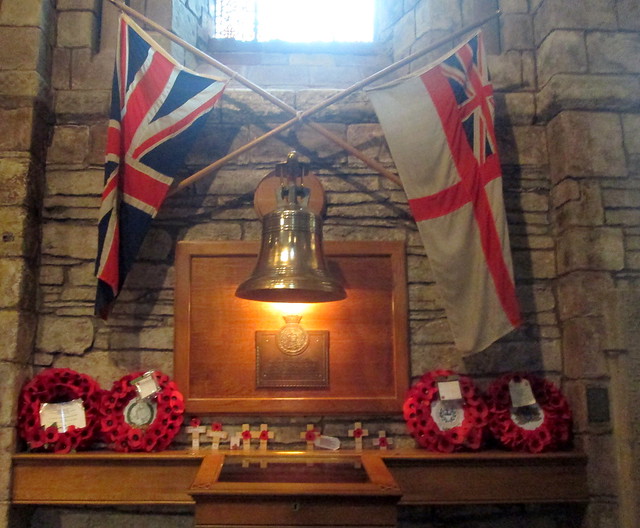
Royal Oak Memorial

Further along the same wall lies another site of more general remembrance, a niche containing poppies and candles.
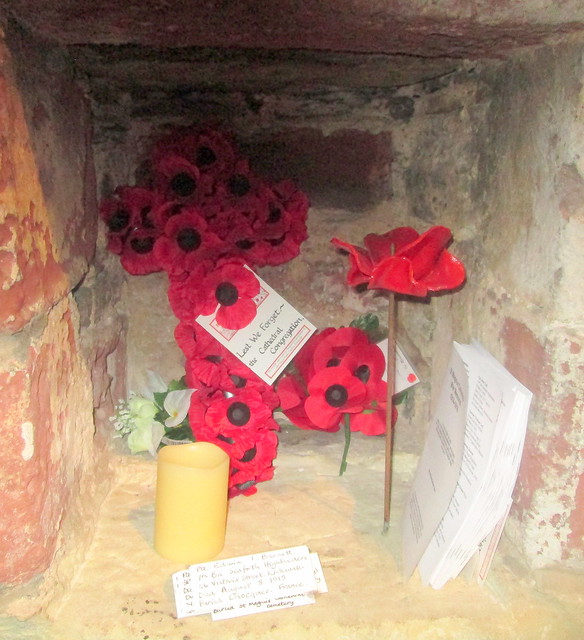
Remembrance niche, St Magnus Cathedral, Kirkwall

Bert Trautmann

Bert Trautmann, one of the icons of post Second World War British goalkeeping (ironic since he was a German,) has died.

His signing by Manchester City in 1949 upset quite a few people who so soon after the war felt insulted that a German should take up such a high profile position.

His war record is astonishing. Like most of his generation he was under the influence of Nazism, joining the Jungvolk. When the war came he joined the Luftwaffe as a radio operator before volunteering to become a paratrooper. He was posted to the Russian front and won an Iron Cross First Class. At one point he was captured but a German counter-attack freed him. In Russia his unit suffered 70% casualties. He was transferred to the West where he was captured twice more, with two more escapes, before jumping over a fence and landing at the feet of a British soldier who said, “Hello Fritz, fancy a cup of tea?” He spent time as a POW, refused repatriation when it was offered after the war, going back to Germany a year or so later but decided he preferred Britain.

His most famous accomplishment in football was finishing the 1956 FA Cup final after sustaining a broken neck. He knew he was injured but its serious extent did not become known till three days later after the X-rays.

It was several incidents like this in FA Cup finals around that time that eventually saw the goalkeeper afforded more protection in Britain.

Bernhard Carl Trautmann: 22/10/1923-19/07/2013. So it goes.

free hit counter script