Archives » Interzone

The Mountains of Parnassus by Czesław Miłosz

Yale University Press, 2017, 188 p. Translated from the Polish Góry Parnasu, Science Fiction, Wydawnictwo Krytyki Polityczenej, 2012, by Stanley Bill. Reviewed for Interzone 268, Mar-Apr 2017.

 The Mountains of Parnassus cover

My knowledge of Polish SF has heretofore begun and ended with the works of Stanisław Lem. I saw this book as a welcome opportunity to rectify that. However, Miłosz made his reputation as a poet and essayist – as cited in his Nobel Prize – and this unfinished work (deliberately unfinished, the translator’s introduction tells us) is, as far as I can tell, his only attempt at an SF novel. Miłosz apparently had doubts about the viability of the novel as a form, though he considered SF’s realist conventions as the most promising vehicle for it even if “Science Fiction has mainly consisted of gloomy prophecies.” In his Introductory Remarks to the novel he says will “never be written” he notes that his depiction of two female characters “who do not appear in the pages printed here” made him shrink from the “horror” of writing a “novel from life.” Since “literature always fares awkwardly when it strives to depict good people and good intentions,” he describes what lies in front of us as artistically dubious and immoral. So much for fiction, then.

The book as a whole seems designed more for the academic than general reader with its Translator’s Introduction plus Note (both complete with references) emphasising Poland’s highly literary tradition of SF writing and Milosz’s view of SF as akin to scripture in its use of the past tense to describe future events. Correspondingly the “novel”’s latter parts are steeped in Catholicism. The style is discursive, its six sections reading more like essays than a conventional narrative. Strewn throughout them are nuggets allowing us to glean the outlines of society plus references to powerful groups of various sorts; the Botanists’ and Astronauts’ Unions, the Arsonists’ Association. There is no dialogue; unless you count the Mass of the Catechumens in the Appendix.

A description of the Mountains of Parnassus, supposedly kept in a state of wilderness, is written almost like a gazetteer. Their visitors exist in “an Earth without fatherhood” and strive to become their own fathers. A general atmosphere of ennui (avoiding “killing time” via the M37 current or erotic games, which prove unsatisfactory palliatives) leads a character called Karel to play Russian Roulette. His survival and altered mental state lends him immunity to the activities of an organisation known as The Higher Brethren of Nirvana which has begun to cull humans to prevent degeneration and extinction, its victims simply disappearing, each “losing its unitary quality in a single moment” with no one knowing the criteria for selection.

There follows an adumbration of the theories of Professor Motohiro Nakao which overturned the practice whereby “long ago the more energetic rulers had made the strange assumption that the minds of the ruled were a threat if they could not be convinced by persuasion or fear.” Data collection of “tracks” of perception can identify any which may be harmful to the rational social order defended by the Astronauts. This leads to Cocooning, interfering with the ability to communicate by slowing or accelerating the speed of a person’s thoughts thus denying access to those of others.

The “Cardinal’s Testament” of Petro Vallerg, all but the last celibate, finds him struggling to understand the thinking behind John XXIII’s aggiornamento in calling the Second Vatican Council, as it caused a rotting structure to collapse by attempting to refurbish it. Vallerg recognises the Church’s failings, where ritual has petrified into form, but “if the Church had not used the stake and the sword of obedient monarchs in the critical thirteenth century, little would have remained of Christianity,” and “no purely human institution similarly depraved could have survived,” but bemoans “the shame that induced us to reject the relative good simply because it was relative” and that the numinous has been reduced to metaphor and figures of speech.

Lino Martinez, member of the elite Astronauts’ Union, whose perk for risking their lives on humanity’s behalf is monthly longevity treatments, is never the absolutely perfect Astronaut and finding desires, passions, betrayals and faults reduced to miniature dimensions and the effects of time dilation disturbing, he deserts, to expose himself to time.

An Appendix: Ephraim’s Liturgy looks back to when inhabitants of Earth were allowed to run wild as educating them would be too difficult; “the petty and insignificant became great and significant”; a guaranteed small income allowed anyone who wished, to be an artist (but structuralism destroyed any hope of immortality thereby, rendered works indistinguishable) and the promise of communication had led to its negation. Ephraim therefore believed speech could be imparted only by ritual.

It’s all undeniably intellectual, almost Stapledonian but lacking the extraordinary timescale and perspective. I doubt it’s representative of Polish SF, of anything but Miłosz himself.

Pedant’s corner:- in the Translator’s Introduction “allows Milosz to takes these” (take.) I found it odd that the author’s full name (and indeed Lem’s first) – except twice, both times in Notes – is rendered with an unPolish unbarred l while that of another mentioned Polish writer, Sławomir Sierakowski, isn’t. Otherwise: “In the name of the Kingdom. I made sacrifices…..” (no full stop necessary?) snobbism (snobbery is more usual,) “sent their long ago” (there,) Bureaus (Bureaux.)

Latest Review

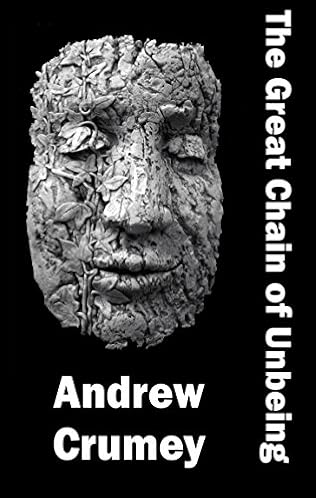
The Great Chain of Unbeing cover

Interzone has sent me Andrew Crumey’s latest novel, The Great Chain of Unbeing, for review. Review to appear in Interzone 275, May-Jun 2018.

Not the most prepossessing of covers, but I shan’t judge it on that.

Crumey has been one of my favourite authors since I first read Mobius Dick in 2010. Not one of his books has so far proved a disappointment. Let’s hope The Great Chain of Unbeing lives up to the standard he has set for himself.

Interzone 274 Has Arrived

Interzone 274 cover
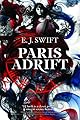
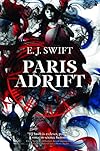
Paris Adrift cover

After its brief hiatus, Interzone is back, this time with issue 274.

Among the usual selection of goodies – including no less than seven stories – this issue contains my review of Paris Adrift by E J Swift.

Interzone 274

Paris Adrift cover

Interzone has been taking a wee break.

The next issue, no 274, is though, I believe, scheduled to be published in March.

In the meantime I have received a copy of Paris Adrift by E J Swift for review in that number. She is the author of a trilogy which I’m afraid I haven’t read.

I have sampled her shorter fiction though.

Interzone 273

 Interzone 273 cover

Erica L Satifka’s Editorial states her surprise and delight at winning the best newcomer award at Fantasycon for her novel Stay Close. Jonathan McCalmont’s column1 comments on the ebb and flow of the Science Fictional year due to the awards cycle and bemoans the narrowing down of discourse to only the professional sphere. Nina Allan extols the merits of the French short SF film La Jetée. Book Zone is now relegated to coming after Nick Lowe’s Mutant Popcorn film reviews. This edition features my review of Frances Hardinge’s A Skinful of Shadows plus others on Gnomon2 by Nick Harkaway, 2084 an anthology edited by George Sandison, Raven Stratagem by Yoon Ha Lee, Tricia Sullivan’s Sweet Dreams, the new Ann Leckie, Provenance, Jane O’Reilly’s Blue Shift, Jane Yolen’s collection, The Emerald Circus, the tie-in book to the Channel 4 series Philip K Dick’s Electric Dreams, Jeanette Ng’s Under the Pendulum Sun: a Novel of the Fae and The Overneath3, a collection by Peter S Beagle.

In the fiction we have:-
Looking for Laika4 by Laura Maro, an altered history where the Soviet Union seems to have survived longer than in our timeline. An adolescent with fears of atomic conflict consoles his younger sister with tales of Laika the first space dog travelling the universe in search of a better planet. Off-stage in this story London is immolated in a nuclear strike.
After the Titans5 by Rachael Cupp is a fabular construction in a bucolic setting where Titans roam the land and ordinary folk are as flies to the gods.
In the future of Dan Grace’s Fully Automated Nostalgia Capitalism people are pervaded by mites of all sorts that protect them from the harmful effects of smoking and the like. But the mites also act as agents for control. Nevertheless petty acts of defiance are possible.
The Big So-So6 by Erica L Satifka is set in the aftermath of an alien takeover where they used a drug to pacify and classify the populace. Then they withdrew it and themselves.
The Garden of Eating7 by R Boyczuk riffs on the Garden of Eden theme in a post-apocalypse setting where an (AI?) remnant of the UN counsels a young boy against a police-like entity called the Amerigun.
James White Award Winner The Morrigan8 by Stewart Horn is narrated in a style flavoured by demotic Glaswegian. While well-written it depressingly panders to the “hard man” image and the gang culture by describing the influence of the (possibly other-worldly) woman who instigates the biggest gang fight in Glasgow’s history.

Pedant’s corner:- 1“less time, less money, and less staff,” (I know staff is technically singular but fewer staff is a more natural usage,) “that might have an influence on the discourse: Ordinary fans (surely needs a full stop. Not a colon.) 2 “into which a body is broke” (broken?) 3”The sheer breath of theme” (breadth,) “eventually a pair of elderly Turkish mystics take the tenants to..” (a pair takes,) “characters getting out of their depth” (characters, so depths,) “in which monarch’s relinquish power” (monarchs,) “intervenes in a case of marital fidelity and creates chaos” (infidelity? Possibly not.) 4“Taken a deep shuddering breath, and began to read” (the previous sentence was in the pluperfect so begun to read,) “they lay in rows” (this one is present tense, so “they lie in rows”. Mauro has the preterite, lain, correct, though.) 5To emphasise the ‘ancient’ nature of the tale this has a ligature between the letters s and t – as in st – when they occur consecutively within a word. “I say, May all creatures tremble,” and, “He says, Make to me a sacrifice” (why not put in the quote marks?) Cronus’ (Cronus’s.) 6written in USian, “none of them look at us” (none looks.) 7Written in USian. 8Crosslea park (that’s a proper noun so Crosslea Park,) “‘They’re gonnae to be” (no “to” required,) “like was made for cutting” (like it was made for cutting.)

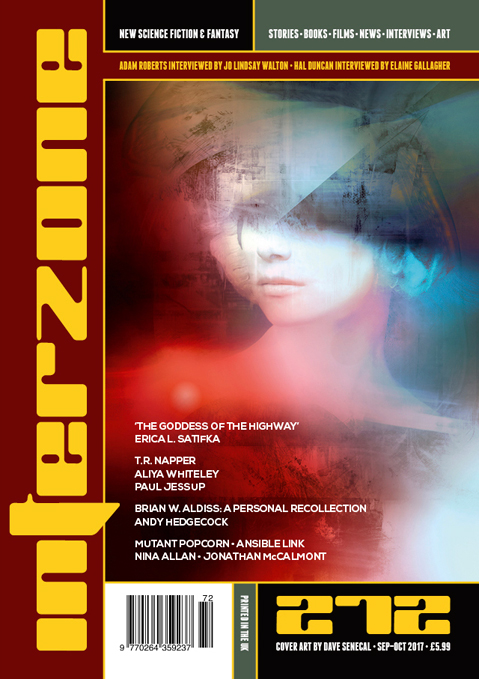
Interzone 272, Sep-Oct 2017

TTA Press

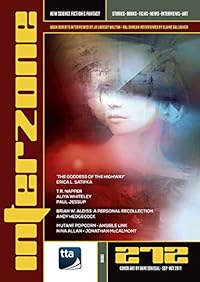
Interzone 272 cover

Andy Hedgecock’s Editorial1 is an appreciation of the late Brian Aldiss of blessed memory. Jonathan McCalmont2 ponders the uses of allusion, contrasting the reductive and lazy with the dense or expansive. Nina Allan welcomes post-SF. Book Zone has an interesting and discursive author interview by Jo Walton3 with Adam Roberts to tie in with his new novel The Real-Time Murders but neglects to review the book. Duncan Lunan4 reviews Paul Kincaid’s book of criticism Iain M Banks mostly by relating his experiences of the late master. There is also Juliet E McKenna’s take on Charles Stross’s Delirium Brief, Stephen Theaker5 on Ada Palmer’s Too Like the Lightning while John Howard reviews Xeelee Vengeance by Stephen Baxter, with the final item a review of Hal Duncan’s A Scruffian Survival Guide by Elaine C Gallagher who also interviews6 the author.
In the fiction:
As the world slowly rebuilds after war and ecological disaster, Blessings Erupt by Aliya Whiteley tells the story of the last of the original plastic eaters, consuming the hydrocarbon-based tumours that afflict the population in return for years of service to the company he represents.
The Music of Ghosts7 by Paul Jessop is set on a generation starship after Earth has been destroyed. The voyagers’ essences are supposed to be uploaded into the library after their death but things go wrong.
In a Melbourne fifty years past any relevance it ever had Ghosts of a Neon God8 by T R Napper tells of two small time crooks who are unwittingly embroiled in a dispute between the Chinese who run the place.
A white mist of unknown origin – possibly alien, possibly human – has “clouded cognitive processes and slowed down conscious thought” and in Erica L Satifka’s The Goddess of the Highway9 people are fitted with plates in their heads in a caste system to suit each to their new roles. Viewpoint characters Harp, a Plastic who monitors a truck criss-crossing the former US, and Spike, a Platinum, come together to try to join the resistance. The titular goddess may be a manifestation of the plates.

Pedant’s corner:- 1Aldiss’ (Aldiss’s.) 2Written in USian, “the crowd are right” (the crowd is.) 3Lord Peter Whimsy (did Roberts actually say that? I believe him capable of such punnery but in English English – as opposed to Scottish English – the correct, Wimsey, and the pun, whimsy, are much less distinguishable,) descendent (descendant,) 4Banks’ (Banks’s,) “human affairs are so complex than any stance (that any stance,) 5“A series of innovations have set this world apart” (a series has,) 6fit (fitted) 7Written in USian, “the sun grew wane and hungry with light” (wan?) “the whirring of machines are chugging” (the whirring is chugging but even that is clumsy.) Ray stops programming for a moment and touches Ray’s hands” (Mark’s hands.) The story is riddled with errors in tense. It’s written in the present but has past tense verb forms intruding, “He’d been training for this day” (He’s ) “And his heart was a wild thing inside his ribs” (is.) “They ran into the storage facility” (run,) “and then she turned” (turns.) 8“Now it may as well not even existed” (exist,) his practiced stride (practised,) focussed (focused.) 9Written in USian, hocking up (hawking,) “the majority of what gets shipped are luxuries” (the majority is,) “intersecting a round sphere” (I’d like to see a sphere that isn’t round!)

Interzone 273

Interzone 273 cover

Interzone 273 has arrived.

Included along with the usual columns, fiction and reviews this one contains my review of Frances Hardinge’s A Skinful of Shadows.

I note the Book Zone now occupies the last part of the magazine, its order having been swapped with Nick Lowe’s film reviews.

Interzone 271, Jul-Aug 2017

TTA Press

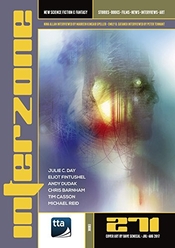
Interzone 271 cover

Roy Gray takes the Editorial and describes a visit to the summer’s Barbican exhibition, Into the Unknown: A Journey Through Science Fiction. Jonathan McCalmont discusses China Miéville’s history of the Russian Revolution October, describing it as the book Miéville was born to write. Nina Allan again reflects on SF’s distinction or otherwise as a genre and the necessity to question and reinvent its tropes. Book Zone1 has appreciative reviews of Nina Allan’s The Rift and Emily B Cattaneo’s collection Speaking to Skull Kings and Other Stories plus author interviews with the pair and also considers novels from Eleanor Lerman, Aliette de Bodard and Taiyo Fuji along with Ex Libris, an anthology of stories set in libraries, not to mention my review of Justina Robson’s The Switch.

In the fiction:-
Julie C Day’s The Rocket Farmer2 has three narrative viewpoints in its 10 pages: the descendant of a long line of Mongolian rocket farmers, her daughter, and one of the rockets. It is the daughter who is the first to truly understand the rockets.
Gods in the Blood (of those who rise)3 by Tim Casson is narrated by a science teacher (who has rather unprofessional biological deterministic views about his charges I must say. But these turn out to be plot related.) The nearby Genomic Innovation Facility is manipulating human epigenetics. All this is tied in with a legend from a Sumerian manuscript.
In If Your Powers Fail You in a City Under Tin4 by Michael Reid a tentacled creature called the God Beast has settled in the sky over the city now called Duolunduo. Some people have developed superpowers as a result.
The titular Chubba Luna5 in Eliot Fintushel’s story is an interplanetary music star in a future where people’s life partners are allotted to them in accord with their biochemistry. This doesn’t turn out any better than choosing them for yourselves.
Chris Barnham’s When I Close My Eyes is a mix of SF and ghost story. It is the tale of the first potholer on Titan, a man who hallucinates his dead wife while encountering extraterrestrial life after being trapped by an ice-fall.
The McGuffin of Cryptic Female Choice6 by Andy Dudak is a spermathecal, a mechanism introduced to the womb by virus which allows women to store various men’s sperm and edit their content to produce a desired genome. The societal backlash is portrayed.

Pedant’s corner:- 1“while allowing they catch up” (allowing them to catch up,) “how do you feel it has effected your life as a writer” (affected,) Goss’ (Goss’s.) 2Written in USian, “so that it spread across the table” (the rest of the story is in present tense, so “spreads”,) practicing (practising.) 3where a bunch of other kids were gathered (a bunch was gathered.) 4Written in USian, ”none of them recognize” (none recognises,) “‘can you come with?’” (with me,) “he shines it on the floor near the figure, trying not to startle them” (not to startle it.) 5Written in USian. 6Written in USian, inside of (inside,) “there used to be hundreds of words for love like Inuit words for snow” (isn’t that snow thing a bit of a myth?)

Interzone 270, May-Jun 2017

TTA Press

Interzone 270 cover

The Editorial apologises for housekeeping issues not entirely within the magazine’s control, Jonathan McCalmont’s column argues for a recognition that the SF and Fantasy community still has a lot to do to welcome and encourage, writers and readers of black or other “minority” (my quotation marks) background, instead of discouraging them as at present, Nina Allan1 reflects on her experience as a shadow Clarke Award judge and concludes that it is difficult to argue for SF as any longer being distinct from wider literature; a novel is good or it isn’t regardless of its origin or intent. Book Zone contains Paul Kincaid’s* review of Kim Stanley Robinson’s 2140, reviews of the latest novels from Clare North2 and Cory Doctorow plus the collaboration between Andrew Lane and Nigel Foster as well as collections by Ellen Klages and regular Interzone contributor Malcolm Devlin (who is also interviewed) along with my review of Karen Hurley’s The Stars are Legion.
(*Kincaid mentions austerity as being needed to pay for the bank bailout after the 2008 financial crisis. It wasn’t. The economy was beginning to recover by the time of the 2010 election. Austerity was a choice made by the incoming government for ideological, political, reasons. The bailout merely provided the excuse for its imposition. And the measures killed the recovery stone dead.)
As to the fiction:-
In Rushford Recapitulation by Christopher Mark Rose3 women in Rushford, New York, start giving birth to technological artefacts, bringing a rush of visitors, protesters, pregnant mothers. The technology becomes less advanced as time goes by.
Like You, I am a System4 by Nathan Hillstrom features an intelligence of silicon and electric current coming to consciousness and taking over its environment. Then it interferes in the wider world.
Dirty Code5 by Wayne Simmons is set in what appears to be a simulation. The protagonist keeps waking up with a new face and is in the employ of someone who wants him to get rid of those passing on the titular dirty code by infecting others via activities in strip clubs and the like.
Encyphered by Jonathan L Howard is the life story of a man obsessed with cyphers, determined to keep his secrets (after all, we all have them) to himself till the day after his death. It is also a potted history of cryptography and cryptanalysis and contains the wonderful observation, “In those halcyon days before successive austerities and unimaginative governments, the library was a mighty thing indeed.” I’m struggling to see it as either SF or fantasy though.
In The New Man6 by Malcolm Devlin a man killed in an accident in the warehouse of the cloning company where he works is, to make them look good, revived in one of their bodies. His new body is the basic model though. The warehouse seems absurdly low-tech for a company making such a modern product.
Evangeline and the Forbidden Lighthouse7 by Emily B Cattaneo is a tale of childhood friendship, messages in bottles, roads not taken, the regrets of adulthood and that tantalising, inaccessible, forbidden lighthouse. All this in only eight pages.
In Memories of Fish8 by Shauna O’Meara virtual tourism enabled by drone footage is the big online attraction. A young woman at the viewed end takes a drone on a journey through areas the local authorities don’t want seen. While the story’s target is compassion fatigue it strays close to perpetuating the idea that dreadful living conditions in traditionally poor countries cannot be ameliorated. Since the viewer’s country had suffered extreme drought the story might have had more punch if the situations of viewer and viewed had been reversed.

Pedant’s corner:- 1focussed (focused.) 2involunatary (involuntary,) and a sentence with four verbs whose subject is team, the first verb is singular (tick) but the remainder plural. 3written in USian; “far ahead or behind schedule” (far ahead of or behind schedule,) “Rushford’s human inhabitants where healthy and normal” (were healthy,) blunderbuss (blunderbusses,) “Inca kuipu” (quipu.) 4written in USian; ”none of you pick your own nodes” (picks.) 5written in USian despite the author being Northern Irish. 6over emphatic (over-emphatic makes more sense,) fit (fitted,) “the both of us” (no “the”; just “both of us”.) 7Written in USian. 8”that this where she lives” (that this is,) “the olfactory interpreter’s best attempt at recreating a stench that is probably far worse in person” (in person is for, well, a person; not a smell; “in reality” fits better here.)

Interzone 272

Interzone 272 cover
A Skinful of Shadows cover

Two packages from Interzone have arrived.

The latest issue, Interzone 272, containing all the usual but no contribution from me this time.

An ARC (uncorrected proof) of A Skinful of Shadows by Frances Hardinge for me to review for the next issue.

Ms Hardinge is another writer new to me though her entry on Fantastic Fiction lists seven previous books by her. Most seem to be fantasy works.

free hit counter script