Archives » Interzone

Another Review Book

My latest review book for Interzone is by Jen Williams, another writer new to me.

Ms Williams’s novel, her first, is entitled The Copper Promise and has a 2014 copyright date.

Plenty of time for this. The review – for Interzone 251 – is not due in till the end of January.

It’s a bit early yet for Interzone 250, which will contain my review of Alastair Reynolds’s On The Steel Breeze , Book 2 of his Poseidon’s Children series.

Review Delivered

My review of Alastair Reynolds’s On the Steel Breeze has been forwarded to Interzone.

Reviews head honcho Jim Steel tells me I was first in this time. (We aim to please.)

It’s due for Interzone 250, Jan-Feb 2014.

On The Steel Breeze

My latest book for Interzone review is Alastair Reynolds’s On The Steel Breeze, second in the Poseidon’s Children series, the first of which, Blue Remembered Earth, I read only a couple of weeks ago.

It’s a bulky beast and was too big for my letter box. Just as well I was not in a state of indecency as I had to open the door to the postwoman.

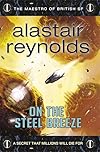
The cover of On The Steel Breeze is emblazoned “The Maestro of British SF, A Secret Millions Will Die For.”

Is he?

Planesrunner by Ian McDonald

Everness Book 1. Jo Fletcher Books, 2013, 373p. Reviewed for Interzone 246, May-Jun 2013.

Tottenham Hotspur supporter, school team goalkeeper and fine Indian cook, Everett Singh witnesses the kidnap of his physicist father, Tejendra, just before they were due to meet on an access visit. He provides the police with mobile phone photos of the kidnap. When his dad’s boss, McCabe, turns up asking if Tejendra had left Everett anything, Everett knows something more profound is afoot. Moreover, when his pictures are returned they have been altered. And he is being followed to school and back. As we are immersed in Everett’s world his mistrust of the police and the strained relationship with Everett’s mother these encounters engender are portrayed well, though like all young protagonists Everett is perhaps just a touch too knowing.

Soon a mysterious folder marked “Infundibulum” and obviously left by his father appears on Dr Quantum, Everett’s laptop. Everett knows infundibulum means “bigger inside than out” – references to Doctor Who follow – and recognises the contents as a representation of the multiverse. His father named him after the creator of many worlds theory and he has always been able to think in up to seven dimensions. This facility allows Everett to tie the Infundibulum topologically into a map of the many worlds. Another of his father’s colleagues has given him clandestine information about the success of the many worlds project and footage of other universes from beyond the Heisenberg Gates. Ours is E10 in the Plenitude of Worlds but none of the others has a map, only Everett. This scenario may have been too much for most writers to pull off but McDonald’s exposition of the arcane details is lucid and he uses all this only as a jumping off point. The necessity for plot to rumble on, though, for action, marks this out as a YA novel. Indeed there are echoes of The Northern Lights – not the least of which is the increasing presence of a powerful villainess, Charlotte Villiers – which, given the target audience, is no bad comparison. Echoes of this kind are almost inevitable when the necessity of holding a young audience’s attention is taken into account. There is plenty to keep the adult reader going too, though.

Armed with his knowledge Everett contacts McCabe and is transported to where the many worlds project has its base near the Channel Tunnel. Diplomats from the Plenitude are present as Everett demonstrates the ability of his map to target contact with other worlds. One of them threatens him with a strange gun and he jumps through an open gate into E3, a world with no oil-based technology, where rugby is the main spectator sport – and where Everett only has himself to rely on. This is one of the (arguably necessary) perennial features of “children’s” fiction: the adventure can only begin if no parents are around to prevent it. The stories are usually the better for it.

Everett finds a library and researches his new environment, quickly working out that the Plenitude is probably keeping his dad in the Tyrone Tower.

Later, on the underground, Everett meets the wielder of a strange tarot deck, a young girl called Sen Sixsmyth, who tries to filch Dr Quantum, but Everett decides to befriend her. Sen turns out to be an Airish – crew of the airships which ply the skies of E3. Her home is the Everness, whose captain is her adoptive mother and whose crew includes a “Southern” gentleman addicted to quotations and a Scottish accented guy in charge of the engines. “Captain, I canna get full power when there’s no engine…” Due to his culinary skills Everett is accepted as a crew member and the real fun starts.

To communicate with each other the Airish use a version of Polari, in our world an argot of gay subculture. (This reference would surely go over the heads of most YA readers were an explanation and glossary not supplied at the end.) The Airish have their own customs and loyalties and not a few colourfully named individuals. Any discrimination Everett experiences on E3 is not due to his skin colour but that he is now Airish.

The details of this other world feel right even if they are a touch old-fashioned but it is a kind of steampunk scenario after all. Moreover it is one which McDonald clearly has enjoyed creating. Set pieces including Sen penetrating the Tyrone Tower, the inevitable pursuit by Charlotte Villiers and a battle between airships for arcane Airish reasons keep things moving nicely.

Being part 1 of the Everness series nothing is truly resolved by the end of Planesrunner but the dénouement and the setting up of the sequel have a logic of their own, consistent with what has led up to them.

Planesrunner is bona stuff. One might even say fantabulosa.
Latest Reviews

Interzone 248 (Sep-Oct 2013) with my review of Catherynne M Valente’s Deathless has been out for a few weeks now.

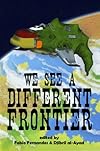
My review of We See a Different Frontier: A Post-colonial Speculative Fiction Anthology for Interzone 249 (Nov-Dec 2013) has been submitted.

We See a Different Frontier

My latest review for Interzone – now arrived – will be of the above book, a collection of stories of the colonial experience written from the perspective of the colonised.

I have been as yet unable to source from the internet a picture of the cover.

Review Delivered

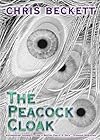
The Peacock Cloak cover

My review of Deathless by Catherine M Valente has now been sent to Interzone.

It will appear in the Sep-Oct edition, issue 248.

Issue 247, with my review of Chris Beckett’s collection The Peacock Cloak ought to be available soon, if not already.

Deathless Interzone

My latest review book for Interzone is Deathless by Catherynne M Valente.

Ms Valente is new to me but the blurb seems interesting as it promises a combination of fairy tale (Fantasy elements then) and Russian History.

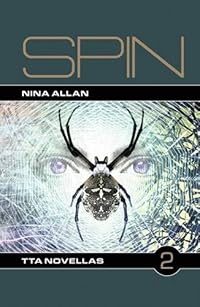
Spin by Nina Allan

TTA Press, 2013, 92 p.

Novella no. 2 from TTA Press, publishers of Interzone and Black Static.

This is a strange atmospheric piece, very well written.* It is set in a Greece where iPads and emails are in everyday use and holographic people are difficult to discern from real ones but triremes roam the seas and Carthage has fought a war with Corinth within the past 100 years.

When narrator Layla Vargas was young her mother was executed in a bizarre way for having unnatural powers. Layla has now grown and set out for a new life in Atoll City. On the bus on the way she meets an old woman who will influence her future. Layla’s uncommon ability to sew tapestries attracts the attention of a woman whose son has a strange disease and who wishes Layla to cure him. Layla is reluctant to be thought unusual.

Despite the SF trappings there is throughout the feel of fantasy and the dénouement is firmly fantastical. It was refreshing to read a piece in that vein not firmly rooted in mediævality.

The writing is measured and beautifully modulated, the characters rounded and believable. The story concluded a bit like a popped balloon though, all the intrigue that had been carefully built up thereafter more or less dribbling away. It was as if Allan had come up against her word limit and had to find a way to stop. That’s a pity as there was scope here for more exploration of the scenario and greater length. Allan knows what she is doing though and does it well.

*It is a pity, however, that in a novella entitled Spin there is a “span” count of 1.

Interzone 246 and the James White Award

TTA Press, May-Jun, 2013.

Interzone 246

This accompanied Nina Allan’s Spin, a TTA novella which I have promised to review here. My review of Ian McDonald’s Planesrunner appears in this issue, which I assume I received as a contributor’s copy.

The Machinehouse Worker’s Song by Steven J Dines
Men work stoically at their shifts in a machinehouse which they cannot leave until they succumb to an apparently psychological sickness, or death. The story is set at a time when only two of them remain.

Triolet by Jess Hyslop
Mrs Entwistle grows poems (which seem to be exactly like flowering plants but speak their verses when touched.) One day she gives James and Lisa a triolet. Its repetition presages alteration.

Sentry Duty by Nigel Brown
An alien stands guard for her Sisterhood and interacts with the human whose skycart has landed in their territory. This story would not have been out of place in a 60s SF magazine.

The Angel at the Heart of the Rain by Aliette de Bodard
An immigrant from a war torn country comes to terms with her new existence.

Thesea and Astaurius by Priya Sharma
A reworking of the Minotaur story featuring the woman Thesea. Minos is a blood-crazed madman and Deadalus wields modern technology.

The Core by Lavie Tidhar
Achimwene follows his lover Carmel through Central Station. She is a strigoi, a data vampire to whom the Station’s children are attracted. A strange piece, undermined for me
by the use of the word “faint” once each in the first two lines, describing respectively the light and a glow.

Cat World by Georgina Bruce
Narrated by an eight year old girl, an orphan who lives on the streets with her sister. Flavoured chewing gum takes their minds into Cat World. Her sister disappears and she has to fend for herself.

The James White Award is a short story competition open to non-professional writers and judged by a panel of professional authors and editors. The winner receives a cash prize, a trophy and publication in Interzone. This year’s winner, selected by Aliette de Bodard and Ian McDonald, was:-

You First Meet the Devil at a Church Fete by Shannon Fay
A well written tale narrated by one Stuart Sutcliffe, who is tempted by the devil with promises of the band he’s in with John and Paul – and George – becoming big. Stuart turns him down. The rest is history.

free hit counter script