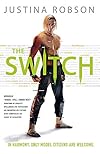
The Switch by Justina Robson
Posted in Justina Robson, My Interzone Reviews, Reviews published in Interzone, Science Fiction at 20:00 on 21 July 2018
Gollancz, 2017. Reviewed for Interzone 271, Jul-Aug 2017.
On Harmony, isolated from the rest of the Diaspora, balance is everything. It is ruled by a theocracy known as the Alchemy. Driven by its founder, Tecmaten, the Alchemy seeks to create, by non-technological manipulation of DNA, the pinnacle of human development; people called Exalted who have special powers. It teaches everything is twofold, arising from twinned energy flows; it preaches light must always be balanced by dark. Consequently it has a sister dark-side city, Chaontium, to which – since rejects must be treated with mercy – they are consigned.
Instead of a tidy sun and moon, one such reject, narrator Nico Perseid, a male homosexual, is composed of two suns. Even in Chaontium consummation of such sexuality is illegal as it would be a meeting of four suns and so burn through the fabric of reality.
We first encounter Nico when he is on trial for the murder of Chaontium gang boss Dashein VanSant, a rap for which he has been promised escape from the death penalty. This is not his first such deliverance. Chapter two flashes back to his childhood in Chaontium’s state orphanage where he met his lifelong friend Twostar Fae. They seized a chance to flee but Nico was hit by a car. Seemingly dead, he was revived by a bystander whom Twostar thinks was an Exalted. Nico, though, doesn’t believe in the theology of the Alchemy or its woo – “spooky bullshit nobody can prove”. In a kind of foreshadowing that is slightly over-egged he also occasionally sees a minotaur.
For Nico and Twostar life in Chaontium is a continual struggle till they are taken in by a gang. He is kidnapped by VanSant for a career in a variety of kickboxing which reads more like lethal cage-fighting. Under the guise of a wetware upgrade to prevent him dying in the ring Nico undergoes an operation to insert a pilot switch – provided by Twostar’s lover Tashin DeKalfu – a piece of Diaspora tech capable of synching with a starship; the only way out of Harmony except death. He wakes up to the murder charge and Tashin’s betrayal, the presence in his head of a Forged Interface, a Chimeric Avatar Switch, a Transhuman converter which can interface with anyone else and allows “Tek or Forged ships to pilot human or other biological avatars”. In other words, telepathy and remote sensing with a gloss of rationalisation.
An awful long time is spent on this set-up but from hereon in the focus is on Tashin’s agenda, the penetration of the Alchemy to try to prove it has been trading illegally offworld. Finally, we have the revelation of where and what Harmony actually is.
Nico is an engaging enough narrator, albeit overfond of expletives, but naturally impatient of the world he inhabits, “Cisnormativity. That isn’t even a word. It shouldn’t even be an idea. It should be destroyed in hellfire.” Despite his disparagement of woo and The Alchemical Wedding (the locus where mysticism, symbolism and reality meet to give rise to a new kind of being,) his encounter with the powers of mind of the Exalted and witnessing an apparent resurrection (or, “reanimation by goldlight intervention”) leads to some musing on the possibility of souls, of energy that exists above and beyond that of body and mind.
There is an idiosyncratic approach to chapter titling (One: is the loneliest number; Seven: sins; Three Threes – the charm; Light the Blue Touchpaper and Count to – Ten; Thirteen. Triskaidekaphobia can kiss my ass,) but these also give a flavour of Nico’s irreverent narrative style. There are times when the information dumping tends to be ad hoc but Robson has deployed a good coinage in the word datmosphere. There are some instances of odd syntactical choices, verb tense anomalies and phrases like “coins down the back of the sofa” and “Defcon One” which hauled me back out of Nico’s frame of reference into our own.
The setting is undeniably Science Fiction but, since the Exalted’s abilities are never truly explained hence might as well be magic, the whole seems an odd blend with outright fantasy and we don’t see enough of Nico’s early relationship with Twostar to make his enduring attachment to her entirely credible.
Fittingly there is a claustrophobic feel to the novel but it all feels rather breathless. Interesting but flawed, The Switch somewhat ironically suffers from a lack of balance.
Pedant’s corner:- a missing comma before a quote, (x 2,) “you do the math” (it’s maths,) ass (arse,) “a host of burning issues were eating him up” (a host was,) Daylus’ (Daylus’s,) “than I would’ve betted he could” (than I would’ve bet.) Dashein spelling varies with Dashain.