Archives » Ian Sales

Adrift on the Sea of Rains by Ian Sales

Whippleshield Books, 2012. 54p plus 21p appendices.

Not only does the usual warning apply to this review, the book has a quote from me on its back cover.
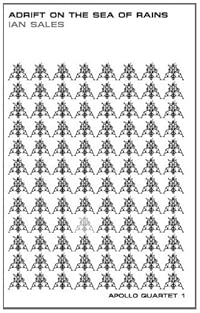
 Adrift on the Sea of Rains cover

In a timeline where NASA did not abandon Moon landings and the Cold War gradually became hotter and hotter before finally boiling over, a group of US astronauts is stranded on the Moon with the Earth only a devastated, barren cloud of dust in their sky. Their only hope of survival is a piece of weird Nazi tech “liberated” at the end of WW2, a “torsion field generator” known as the Bell, which one of them is using to try to jump into a universe where life on Earth is still intact. This ongoing story strand, told in an urgent present tense, is interspersed with the back story of Colonel Vance Peterson, a gung-ho USAF pilot whose past is related, in reverse, in italic sections with larger page margins. After several abortive tries with the Bell a shift at last brings a blue Earth. There is no radio contact but telescopes reveal a space station in Earth orbit. The astronauts cobble together fuel and a return vehicle from the left over Lunar Descent modules scattered near their Mare Imbrium base. Peterson flies it “home.” To reveal what welcomes him would be a spoiler.

Both narratives are seen from Peterson’s viewpoint and crammed full of the alphanumeric soup that was/is NASA speak. I must say, though, I wasn’t entirely convinced by Peterson’s blinkered psychology.

An abbreviations section is provided in the appendices for those who need it and a glossary reveals the history of the US and Soviet space programmes in the altered timeline. Sales’s research is not exactly worn lightly – the man has probably forgotten more about the space programme than I ever knew – but it adds a high degree of verisimilitude and is arguably necessary.

Overall, though, this story stands comparison with any of those nominated for the recent BSFA Awards.

And the quote? “Science Fiction as it might have been. A FALL OF MOONDUST meets DR STRANGELOVE – with a dash of The Cold Equations.”

Rocket Science

Rocket Science

As well as publishing his own book Adrift on the Sea of Rains, Ian Sales has been editing the anthology Rocket Science which is being launched this weekend under the imprint of Mutation Press.

Mutation Press’s previous venture, the anthology Music for Another World, was full of high quality content. I expect no less of Rocket Science.

My Second Blurb

Ian Sales (see link to his blog on my side-bar) has a book out.

Well, not quite. It’s actually a short story in book form, the first in a projected series. Its full title is Apollo Quartet 1: Adrift on the Sea of Rains.

Ian asked some people to provide comments to put on its cover. One of them was me! (We call it “blurbing.”)

It’s only the second time I’ve ever been asked to provide a blurb. The first was for David S Garnett’s Bikini Planet but he’d asked just about everyone he’d ever bought a story from to do it so that doesn’t really count. Those quotes took up three pages.

I don’t yet know if Ian has included the quote I gave him.

His book will be available in hard- and paperback and copies will be on sale at Eastercon.

Rocket Science?

There are two interesting posts over at Ian Sales’s blog.

The first is an attempt to (re)define “hard” SF. As far as he sees it – and I largely agree – this is SF that is bound, more or less, by known physical laws, by the restraints inherent in, for example, Physics and Chemistry.

In this regard any use of the trope of, for example, faster than light travel is – despite decades of convention and use in what might otherwise be considered hard SF stories – not hard SF in the strictest sense, as, to our best knowledge, the speed of light is an insurmountable barrier.

This is not to decry other types of SF (which are perfectly legitimate) merely to say that they go beyond the bounds of the known and, in the case of Space Opera in particular, which cleaves the paper light years with carefree abandon, actually tend towards wish-fulfillment. Though of course there is the necessity of getting characters from here to there in a reasonably efficient, non-boring manner.

It is amusing to recall here what is perhaps the most famous phrase in Science Fiction – certainly in its dramatic form, “Ye cannae change the laws of Physics, Captain.” This from a TV programme which made a habit, nay a virtue, of portraying just that.

Ian makes a distinction between hard sciences (Cosmology, Physics, Chemistry) and softer ones such as Psychology, Archaeology and Anthropology. While agreeing that the term is most often interpreted this way I wouldn’t myself say that stories featuring these could not be hard SF.

The second of his posts is an announcment that he will be editing an anthology of… hard SF; to be called Rocket Science.

No need to rush. Submissions will not be accepted till 1st August.

Rocket Science is itself a term that has often irritated me as it is most often heard in the phrase, “It’s not rocket science, is it?” as if rocket science was at the cutting edge, inherently incomprehensible. As Ian points out in his post, the science of rocketry – as opposed perhaps to some of its technological aspects – has, due to its basis in chemical reactions whose energetic outcomes are limited and, moreover, fixed – not evolved much in a century.

I know it’s use is as much metaphorical as anything else but I’ve always felt tempted to respond to anyone who trots out the, “It’s not rocket science,” line, that rocket science isn’t rocket science.

Rocket Science, however, may be.

The Women’s Press SF Line

Further to Ian Sales‘s meme about women SF writers he posted an item about The Women’s Press SF line which was published in the 1980s in a distinctive grey border and spine with cover art in a characteristic style.

The usual applies. The ones in bold I’ve read. (Edited to add. Since then I’ve read the ones asterisked.)

1. Kindred, Octavia Butler
2. Walk to the End of the World and Motherlines, Suzy McKee Charnas*
3. The New Gulliver: Or The Adventures of Lemuel Gulliver, Jr. in Capovolta, Esmé Dodderidge
4. Machine Sex and Other Stories, Candas Jane Dorsey*
5. Native Tongue, Suzette Haden Elgin
6. The Judas Rose, Suzette Haden Elgin
7. The Incomer, Margaret Elphinstone*
8. Carmen Dog, Carol Emshwiller*
9. The Fires of Bride: A Novel, Ellen Galford
10. The Wanderground, Sally Miller Gearhart
11. Herland, Charlotte Perkins Gilman*
12. Despatches from the Frontiers of the Female Mind, Jen Green & Sarah LeFanu*
13. The Godmothers, Sandi Hall
14. Women as Demons, Tanith Lee
15. The Book of the Night, Rhoda Lerman
16. Evolution Annie and Other Stories, Rosaleen Love
17. The Total Devotion Machine, Rosaleen Love
18. The Revolution of Saint Jone, Lorna Mitchell*
19. Memoirs of a Spacewoman, Naomi Mitchison
20. The Mothers of Maya Diip, Suniti Namjoshi
21. Planet Dweller, Jane Palmer*
22. The Watcher, Jane Palmer*
23. Woman on the Edge of Time, Marge Piercy*
24. Star Rider, Doris Piserchia*
25. Extra(Ordinary) People, Joanna Russ
26. The Adventures of Alyx, Joanna Russ
27. The Female Man, Joanna Russ*
28. The Hidden Side of the Moon, Joanna Russ
29. The Two of Them, Joanna Russ
30. We Who Are About To.., Joanna Russ
31. Queen of the States, Josephine Saxton*
32. Travails of Jane Saint and Other Stories, Josephine Saxton
33. I, Vampire, Jody Scott
34. Passing for Human, Jody Scott*
35. A Door Into Ocean, Joan Slonczewski*
36. Spaceship Built of Stone and Other Stories, Lisa Tuttle
37. Across the Acheron, Monique Wittig

Only three out of 37 and two by the same author.
Mind you, a lot of SF by women wasn’t available to The Women’s Press as it was published elsewhere. That’s my excuse anyway.

Science Fiction Mistressworks

There’s an interesting conversation going around vis-a-vis Science Fiction so-called Masterworks.

Both Ian Sales and Paul Raven over at Futurismic have commented on the lack of female writers in the Gollancz series. Ian has even gone so far as to produce a meme listing 91 women Science Fictioneers.

There is perhaps a need to boost the recognition of the contribution of women to the genre (The Women Men Don’t See) though I have the impression there are more about than there were but as a contest this isn’t one.

Ursula Le Guin trumps everyone.

Everyone, female or male.

Even Robert Silverberg.

Science Fiction And The Future

Recently Elizabeth Bear, guesting on Charlie Stross’s blog, and Ian Sales have commented on the writing process especially as it applies to Science Fiction.

Both touch on what is SF and what is not.

Bear bemoans the expectation that SF writers know what the future will be like.

We don’t of course. No one does. At best we can suggest possibilities and post warnings.

Bear states what is obvious with a little thought: that she writes for today’s audience about today’s concerns.

Sales also emphasises the point that SF writers are only ever actually writing about the present and then proceeds to wax more or less lyrical on the info dump and its special salience, necessity even, in the SF story.

For anyone interested in writing both posts are worth a look.

free hit counter script