The Marriage Portrait by Maggie O’Farrell
Posted in Other fiction, Reading Reviewed at 12:00 on 22 July 2023
Tinder Press, 2022, 446 p.
 In the novel’s first paragraph Lucrezia de’ Medici – married to Alfonso d’Este, Duke of Ferrara, for less than a year – realises that her husband intends to kill her. Forthcoming chapters relating her time at the retreat called Fortezza, near Bondeno, to which Alfonso has taken her, presumably for this sinister purpose, are in the same present tense as this one is. These are interspersed with past tense chapters unfolding the tale of her life up to that point as the third daughter of Cosimo I de’ Medici, Duke of Tuscany.
The second chapter begins, “In the years to come, Eleonora would come to bitterly regret the manner in which her fifth child was conceived.” This, of course, brings immediate echoes of Gabriel García Márquez. Here, though, such a proleptic pronouncement is perhaps more justified since it is not about this story’s future but describing its past. Eleonora’s misgivings are of course borne out since Lucrezia grows up an unusual child, aloof from her siblings. She was drawn to a tigress brought to her father’s menagerie and touched its fur without consequence, she has a great skill in drawing and painting, most of which has to be hidden from those around her – especially her ultra-conventional husband. Her best paintings are only for her own satisfaction, later used as palimpsests for images more acceptable to the wider world.
Alfonso d’Este had originally been betrothed to Lucrezia’s elder sister, Maria, but she unfortunately died. The alliance between the houses of Tuscany and Ferrara then fell on Lucrezia’s shoulders – at the age of thirteen. In the novel Lucrezia is against this even at her marriage’s eve. At its first mooting, her nurse, Sofia, conspires to pretend that she is not yet child-bearing by concealing any evidence of menstruation. Such prevarications had to end of course and Lucrezia is finally wed – to a man she had seen only once before and who turns out to be cruel and vindictive, and since his dynasty rests on shaky foundations, interested only in the provision of an heir.
As a young ingénue, Lucrezia’s ignorance of the politics of the Ferrarese court is exacerbated by Alfonso’s secretiveness about them. His mother had turned Protestant and thus a source of considerable embarrassment, before she fled abroad. His sisters Elisabetta and Nunciata make some efforts to befriend Lucrezia but are in thrall to Alfonso as well as in his power. The example Alfonso makes of Elisabetta’s presumed lover and besmircher of her honour, Ercole Contrari, is gruesome but illuminative of character. And brings home to Lucrezia her powerlessness in her new role.
The marriage portrait of the title (apart from the depiction the novel gives us of the marriage of Lucrezia and Alfonso) has been commissioned by Alfonso from the famed Il Bastianino, who sends his pupils Jacopo and Maurizzio to make preliminary sketches. Lucrezia saves Jacopo’s life by administering milk and honey when she comes upon him comatose in a corridor in the aftermath of a fit of some kind. An immediate connection forms between them. This fateful association provides the lever for the novel’s resolution (in which O’Farrell permits herself to embellish the historical record.)
To modern Western eyes the sacrifice of a young girl on the altar of political or family alliances for dynastic purposes is objectionable. However the practice was unquestioned in historical times and is even yet widespread in other parts of the world. Humans still have a lot of progress to make in the matter of recognising the worth of one half of the species. Then again power corrupts. To be a male underling during the Italian renaissance was also to be (relatively) powerless, as an incident between Alfonso’s right hand man, Baldassare, and a servant illustrates.
While not quite reaching the heights of O’Farrell’s previous novel Hamnet, this is good, readable stuff. She conjures up the society of renaissance Italy well and puts us into the mind of an idiosyncratic young girl not yet fully wise to the ways of her world and shows how it changes her.
Pedant’s corner:- “into narrow streets of the city” (into the narrow streets.) “All is not lost” (Not all is lost,) mink (Lucrezia thinks of this as a comparison to a stone marten in a painting. The European mink’s range did not include Italy but that does not necessarily exclude it from her knowledge,) Hercules’ (Hercules’s,) Zeus’ (Zeus’s.) “‘Did you mother not teach you…’” (your mother,) burglarising (I growled at this. The verb is burgle, not burglarise, the participle required here is burgling.)
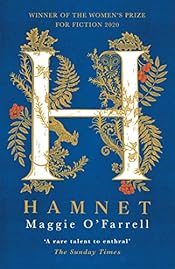 Is there anyone who reads who does not know that Shakespeare had a son called Hamnet, who died as a boy, a name immortalised a few years later in the play titled Hamlet? This is not a spoiler in any case as in a short preface O’Farrell tells us as much, and that Hamnet and Hamlet were the same name, entirely interchangeable in the late sixteenth and early seventeenth centuries.