Under the Glacier by Halldór Laxness
Posted in Fable, Fantasy, Other fiction, Reading Reviewed, Science Fiction at 12:00 on 26 March 2025
Vintage, 2005, 242 p, plus xii p Introduction by Susan Sontag. Translated from the Icelandic Kristnihald Undir Jökli (Helgafell, Reykjavík, 1968) by Magnus Magnusson. First published in English as Christianity at Glacier (Helgafell, Reykjavík, 1972.)
 In her introduction – which, as is usually the best approach with them, ought to be left until after reading the text – Susan Sontag states that novels that proceed largely through dialogue, or are relentlessly jocular or didactic, those whose characters do little but muse to themselves or debate with someone else, or are initiated into secret knowledge, those with characters having supernatural qualities or contain imaginary geography are – despite the long history of the picaresque tale and the many classic stories which exemplify these things – considered innovative, ultra-literary or bizarre, and are given labels to signify their outlier status
Science fiction
Tale, fable, allegory
Philosophical novel
Dream novel
Visionary novel
Literature of fantasy
Wisdom lit
Spoof
Sexual turn-on
and that “convention dictates we slot many of the last centuries’ perdurable literary achievements into one or another of them.” She concludes that thought with, “The only novel I know that fits into all of them is Under the Glacier.”
Our unnamed narrator has been tasked by the Bishop of Reykjavík to journey to the Snæfells glacier to investigate the situation there, where the local pastor Jón Jónsson, known as Prímus (he fixes stoves,) has taken no salary for twenty years. There are rumours the church has been boarded up, the pastor is living with a woman not his wife and he has allowed a corpse to be interred in the glacier.
This is the same glacier to which Jules Verne sent his adventurers under the influence of Árni Saknússemm and the leadership of Professor Lidenbrock to start their journey to the centre of the Earth. Laxness implicitly critiques Verne’s piece of cultural appropriation. The locals at Snæfells do consider the spot to be the world’s centre and have little consideration for the outside world.
The text is in the form of the emissary’s report and during it he only ever refers to himself as the undersigned or the Emissary of the Bishop, soon shortened to Embi. Dialogue is laid out as if in the text of a play and without punctuation otherwise.
Embi, the undersigned, is confused by life at Snæfells. None of his interlocutors seems to give him a straight answer, they talk to him as if he is the bishop and generally are only obliquely forthcoming.
His attitude is that, “‘I was just sent here like any other ass to make inquiries about things that don’t concern me at all and that I don’t care about at all.’”
There is a fair amount of philosophising. A shepherd called Saknússemm II tells Embi, “Of all the creatures that man kills for his amusement there is only one that he kills out of hatred – other men. Man hates nothing so much as himself.”
Pastor Jón says, “‘History is always entirely different to what has happened….. The greater the care with which you explain a fact, the more nonsensical a fable you fish out of the chaos….. The difference between a novelist and a historian is this: that the former tells lies deliberately and for the fun of it; the historian tells lies in his simplicity and imagines he is telling the truth.’”
Dr Godman Sýngmann has a robust take on religion, “‘The Christians without ceremony stole from the Jews their national literature and added to it a piece of Greek overtime work they call the New Testament, which is mostly a distortion of the Old Testament, and, what’s more, an anti-Semitic book. My motto is, leave the Jews alone. Those who deck themselves out in stolen gods are not viable.’”
Embi is particularly baffled by the information that Sýngmann (when he dies) has four widows but was not a bigamist.
In a diversion on skuas the narrator indulges in a little meta-textual teasing. “All birds fly better than aeroplanes if they can fly at all. All birds are perhaps a little wrong, because an absolute once-and-for-all formula for a bird has never been found, just as all novels are bad because the correct formula for a novel has never been found.”
At one point we are told that Prince Polo biscuits are the only gastronomical delicacy that Icelanders have allowed themselves since they became a wealthy nation.
A woman named Úa, who may be the pastor’s wife (or may not,) turns up. She has travelled the world and is of the opinion that “‘Americans are children. Children believe in guns and gunmen. One hundred forty-seven gunshots in children’s television a week. In children’s films there have to be child murders.’” She spends her time knitting sea-mittens as she thinks the world requires them.
She also says, “‘In our society the rules about love are made either by castrated men or impotent greybeards who lived in caves and ate moss-campion roots.’”
Under the Glacier has no plot as such, the concepts discussed within it are sometimes abstruse, the conclusion is illusory.
It is utterly memorable.
Pedant’s corner:- In her Introduction Susan Sontag slightly mischaracterises Science Fiction as always featuring a male protagonist. That is certainly no longer true and wasn’t in 2004 when she wrote it. Dr Godman Syngmann (in the text it’s Sýngmann,) La Vie de Henry Brulard (it’s La Vie de Henri Brulard.) Otherwise; “All birds are perhaps a little wrong” (All birds is perhaps a little wrong?)
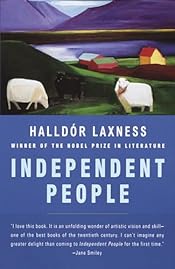 This is the book which established Laxness as the most important contributor to Icelandic literature since the sagas and paved the way for his Nobel Prize. It is the story of the life of Bjartur of Summerhouses, (Gudbjartur Jonsson,) a traditional poet, dedicated to both internal and external rhyming – unlike the new-fangled modern stuff with its simpler structures – and his interactions with family, neighbours, local merchants and the authorities in his determination to be an independent man. His most important relationship though is with his sheep. He is obsessed by them: so much so that he even looks a gift cow in the mouth. Independent People is in part a threnody to a lost way of living, an intense attachment to the land, a frugal kind of existence (in turf-roofed huts with no furniture unless built-in and rotting tables nailed to window ledges) that had lasted over a thousand years.


