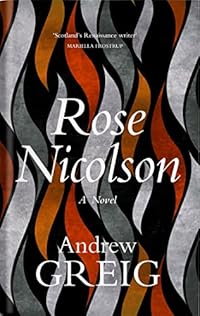
Rose Nicolson by Andrew Greig
Posted in Andrew Greig, Reading Reviewed, Scottish Fiction, Scottish Literature at 12:00 on 2 March 2022
Memoirs of William Fowler of Edinburgh: Student, Trader, Makar, Conduit, would-be lover in the early days of our Reform.
Riverrun, 2021, 458 p
Greig has been described as Scotland’s first post-Calvinist writer. With this book it seems he has decided to run with that designation. In many ways a companion volume to Fair Helen, this is the second time he has examined the genesis of the country’s immersion in that stern, moralistic creed. We also find references to Montaigne again, not to mention Walter Scott of Branxholme and Buccleuch. For added measure we are given a glimpse of Giordano Bruno and extended encounters with George Buchanan, Jamie the Saxt and the political struggles of the times.
Above all though, as a novelist Greig is the great expositor of love, the grand theme that runs through all his prose work, but with a poet’s eye for its joys and sorrows. And of course, where would literature be without it?
The love in question here is that of narrator William Fowler of Anchor Close, Embra (“Fowler” always designates Edinburgh in this way,) for Rose Nicolson, the sister of his companion scholar, Tom, at the University of St Andrews, to whom he is drawn one day as he sees her mending fishing nets, down by the harbour. He becomes a friend of the family but Rose has an understanding with John Gourlay, a fisherman with boats and, more crucially, prospects. He also discovers Rose’s remarkable intellect, which distances her from her peers, and her unusual views about God, which could threaten her survival.
Given their times the book shows us debates about free will and predestination and Fowler says that “Humanism and the Reform were brothers locked in a deadly embrace, for one was destined to destroy the other.”
This historical era, for so long unexamined, has become ripe for novelistic consideration. It was a more foundational moment for Scotland than the Jacobite rebellions much more harped on by Scottish literature. It was the time when the country plunged into the dark umbra of Calvinism from which it has only emerged, blinking – and astonished at itself – during the last fifty years. As Will says in his last words to Rose, “‘But you’ll be back some day? …. When times are fit?’” She replies, “‘In five hunner years they may be fit.’”
The book also encompasses 16th century Scotland’s JFK moment – hearing of the death of John Knox. Of that firebrand preacher’s style Tom says, “‘Aye, he was the great rebuker,’” before adding, “‘It’s a sair fecht, to keep men rightly building our New Jerusalem.’”
The politics were dark and messy. Adherents of the old faith – Will’s mother for one – have a strange belief they work towards that the exiled Queen Mary might return at the head of a French army and be restored, perhaps to share the throne with her son, Jamie Saxt. In his minority various regents had come and gone; most by violent or nefarious means. Even the great survivor, Regent Morton, will fall while Jamie Saxt is forever prey to threats of kidnap and manipulation.
The fanaticism of statements like, “‘This is now a Protestant nation. Dissent will not be tolerated,’” is contrasted with the situation in England. “We had no theatre in Scotland, on account of the Kirk.” Fowler asks, “A Reformed Kirk indeed, but of what kind? And who would limit its reach? The King?” On his trip to Paris he notes the sumptuousness and brilliance of the stained glass in Paris churches. All such fripperies had been stoned out of Scotland, and the Cathedral in St Andrews pillaged of its stone. The town’s once thriving economy, dependent on pilgrims, has vanished, the University is on its uppers.
Nevertheless, that reform, since it believed women had souls, had ensured the teaching of girls up to the same age as boys. (Much good it did them. They were still liable to be denounced as witches or pawns of the Devil.)
But human impulses always survive. “What a piece of work I am,” Will says, “that can encompass fleshly desire, tenderness, sorrow and soul, and the impulse to violence, all within one afternoon. Did Aristotle know of this? Did the risen Christ?” The melancholy that rests in the Scottish soul is expressively conveyed in his response to a song. “I kenned the bleak melody and the story, as did everyone in the hall, for it was ours.”
Though he denies it to his mother, “‘No. Absolutely not,’” the text could be read as if it was Will rather than Gourlay who fathered Rose’s child. “But a stranger I must be.” He certainly exhibits a fatherly interest in Lucy. But he was in love with her mother and notwithstanding her comment to him about her marriage, “‘There were pressing reasons,’” their later conversations argue against that interpretation.
Will’s life, though, and much of the narrative, becomes embroiled in the machinations of the high heid yins and affairs of state, his profession of trader allowing him to be a conduit (a spy in plainer terms,) Walter Scott of Buccleuch’s indebtedness to him for the loan of a dirk on their first meeting and for a subsequent intervention a major factor in his – and eventually Rose’s – fortunes. Lives can be messy and unpredictable. Only in fairy tales does everyone live happily ever after.
Yet some tranquillity can be found. Tom says, “‘Our Stoic masters spend o’er much attention to making a good death, and not enough to living beforehand.’” On which the later in life Will, narrating from the vantage point of old age, reflects, “I felt those words lodge, quivering, somewhere near my heart. Despite everything, they remain there still.”
There are sly allusions; such as to Shakespeare “‘I had not dreamed of such philosophy’” and Larkin “Love and memory remain, to hurt us into life” and many incidental pleasures, little vignettes of Scottish habits and attitudes. When greeted after a beating with, “‘Man, ye look an awfy mess,’” Fowler tells us, “This was what passed for affection in these parts.” It still is.
Greig is always good on what it is to be human. “Perhaps the course of one’s life is made by the particular manner in which we never quite resolve ourselves.”
Rose Nicolson is a magnificent, learned, wise book, imbued with sensitivity and grace, and in its elegiac sense of loss, Scottish to the core.
Pedant’s corner:- “One of the old woman” (women,) “Slainte var” (Usually spelled Slainte mhath.) “For a while I believed there was some sounds behind us” (were some sounds,) Averroes’ (Averroes’s,) “window of main house” (of the main house,) Lucretius’ (Lucretius’s,) “he’d auction his grannie were she were still alive” (that second ‘were’ is superfluous,) “before agreeing marry to young Bothwell” (either ‘before agreeing marriage to’ or, before agreeing to marry’,) “but none were her” (none was her.) “Now she truly looked me at me” (the first ‘me’ is superfluous,) “we all dreamed off” (of,) maw (used in the sense of mouth; a maw is a stomach,) our gang were back (was back,) a missing comma at the end of a piece of direct speech, a missing end quote mark at the end of another, “Kirk o Fields” (usually Kirk o Field,) uses the Scots word ‘baffies’ in its correct sense of ‘slippers’ in the text but the glossary has a baffie described as a golf club, Ulysses’ (Ulysses’s.) “The kirk had lost one of their own” (one of its own.) “The recent intake of Kirk ministers were poorly trained and credulous” (the … intake … was poorly trained,) “the Presbytery were resolved” (was resolved,) Tollbooth (Tolbooth,) “came through the St Andrews” (came through St Andrews.) “We crossed the Forth by boat” (the previous scene was set in St Andrews. Starting from there to go Perth – especially going via Falkland as they do – there is no need to cross the Forth. Indeed had they done it once, they would have had to do it again, in reverse,) a missing full stop.) In the glossary; supervisr (supervisor,) narow (narrow.)