Crabwalk by Günter Grass
Posted in Other fiction, Reading Reviewed at 12:00 on 27 March 2022
faber and faber, 2004, 238 p. Translated from the German Im Krebsgang by Krishna Winston.
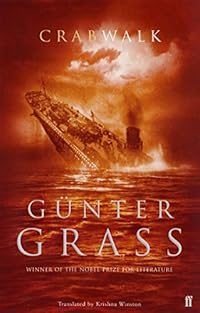
On 30th January 1945, the twelfth anniversary of Hitler achieving power, Paul Pokriefke, the narrator of this novel, was born. This was exactly fifty years after the birth of one Wilhelm Gustloff. On 30th January 1945, a former Strength through Joy ship named after this Nazi “martyr,” a ship now packed with refugees – mostly women and children but with some wounded soldiers aboard – fleeing the Red Army advance into Germany, was sunk after being hit by three torpedoes fired by the Soviet submarine S-13, delivering its cargo of humans, dead or not yet dead, into -18oC temperatures. Paul’s nine months pregnant mother was one of the passengers. The shock turned her hair white.
That sinking comprised the single greatest loss of life in one event in maritime history, even if the exact number who died can never be known. Yet years later “it still seems as though nothing can top the Titanic, as if the Wilhelm Gustloff had never existed, as if there were no room for another maritime disaster.”
So how, especially as a German, does a writer approach this tangled topic? Though their losses have been acknowledged, victimhood has not traditionally been claimed for German casualties of the Second World War. Still less afforded to them. How could a near contemporary of the perpetrators of the biggest set of crimes in history (certainly modern history) dare to?
Calmly, soberly, authoritatively and novelistically, it turns out. But also obliquely. As Grass asks us via Paul, “Do I sneak up on time in a crabwalk, seeming to go backward but actually scuttling sideways, and thereby working my way forward more rapidly?”
So, embedded in the tale of Paul’s existence – forever dogged by the circumstances of his birth – we have the life story of “the martyr,” Wilhelm Gustloff, born in Schwerin in 1895, who joined the Nazi party and recruited over 5,000 members from German and Austrian citizens living in Switzerland, where he was killed by a man named David Frankfurter, who claimed to have fired the fatal shots “because I am a Jew.” And that of the submariner, Aleksandr Marinesko, who commanded the S-13. Plus details of the construction and dimensions of the Wilhelm Gustloff (originally to have been named after Adolf Hitler but changed at his request to that of the Nazi’s latest martyr,) its Strength through Joy cruises with no class distinctions between its passengers, its use as a hospital ship in the Norway campaign and later as a military and refugee transport.
Paul, always fatherless – several men were subsequently implied by his mother to be possible candidates – is haunted by that thrice cursed date, as was his mother. Her accounts of the sinking and his birth vary, however, and like Paul’s fatherhood are not to be trusted. Paul’s lack of a father possibly led to his estrangement from his own son Konrad (Konny) whom Paul suspects, in a ramification of how that fateful January date echoes through his life, is behind an internet site named the Friends of Schwerin which lauds the memory of the ‘martyr’ and the ship which bore his name. He follows the online spats that result between Konny and a supporter of Gustloff’s killer (calling himself of course David Frankfurter) with something between bemusement and frustration.
Grass does not flinch from, but neither does he overly dwell on, the sinking – a catalogue of errors on the part of its officers, at the time the Wilhelm Gustloff had astonishingly no less than four captains each arguing with the others – and its many horrors, nor on the grisly prospect of being overrun by the Red Army. The German reoccupation of Nemmersdorf had revealed how brutal Soviet revenge could be. Publication of its details in Germany, intended to stiffen the population’s resistance, instead led to streams of refugees fleeing westwards.
Despite never mentioning the atrocities committed by the Nazis and their cohorts, nor does he try to exculpate his countrymen, “History, or, to be more precise, the history we Germans have repeatedly mucked up, is a clogged toilet. We flush and flush, but the shit keeps rising.”
As to the fatalities; in retrospect, “One zero more or less – what does it matter? In statistics, what disappears behind rows of numbers is death.” Each death, even in a larger catastrophe, is an individual tragedy.
At the heart of this novel – and it is a novel despite all its statistics and historical details – is the impossibility of escaping history. The circumstances of Paul’s birth, that sinking, toll through the years, Konny’s distance from his father and closeness to his grandmother manifesting itself in an almost wilful obsession, unamenable to reason and leading to yet more tragedy.
Paul feels it. “Everything that I try to crabwalk away from, or admit to in relative proximity to the truth, or reveal as if under duress, comes out, as he” (Konny) “sees it, ‘after the fact and from a guilty conscience.’”
For history is personal. Perhaps only the novel can deal with it.
Pedant’s corner:- In the preamble; versitilty (versatility.) Otherwise; “never miss an chance” (a chance,) “the planned invasion of England, Operation Seal” (that operation’s code name was Seelöwe, Sealion, not Seal,) Ruanda (German spelling of Rwanda?) “With August Pokriefke might there have been trouble” (‘With August Pokriefke there might have been trouble’ is a more natural word order,) an extraneous end-quotation mark, botswain (x 2, boatswain,) “with premediated deliberateness” (premeditated?)

