Archives » Denmark

Rochdale Town Hall, Stained Glass

One of the striking features of Rochdale Town Hall’s interior is the stained glass windows many of which feature portraits of the Kings and Queens of England.

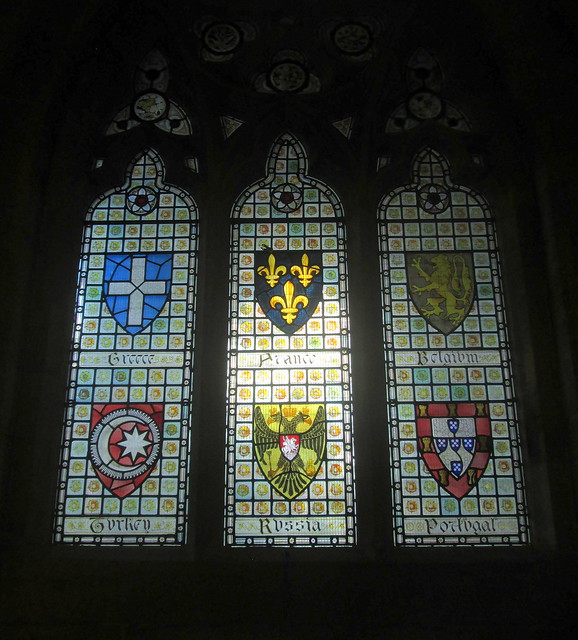
The windows flanking the entrance though have stained glass representations of the coats of arms of European countries, here Greece, France, Belgium, Turkey, Russia and Portugal:-

Rochdale Town Hall, Stained Glass Windows 1

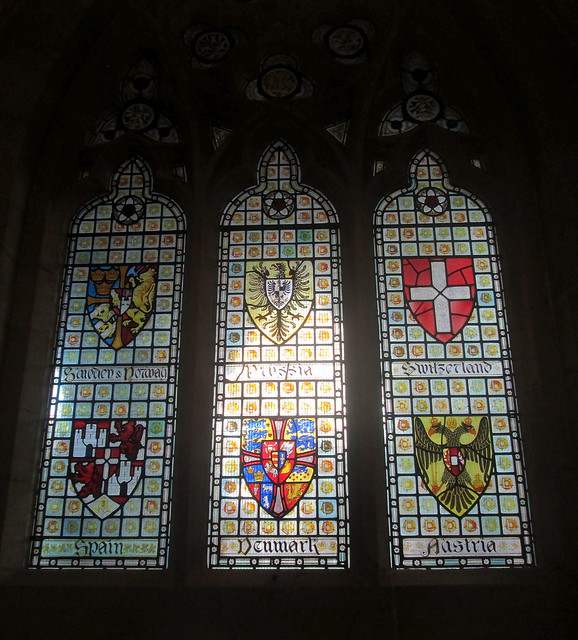
The other such window betrays the building’s age. Coats of arms for Sweden & Norway, Prussia, Switzerland, Spain, Denmark and Austria. Note Sweden & Norway, as was (they separated in 1905) and Prussia which, subsumed the rest of Germany in 1871.

Stained Glass Window, Rochdale Town Hall

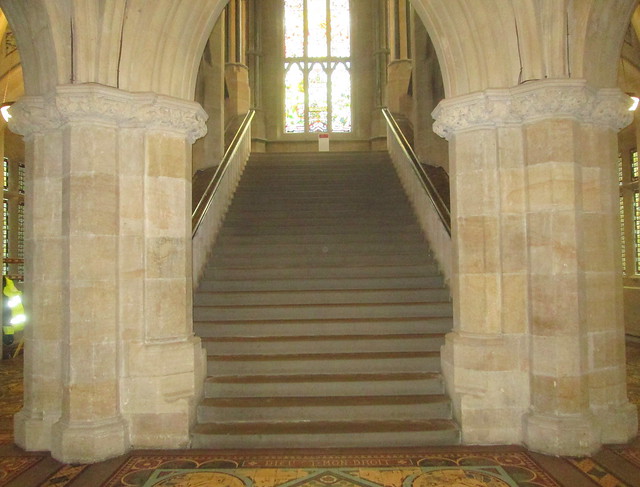
Grand staircase:-

Rochdale Town Hall Staircase

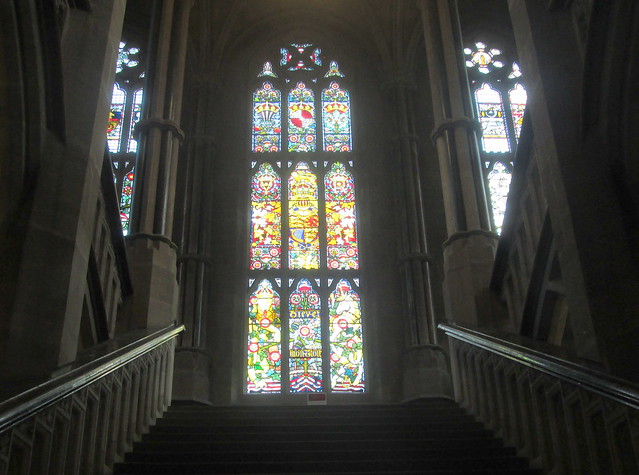
This is a closer view showing the stained glass window on the half-landing to greater effect.

Rochdale Town Hall, Stained Glass

The Netherlands 4-2 Denmark

Women’s European Championship Final, De Grolsch Veste (Arke Stadion,) Enschede, 6/8/17.

This was a great watch – certainly in the first half. Attacking football, end-to-end stuff, four goals, lead changing hands, two equalisers.

The Netherlands had the best of the opening exchanges but Denmark had shown intent before the penalty with which they took the lead, Afghan refugee Nadim putting it away with aparently no nerves.

The main Dutch ploy in the early stages was to exploit De Sanden’s pace down the right which led directly to their equaliser, her pinpoint cross converted by Miedema. Martens then made a goal out of nothing by running across the defence and turning it back against the goalkeeper’s expectation. The keeper maybe still ought to have made the save though.

Denmark’s equaliser was a supreme example of a forward making a goal for herself. Harder bent her offside beating run beautifully, staying in her own half till the pass was played before running half the length of the pitch, cutting across the defender and clipping the ball back between her opponent’s legs into the near corner.

It had been a breathless first half.

It couldn’t continue. Things settled to a slightly slower pace in the second.

The Dutch got themselves in front via a free kick given away too cheaply and the goalkeeper’s mistaken anticipation of where Spitse would place the ball. From there Denmark huffed and puffed, even hitting the frame of the goal, but never looked composed enough to take it away from Holland. The writing was on the wall when they threw a centre half up front and they duly paid the price as Miedema more or less replicated the latter movement Harder had made for her goal.

Some iffy goalkeeping apart this was a great advert for women’s football. (Iffy goalkeeping is not unknown in the men’s game too.)

The Holocaust and the State

There was an interesting article in the Guardian of 16/9/15 where Timothy Snyder argued that the conditions necessary for the Holocaust of Jews (and others, but mainly Jews) by the Nazis to take place have largely been misunderstood.

Snyder sees it as crucial that in the areas where most killings occurred, principally in the lands of pre-war Poland, the Baltic States and what had been Soviet Belarus and Ukraine, the apparatus of the state was no longer functioning – had indeed been deliberately destroyed. This was the necessary precondition for the activities of the Einsatzgruppen and the SS to be so unconstrained.

Though Snyder’s focus is on Eastern Europe I found myself thinking that in Western Europe too the absence of state institutions was a factor contributing to whether or not transportations to the killing zones of those whom the Nazis saw as undesirables came about. In Denmark, where the king remained and most institutions stayed intact (at least until 1943,) most of the Jews escaped or survived. By contrast in the Netherlands, whose monarch went into exile in Britain, and in France, where the Third Republic collapsed and Vichy was a puppet, deportations were much easier and in some cases even facilitated.

We have seen the consequences of the absence of the state relatively recently in Afghanistan – the Taliban would not have come to power there if not for the chaos engendered by, first, the Soviet presence and then its retreat (effectively driven out by a mujahideen aided and abetted via US and Western support) – in the disarray of Libya and now in Iraq and Syria where ISIS/ISIL/Daesh would not have had the opportunity to grow as quickly or at all if there had not been the vacuum created by the destruction of the Iraqi state and the failure to replace it.

Contrary to what some libertarians appear to think it seems the state really is a force for good.

Postscript:- While looking over the above it also occurred to me that the killing fields in Cambodia, while a consequence of Pol Pot’s take-over, were also due to state collapse, in this case that of the pre-revolutionary government. I suppose too that La Terreur in revolutionary France and the turmoil in the former Russian Empire after the Bolshevik coup are examples of what happens when state organisation suffers disruption. To avoid chaos a polity requires not people with guns but checks and balances; plus a functional judicial system capable of holding those in power to account.

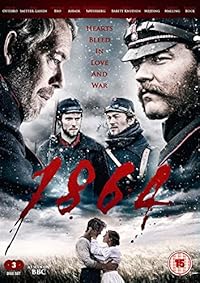
1864

 1864 cover

When this Danish TV series – the most expensive production in Danish television history – was first trailed on the BBC and I saw the blue uniforms I thought it would be about the War Between the States (known on this side of the Atlantic as the American Civil War) as the date fitted. I was immediately interested. I’ve read a lot about that conflict and watched the Jim Burns TV series several times. Looking more closely I realised that I didn’t recognise the painting shown on the trailer or the figures within it (I most likely would have for an American Civil War painting) and of course the uniforms’ details weren’t quite right.

I was therefore even more intrigued when it dawned the series was about the Second Schleswig War as that was something I knew vaguely about from History, at school. Once read, who can forget the comment the UK Prime Minister at the time, Lord Palmerston, made about the intricacies of the Schleswig-Holstein question – which in the series was uttered to that fine actress Barbara Flynn, in the person of Queen Victoria – that there were only three men who ever understood it; the Prince Consort, who was dead, a German professor who had gone mad and Palmerston himself, who had forgotten all about it?

As presented in the series, the war seems to have been provoked by Denmark in a fit of collective insanity. The programme, which has been criticised for historical inaccuracies (it would be difficult to portray any conflict televisually without some of that I’d have thought) certainly presented the Danish Prime Minister, Monrad, as an utter nutter. There seemed to be an element of hysteria in the air that prefigured the Germany of 1939. (Then again there was widespread welcome to Britain’s declaration of war in 1914, so no need to point fingers; except the UK hadn’t sought that conflict – at least not directly.)

However the dire results of the Second Schleswig War for Denmark meant that, to that country’s credit, no Danish military action outside its frontiers again took place until the NATO bombing of Kosovo in 1999.

Scenes were shown from both sides of the conflict and also the sidelines as Palmerston affected to intercede. The subtitles were no intrusion (1864 went out in the BBC 4 European detective slot on Saturdays at 9 pm.) As near as I could tell each nationality in the series spoke in its own language. (I have a smattering of German but no Danish except what I could glean from the dialogue’s similarities to German, English and, occasionally, Scots.)

For the series the necessity of introducing a human aspect to the conflict in the shape of estate manager’s daughter Inge and the two brothers Laust and Peter, with whom she has a special bond, allowed the introduction of those perennial literary concerns, love, sex and death. There was love to be sure, but not much sex – only four scenes as I recall, three of them having not much to do with love, plus another featuring boys attempting to masturbate – but enough death and destruction to slake anyone’s desires. The battle scenes were impressive – and visceral.

Overall the series was magnificent television, well worth checking out if you didn’t catch it, but I thought the elements of mysticism involving one of the soldiers from the village were unconvincing and the framing device wherein a disaffected young woman from our century sent to his house for a form of community service helps read out Inge’s memoirs to an old man (who is Inge’s grandson) was perhaps unnecessary, though it did give the sense of consequences cascading down the years and a contrast to the privations of the soldiers of 150 years earlier.

When I last looked in the BBC shop, the DVD of this was out of stock but the Blu-ray was available.
Euro 2012

I’ve not posted about Euro 2012 yet because I’ve not seen many whole games.

I did catch all of the England – Ukraine game last night, though. If Ukraine had had a striker they’d have won this. England rode their luck and not just with the ball over the line incident.

I take issue with the commmentators over that. In real time I couldn’t tell if the ball was over the line or not. Even with the benefit of the replay using the along the line view I couldn’t tell that the whole ball had crossed the line when John Terry kicked it out. Neither could the fifth official be sure. And he has to be sure to give the goal. It was only when Terry was stripped from the picture and the frame was frozen that I could tell – and how was I to know what other manipulation may have been done to the image? The line official didn’t have that luxury.

Still, roll on goal line technology.

It must be said Uefa haven’t exactly covered themselves in glory over the Niklas Bendtner fine and ban for ambush marketing vivs-a-vis racist chanting and inappropriate banners.

As to possible winners; who knows?

Spain look get-at-able at the back. If it weren’t for Iker Casillas they would have been going home early: both Italy and Croatia would have beaten them. They also seem to have developed this novel way of trying to win football games. It involves not trying to score goals. (To be fair Dumbarton have been using that system for donkey’s years; but not deliberately.)

Against Croatia the Italians did that Italian thing of taking a lead and trying to hold it. The only thing is their defence isn’t good enough these days to sustain it. Had they gone for the second they might have saved themselves a fraught third game. They looked good going forward against Spain though.

Greece? Not likely, but we’ve thought that before.

Germany look impressive and Mario Gomez has morphed from being the German Luca Toni and suddenly found goal scoring form in a tournament.

Czech Republic? I doubt they’ll have enough to beat Portugal who were too fragile at the back against Denmark. But do the Portuguese have enough striking options beyond Ronaldo to get to the final?

France were shown up against Sweden and must play Spain.

England are teed up to lose to a Mario Balotelli goal. They have exceeded their usual Euro performance in getting to the quarter-final, after all.

At this stage it looks like the Germans.

Scotland 2-1 Denmark

Hampden Park 10/8/11

I know this is a bit late but I only saw the highlights of this game. It looked like we were hammered 1-2. Denmark made much the more and better chances but Scotland scored two and they didn’t.

The first came from a free kick where the Scot, were he a Dane, might have been described as going down too easily.

Allan McGregor flapped at the equaliser. It was like watching Stephen Grindlay.

Scotland’s second was a finely worked effort, though.

A win’s a win. I’d have taken it in any Dumbarton game.

Whether there will be a similar result against the Czech Rep in the upcoming qualifying game is another matter.

Denmark 1-3 Japan

Royal Bafokeng Stadium, Rustenburg, 24/6/10

A thoroughly deserved win for Japan. Denmark were turgid, uncreative and pedestrian. The Japanese were quick, bright and incisive, passing the ball delightfully, and in Keisuke Honda had the best player on the pitch – though some of the other Japanese ran him close. If it weren’t likely to be construed as politically incorrect I’d have said the Japanese were nippy. The Danes weren’t at the races.

Their first two were magnificent strikes (goalkeeping aberrations accepted) but Japan’s third goal was a thing of beauty, Honda turning the Danish defender inside out and giving Thomas Sorensen the eyes before laying it on a plate for Okazaki.

(Speaking of un-PC-ness, what was it with the Germans and that black outfit in the Ghana game? I know it’s one of the colours on their flag but a black uniform on Germans has unfortunate resonances. What was wrong with their traditional green second strip?)

And what odds could I have got on New Zealand going through their group unbeaten?

As I thought in game 1, Italy were vulnerable at the back. Buffon’s absence probably didn’t help them. At least they weren’t wearing that sky blue effort – not to mention the brown shorts – they had at the Confederations Cup.

And France went out early as I expected.

More 1966-all-over-again nonsense to endure from the commentariat.

At least until Sunday.

free hit counter script