Posted in Dumbarton, Iain (M) Banks, Read Scotland 2014, Scotland at 12:00 on 27 September 2014
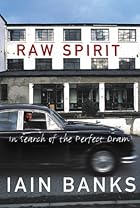
In search of the perfect dram
Century, 2003, 368 p.
I bought this mainly for completeness. I’ve read all of Banks’s fiction and so his only non-fiction book kind of rounds things off. It also qualifies for the Read Scotland Challenge.
It is strange to be writing about this in the wake of the referendum. While the book is ostensibly about whisky it is in reality a hymn to Scotland, in particular its landscape, its “Great Wee Roads” and its inhabitants, not forgetting the West Highlands’ voracious midges and prodigious rainfall. Banks’s liking for fast cars can’t be missed and the numerous inns and hotels he frequented as well as the distilleries and their visitor centres (there is, it seems a whisky “experience” look) will be grateful for the exposure. Had the book been solely about whisky I would not have been the best person to appreciate it as I have never taken to the stuff.
That said, the history and processes of whisky production are described in extremely accessible terms. While Banks attempts descriptions of the single malts he samples in the course of his travels (for which he had no shortage of willing companions) this is perhaps an impossible task – in the way that descriptions of music are often lacking – but the word “peaty” does appear quite often.
Parts of Raw Spirit read like Banks’s non-SF fiction. The verbal interplay between the author and his friends is just like the conversations encountered in say Espedair Street, The Crow Road or Complicity, the asides and digressions – his journeys were undertaken and the book written around the time of the (second, the illegal) Iraq War, occasioning familiar Banksian rants – typical of his mainstream work.
As a book Raw Spirit is barely ten years old yet so much has changed since it was published. Banks himself is sadly no more, as are the Inverleven Distillery at Dumbarton and (not so sadly) the Forth Road and Skye Bridge tolls. The landscape, the Great Wee Roads, the whisky, though, remain – at least those bottles as yet unconsumed.
A delightful addition to the Banksian œuvre.
No Comments »
Posted in Iain (M) Banks, Other fiction, Reading Reviewed at 12:00 on 17 September 2012
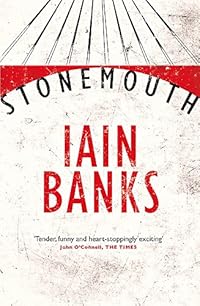
Little, Brown, 2012, 357 p.
Stewart Gilmour returns to his hometown, Stonemouth, somewhere in North East Scotland, to attend a funeral after a five year absence occasioned by two-timing his fiancé, Ellie, the daughter of a prominent local crime boss. The tone is set from the first as he awaits a hard man on the parapet of the suspension bridge that looms large over the town to check his reappearance will not be too unwelcome. The subsequent resumption of old friendships and acquaintances reads true – especially with Gilmour’s once best friend Ferg – as does the evocation of the claustrophobia of life in small to medium sized towns but perhaps less convincing are the threads where Gilmour seeks to unravel the circumstances surrounding the revelation of his dalliance with the “delightful Anjelica” which caused him to flee to London five years before and the fall from the bridge of Ellie’s brother which took place in the interim.
The ongoing narrative is structured over the weekend leading up to the funeral but is interspersed with Gilmour’s memories of earlier times. At one point he reflects on the delights or otherwise of the Scottish wedding reception, with its exhausting and interminable Scottish Country Dances (though the narrative renders the exuberant vocalisation that never fails to accompany these as “yee-hoooch” when it’s actually more like “hee-yeugh.”) There is also a musing on the process by which the world came to be dominated by the values of money and big business and a critique on the sort of selfishness advocated by Ayn Rand.
Though there are moments of light-heartedness and a couple of good jokes the sense of menace is never far away and the story unrolls steadily towards the violent dénouement demanded by the set up and treatment. And it is, after all, a Banks novel: a fact of which the reader is always conscious. Echoes of The Crow Road, Complicity, Whit and The Steep Approach to Garbadale are never far away. And Banks did allow one of his characters to say, “Amn’t I?” (Hurray.)
Stonemouth is accomplished and very readable. Most of the characters (hard men and gangsters apart) are engaging, if sometimes annoying, and pleasingly complex.
No Comments »