Archives » Cloud Howe

The Weatherhouse by Nan Shepherd

Canongate, 2017, 211 p, including 3 p Glossary: plus ii p Dramatis Personae and vi p Introduction. First published 1930.
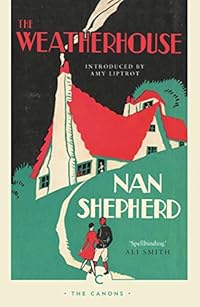
 The Weatherhouse cover

I don’t normally pick up a book according to its cover but I did in this case. It helped that the novel was by Nan Shepherd whose The Quarry Wood I enjoyed a year or so ago. Yet I was also attracted by the illustration which is almost in the style of a 1930s railway poster – a very Art Deco form – even down to the lettering. The house shown is actually wrong though; in two ways. It is much more of an English type of building rather than Scottish and it bears no relation at all to the hexagonal construction described in the text. Pretty, just the same.

That titular Weatherhouse is the home in Fetter-Rothnie of the Craigmyle family, which consists of matriarch Lang Leeb plus her daughters Annie, Theresa and the widowed Ellen. The story though, is more to do with how Garry Forbes, the intended of Lindsay Lorimer, in turn the daughter of Andrew, Lang Leeb’s cousin, came to become a proverb in Fetter-Rothnie.

The former Minister’s daughter, Louie Morgan, claimed after Forbes’s friend David Grey had died in the Great War that she and Grey had been secretly betrothed and carries Grey’s mother’s ring about her neck as proof. Forbes, home from the war as a convalescent, is convinced that can not be the case. He attempts, first to bring the falseness of Louie’s claim to the attention of the Kirk Session (which upsets Lindsay) and then to prevent his knowledge of Louie’s theft of the ring becoming more widely apprehended.

Despite what appears to be a focus on small matters The Weatherhouse nevertheless has a wider resonance, and has some humorous observations. The incidental mention of the man who, because of his brother, waited twenty years to wed his fiancée (who nevertheless brought him children “as a wedding gift”) shows life in those times was not entirely as straight-laced as might perhaps be thought.

Human dilemmas and emotions occur in all places and at all times. Shepherd shows us the humanity of her characters, in all their complexity. This is a fine companion piece to The Quarry Wood. Both these novels bear some similarities to Lewis Grassic Gibbon’s Sunset Song and Cloud Howe but don’t quite have the sweep of the first of those.

Pedant’s corner:- Amy Liptrot’s introduction says Shepherd’s writing is very localised to the foothills of the Grampian mountains and quotes two of the words she uses, stravaigin and collieshangie as being specific to that area. Stravaigin certainly has no such specificity.
In the glossary: keeing (keeking,) snored (smored.) Otherwise: “you’re as light ’s a feather” (light’s,) knit (knitted,) chose (choose,) “a moment before made up on her sister on the road” (before she made up,) a missing comma before a start quote mark.
Grey Granite by Lewis Grassic Gibbon

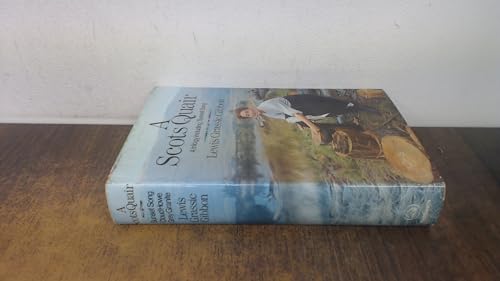
In “A Scots Quair,” Hutchinson, 1966, 156 p. First published 1934.

A Scots Quair cover

After the form of Sunset Song and Cloud Howe, the previous books in Gibbon’s A Scots Quair trio, the text of Grey Granite is divided into four sections, here named after semi-precious stones, Epidote, Sphene, Apatite and Zircon, though unlike its predecessors there is no prelude, proem nor epilude in Grey Granite.

Following the death of her second husband Robert Colquohoun – whose last action to shock his ex-parishioners was to have himself cremated – Chris Guthrie has used what money remains to her to move from Segget and take a half share in a boarding house in the city of Duncairn. [An authorial note at the start informs us this name is amended from the author’s first choice Dundon, since early reviewers in English journals were mistaken in thinking it represents Dundee, nor yet (though it has a Cowgate, a Canongate and a Royal Mile) is it Edinburgh as an American newspaper had it, nor even – notwithstanding its granite buildings – is it Aberdeen (two Scottish sheets) but the city which the inhabitants of the Mearns have hitherto failed to build.]

It is perhaps this setting that makes Grey Granite seem less grounded than the previous two novels in A Scots Quair. While Gibbon’s descriptions of the industrial cityscape are fine they do not have the lyricism of his evocation of rural landscapes. Indeed it is notable that when the story breaks the bounds of the city the writing lifts. But in his defence here Gibbon certainly cannot do without Duncairn. It is absolutely necessary in a novel sequence about modern Scotland (as he was essaying) to encompass the industrial habitat in which most Scots live. And this is only a criticism in the context of Sunset Song and Cloud Howe. Taken on its own Grey Granite would stand as a fine mid-twentieth century Scots novel.

Another factor contributing to Grey Granite’s relative lack of force is the focus moving from Chris to her son Ewan. He is drawn into socialism after taking a job in a metal works which later gains an arms contract. He organises a subsequent strike and is arrested and beaten up by the police. It seems that police accounts of incidents diverging somewhat from what actually happened are never new. In addition, Ake Ogilvie, who had also come from Segget to work in Duncairn, opines, “there was as much graft in the average Scots toun as in any damn place across the Atlantic.”

Once again there is the shifting of narrative viewpoint familiar from Sunset Song and Cloud Howe, by which the Rev MacShilluck for example is well drawn; in a few devastating paragraphs scattered through the book. The text is of its time in some of its references: “psychoanalyst Jewboy chaps” reads shockingly today.

Her business partner, Ma Cleghorn, tells Chris there’s nothing worse than “some old runkle of a woman body living on with no man to tend and no bairns.” As to men, “(they) never live at all. They’re just a squeeze and a cuddle we need to keep our lives going. They’re nothing themselves.” Ewan himself thinks, “A hell of a thing to be History! …. LIVING HISTORY ONESELF.” His treatment of Ellen Johns, a teacher who lodges in the boarding house and helped Ewan along the socialist path is in the end less than gallant. Chris had warned her, though, as we were forewarned in Cloud Howe.

Chris certainly does not have her troubles to seek. Ma Cleghorn dies, Chris contracts a misguided and doomed marriage with Ake Ogilvie, who is instrumental in effecting Ewan’s release from prison. She muses that, “SHE HAD NOTHING AT ALL, she had never had anything, nothing in the world she’d believed in but change… Nothing endured,” and, “We’re all on leading strings out of the past.” She tells Ewan, “The world’s sought faith for thousands of years and found only death or unease in them.” He replies, “It’s the old fight that maybe will never have a finish…. The fight in the end between FREEDOM and GOD.”

On reflection, and after rereading passages, my initial feeling that Grey Granite was not quite at the level of Sunset Song and Cloud Howe may be a touch harsh. It’s a fitting enough conclusion. As Chris comes full circle, “She’d open her eyes and see only the land, enduring, encompassing.”

free hit counter script