Archives » Charles Stross

Interzone 272, Sep-Oct 2017

TTA Press

Interzone 272 cover

Andy Hedgecock’s Editorial1 is an appreciation of the late Brian Aldiss of blessed memory. Jonathan McCalmont2 ponders the uses of allusion, contrasting the reductive and lazy with the dense or expansive. Nina Allan welcomes post-SF. Book Zone has an interesting and discursive author interview by Jo Walton3 with Adam Roberts to tie in with his new novel The Real-Time Murders but neglects to review the book. Duncan Lunan4 reviews Paul Kincaid’s book of criticism Iain M Banks mostly by relating his experiences of the late master. There is also Juliet E McKenna’s take on Charles Stross’s Delirium Brief, Stephen Theaker5 on Ada Palmer’s Too Like the Lightning while John Howard reviews Xeelee Vengeance by Stephen Baxter, with the final item a review of Hal Duncan’s A Scruffian Survival Guide by Elaine C Gallagher who also interviews6 the author.
In the fiction:
As the world slowly rebuilds after war and ecological disaster, Blessings Erupt by Aliya Whiteley tells the story of the last of the original plastic eaters, consuming the hydrocarbon-based tumours that afflict the population in return for years of service to the company he represents.
The Music of Ghosts7 by Paul Jessop is set on a generation starship after Earth has been destroyed. The voyagers’ essences are supposed to be uploaded into the library after their death but things go wrong.
In a Melbourne fifty years past any relevance it ever had Ghosts of a Neon God8 by T R Napper tells of two small time crooks who are unwittingly embroiled in a dispute between the Chinese who run the place.
A white mist of unknown origin – possibly alien, possibly human – has “clouded cognitive processes and slowed down conscious thought” and in Erica L Satifka’s The Goddess of the Highway9 people are fitted with plates in their heads in a caste system to suit each to their new roles. Viewpoint characters Harp, a Plastic who monitors a truck criss-crossing the former US, and Spike, a Platinum, come together to try to join the resistance. The titular goddess may be a manifestation of the plates.

Pedant’s corner:- 1Aldiss’ (Aldiss’s.) 2Written in USian, “the crowd are right” (the crowd is.) 3Lord Peter Whimsy (did Roberts actually say that? I believe him capable of such punnery but in English English – as opposed to Scottish English – the correct, Wimsey, and the pun, whimsy, are much less distinguishable,) descendent (descendant,) 4Banks’ (Banks’s,) “human affairs are so complex than any stance (that any stance,) 5“A series of innovations have set this world apart” (a series has,) 6fit (fitted) 7Written in USian, “the sun grew wane and hungry with light” (wan?) “the whirring of machines are chugging” (the whirring is chugging but even that is clumsy.) Ray stops programming for a moment and touches Ray’s hands” (Mark’s hands.) The story is riddled with errors in tense. It’s written in the present but has past tense verb forms intruding, “He’d been training for this day” (He’s ) “And his heart was a wild thing inside his ribs” (is.) “They ran into the storage facility” (run,) “and then she turned” (turns.) 8“Now it may as well not even existed” (exist,) his practiced stride (practised,) focussed (focused.) 9Written in USian, hocking up (hawking,) “the majority of what gets shipped are luxuries” (the majority is,) “intersecting a round sphere” (I’d like to see a sphere that isn’t round!)

Interzone 269 Mar-Apr 2017

TTA Press

Interzone 269 cover

Steve Rasnic Tem’s Guest Editorial outlines ten actions you could take to help address climate change problems. Jonathan McCalmont’s column1 argues that attempts to open up genre culture to previously marginalised voices are all well and good but that reading genre cannot of itself address the world’s problems, only action can. Nina Allan’s Timepieces2 reflects on the many homes she has had, some of which have fed into her fiction. She hopes she has now settled down. The reviews contain one of Tem’s latest novel Ubo plus an interview with the author. Also covered are the latest novels by Charles Stross, John Scalzi3 and Adam Roberts, the very good indeed Spaceman of Bohemia by Jaroslav Kalfař, and my thoughts on The Mountains of Parnassus by Czesław Miłosz.
In the fiction, The Influence Machine4 by Sean McMullen is narrated by Albert Grant, the only Metropolitan Police Inspector in 1899 with knowledge of science. A woman has been arrested for loitering with intent as her wagon contains something “scientific”. Her machine can peer into a parallel, more scientifically advanced world. The story is delightful but its ending is a bit weak.
A Death in the Wayward Drift5 by Tim Akers didn’t grab me at all. It features divers in a lake of strange water, things called emissary birds, trees that move and, despite the title, more than one death.
Still Life with Falling Man6 by Richard E Gropp. A man who can see into other dimensions is employed to find when a new nexus opens. These are spaces wherein twenty seven million years goes by in a subjective ten seconds. He gets trapped in one and is counting down from ten. This aspect reminded in part of my own Closing Time (Interzone 89, Nov 1994.)
In A Strange Kind of Beauty7 by Christien Gholson the Scoryax Kahtt wander a parched landscape following the prophecies of scrolls. Their Vaithe find new scrolls and translate the prophecies. Heoli’s find points her tribe to a hitherto forbidden place replete with water.
Set in a globally warmed flooded south Florida The Common Sea8 by Steve Rasnic Tem focuses on a man whose oldest memories are visions of another dying world and who is trying to get by in this one. In part the story riffs on The Rime of the Ancient Mariner.

Pedant’s corner:-
1arm sales (arms sales,) “lies not in the protagonist’s ability to leap tall buildings but in the knowledge that his ability to deploy overwhelming force in a manner that is beyond reproach” (of his ability,) “designed to illicit (elicit,) “the moral and political value of books lays not in the quality of the ideas” (lies not, see earlier quote.) 2Merthyr Tidfil (Merthyr Tydfil.) 3emperox (emperor, I believe.) 4waggon is used throughout. I prefer wagon, “open to the naval” (navel.) “seemed” in a present tense sentence; so, seems, discretely (discreetly,) 5”trying to not think of what lay ahead” (trying not to think of what lay ahead.) “Initiates wore …….to allow easy movement … when we are on the lake” (wore, therefore “when we were on the lake”.) 6”The skin, clothing and furniture remains unchanged” (remain,) “There was very little flora” (flora is plural???) 7Xichoh (elsewhere Xicoh.) 8no where to go (nowhere.)

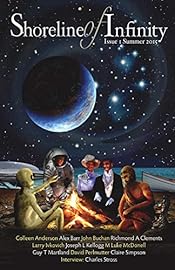
Shoreline of Infinity 1: Summer 2015

Science Fiction Magazine from Scotland, The New Curiosity Shop, 104 p.

Shoreline of Infinity 1 cover

Apart from the fiction, in this first issue of a new venture there is an interview with Charles Stross; Steve Green’s column Border Crossings1 discusses two SF films made mostly in Glasgow over twenty years apart, Bertrand Tavernier’s Death Watch adapted from D G Compton’s The Continuous Katherine Mortenhoe and Jonathan Glazer’s adaptation of Michel Faber’s Under the Skin; in SF Caledonia – John Buchan SF writer,2 Paul Cockburn examines that writer’s SF credentials. Reviews3 discusses five books.

The fiction is varied in scope. Each story has its own one-page art work and a title page to itself. Internal illustrations accompany some others.
More fantasy than SF, The Three Stages of Atsushi4 by Larry Ivkovich is set in Japan in 1531. A woman whose son, Omasu, was swept away in a flood the year before petitions the God Amaterasu to bring him back to life. A strange man in odd armour appears with an entourage of samurai and helps her (in stages,) for Omasu has a destiny.
In Alex Barr’s very well written The Spiral Moon5 a woman astronaut whose mission has suffered a catastrophic failure sets out to circumnavigate the small planetoid she is on, eventually hallucinating as she succumbs to oxygen starvation.
Symbiosis6 by Colleen Anderson has another member of a doomed space mission, on a planet this time, trying to survive by going native. The story’s ending is fantastical rather than SF.
The protagonist of See You Later7 by M Luke McDonnell gets herself a set of AR lenses to match the ones her husband needed for work and finds the settings he uses for his something of a surprise.
In what is intended to be a humorous piece, but is far too over the top to be so, David Perlmutter’s The Brat and the Burly Qs8 gives us an alien superhero, who is part mechanical, flying to Mars to apprehend a wrongdoer whom it has sent to jail once already.
Approaching 43,000 Candles9 by Guy T Martland. Controlled by the Moon, time is switched off once a year, and British Lighthouses travel to attend a conference. At one of these, Voth, from the Isles of Scilly, overhears the Bishop Rock and two other Cornish Lighthouses planning a shut down so that the Bishop’s much needed maintenance will be expedited.
In Broken Glass by Joseph L Kellogg, Slide Stations allow travel between five parallel worlds. RedBrian envies the other Brians who all have their Pats as lifetime companions.
In TimeMachineStory10 by Richmond A Clements a man goes back (and forward) in time but the effects aren’t what he expected.
The extremely short, almost throwaway, Cleanup on Deck 7 by Claire Simpson features a new female crew member on a spaceship under attack seeking refuge in a cupboard with only solvents and bleach available to her as weapons.
Space11 by John Buchan is one of Buchan’s Leithen stories where that gentleman relates to a companion on a deer shoot the tale of his acquaintance Hollond, who forms a theory that so-called empty space is full of “mathematical pandemonium” with “halls and alleys in Space shifting .. according to inexorable laws” and there are Presences within it.

Pedant’s corner:- 1Good Friday isn’t – and never has been – a public holiday in Scotland, PBS’ (PBS’s,) embue (imbue,) 2Given in the contents as page 82, it’s actually page 80. 3Stross’ (Stross’s,) “for an entertaining a ‘management team for dummies’” (one indefinite article is enough,) “their alien mind set giving homo sapien the chance” (either homo sapiens or homo sapien) 4Written in USian, a missing start quote at the beginning of a paragraph, thusly (thusly??? What sort of a word is that?) 5CO2 (it’s CO2.) 6While their normal prey is referred to as herbivores the planet’s top predators are described as cats. However they appear they would not be cats. They are alien. Ditto the so-called trees. “The night painted the blood a sinister substance” (substance? Colour surely?) “Keela tramped determinably” (?? Determinedly, I think.) 7Written in USian. 8Written in USian; on their own free will (of their own free will,) synthetic water (????) embarrasing (embarrassing,) said my peace (my piece that would be,) sat (seated; or sitting,) liquid mercury (even piping hot at normal atmospheric pressure it has no other option but to be liquid, it doesn’t boil till 357 oC) jail-after (jail after.) 9And anyways (a Scot – even if a lighthouse – would say anyway, not anyways,) “couldn’t see more that a few yards” (more than.) 10“there’ll be cure in the end” (a cure,) one sentence had two full stops at its end, Arch Duke Ferdinand (Archduke.) 11caldron (cauldron,) “as keen is a keen sword” (as keen as; or, as keen as is,) Prescences (Presences,) Holland (always Hollond elsewhere,) a missing start quote when a piece of dialogue continues after a narrative interpolation, plus a missing end quote at its end, and another at the end of a paragraph where the next was not a continuation of speech.

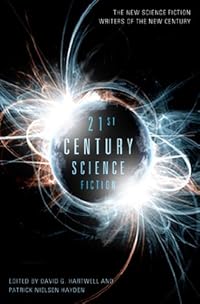
Twenty-First Century Science Fiction edited by David G Hartwell and Patrick Nielsen Hayden

Robinson, 2013, 572 p. Borrowed from a threatened library.

 Twenty-First Century Science Fiction cover

The book cover and spine has 21st Century but the title page Twenty-First Century. The editors choices were made from those writers whose rise to prominence came after 1999 – in a world where they say SF is no longer marginal but a part of the cultural landscape. So to the stories.

In Vandana Singh’s Infinities Abdul Karim is fascinated by mathematics. Visions of beings he calls farishte and sees out of the corners of his eyes lead him to ponder the variety of mathematical infinities and the intersection between transcendental numbers and primes. But life wears him down and his glimpse of the connections does not mesh with the troubles of a divided India. Rogue Farm by Charles Stross is set in a depopulated future and features trees which can store nitrate (effectively making them rockets/bombs) and collective farms composed of several people melded into some sort of tank-like vehicle. I know it was originally published in a US magazine but it’s located in Cumbria yet not only the prose but also the dialogue – with a few exceptions – was written in USian. The exceptions were some unconvincing “ayup”s and a sudden splattering of “Northern” speech in the second last paragraph.

Paolo Bacigalupi’s The Gambler sees an exiled Laotian struggle to get enough click-bait on his news stories, Neal Asher’s Strood features more or less beneficent invading aliens and their pets, which have unusual eating habits. In Eros, Philia, Agape by Rachel Swirsky, Adriana seeks love from and marries a robot called Lucian. Things go wrong when she lets Lucian have free will and their adopted daughter begins to believe she’s a robot. “The Tale of the Wicked” by John Scalzi is an updated version of Asimov’s Three Laws of Robotics stories when the brains of two spaceships in a hot pursuit start to communicate. Bread and Bombs by M Rickert is a post-apocalypse, post twin towers, tale where no-one travels by air, indeed any sighting of an aeroplane is accompanied by fear, and outsiders are treated with suspicion.

Taking its inspiration from a Biblical text and the Uncertainty Principle, Tony Ballantyne’s The Waters of Meribah is set in a universe shrunk to only tens of miles across where a group of scientists is engaged in a bizarre experiment to create an alien in order to break out again. Tk’Tk’Tk by David D Levine features the experiences of a hereditary salesman on a planet inhabited by excessively polite aliens. He comes to an epiphany, as you do. Genevieve Valentine’s The Nearest Thing is the closest to a human an artificial entity can get but the process is neither morally nor emotionally simple for its software designer. In Ian Creasey’s Erosion the comparison evoked by its title is perhaps a touch over-egged in his tale of an augmented human about to leave for the stars out for a last hike along the North Yorkshire coast. Marissa Lingen’s The Calculus Plague tells of the beginnings of transfer of memories by viral infection. One of our Bastards is Missing by Paul Cornell is set in a future where early eighteenth century Great Powers have lasted into the space age, the balance of power is kept steady but they still plot against each other.

A damaged war machine, the last of its platoon, roams the seashore in Elizabeth Bear’s Tideline, collecting material to make memorial necklaces for the fallen. Finistera by David Moles is set on a giant planet with a nitrogen-oxygen atmosphere where floating creatures as large as mountains form homes for people and exploitable resources for the less scrupulous. In Mary Robinette Kowal’s Evil Robot Monkey an augmented chimpanzee wants only to make pottery; but humans – especially schoolchildren – remain humans. The junior of The Education of Junior Number Twelve by Madeline Ashby is the twelfth offspring of a kind of self-replicating android, designed so as not to allow harm to humans. They make perfect lovers though. Even if humans themselves remain as messed up as ever. Toy Planes by Tobias S Buckell sees a Caribbean island join the space-faring nations. Ken Liu’s The Algorithms of Love is curiously reminiscent of Flowers for Algernon in its tale of a designer of truly interactive dolls coming to believe she herself, and all humans, are merely reacting to inbuilt instructions. The Albian Message by Oliver Morton speculates on just exactly what is contained in a pyramid left by aliens in the Trojan Asteroids hundreds of millions of years ago while Karl Schroeder’s To Hie From Far Cilenia supposes layers of “cities” – or at least organised groupings of people – only existing in a kind of online virtual reality parallel to the real world. Brenda Cooper’s Savant Songs is about the search by a brilliant (but socially awkward) female physicist for her counterparts in the multiverse of worlds. Ikiryoh by Liz Williams is reminiscent of Le Guin’s The Ones Who Walk Away from Omelas in that the eponymous child is the repository of all the darkness that would otherwise be present in the goddess who rules. The Prophet of Flores by Ted Kosmatka is set in a world where Darwinism was disproved in the 1950s by dating techniques. Yet on the Indonesian island of Flores unusual bones have been discovered in a cave. The protagonist’s conclusion sticks neatly to the logic of his world.

According to Catherynne M Valente’s How to Become a Mars Overlord each solar system has its own Red Planet and the author provides a stepwise guide to its overlordship but the piece overall is less of a story than a disquisition. In Daryl Gregory’s Second Person, Present Tense Therese has taken an overdose of a drug called Zen, which alters her persona. Her parents don’t accept this. Third Day Lights by Alaya Dawn Johnson features a shape-shifting demon and a human looking for the afterlife of the afterlife. James L Cambias’s Balancing Accounts has a robotic/AI protagonist plying a living for its owners by trading in the Saturn system. An unusual cargo brings problems. A Vector Alphabet of Interstellar Travel by Yoon Ha Lee is another disquisitive story about various different cultures’ star drives. Hannu Rajaniemi’s His Master’s Voice stars a dog (and, yes, it’s called Nipper) seeking the return of its master who has been “condemned to the slow zone for three hundred and fourteen years” for illegally producing copies of himself and, since Rajaniemi sojourned for a while in Edinburgh, could just perhaps have been inspired (a bit) by the tale of Greyfriars Bobby. Plotters and Shooters by Kage Baker is set on a space station dedicated to spotting and destroying Earth threatening asteroids. The station’s hierarchies are disrupted by a new arrival. In The Island by Peter Watts a never-ending mission to seed the universe with jump gates threatens the existence of a millimetre thin organism surrounding its sun like a gossamer Dyson sphere. Escape to Other Worlds With Science Fiction by Jo Walton is set in a world where not only did the New Deal fail but the Second World War did not occur as we know it. By 1960 the US is becoming fascistic. Cory Doctorow’s Chicken Little posits a future where the rich are utterly cut-off from even the wealthy but a drug called Clarity can enable true assessment of risk to take place.

On the whole, strong stuff. There is enough here to suggest that SF is a vigorous culture still.

Pedant’s corner:- “the cluster of competing stories are growing” (the cluster is growing,) metastized (metastasised – I have also substituted s for the USian z,) remittance (remission,) minutia (minutiae,) her sisters’ ability to overcome her fear of their father (their fear?) rung (rang,) “I hate to come out of that jump (I’d hate to,) none of the …. have (none has,) a they as an antecedent to an it, and the killed (and killed,) the architecture of the brains are different (the architecture is different,) a yearning gap (the context suggests yawning gap,) “where his regiment were dining” (his regiment was dining,) a Queen Mother is addressed as “Your Royal Highness,” (I suspect that would still be, “Your Majesty,”) “the Queen Mother’s Office are asking” (is asking,) “the unit are still in the fold” (is still in the fold,) the start quote mark is omitted at a story’s beginning, stripped off (stripped of,) Becqurel Reindeer (they are radioactive, so I presume Becquerel,) borne (born,) Hitchens’ (Hitchens’s – which is used later,) jewelery (the USian is jewelry, in British English it’s jewellery,) the total affect (the noun is effect,) goddess’ (goddess’s, which is used 12 lines later!) equilibriums (equilibria,) Deluvian Flood Theory (Diluvian? – which means flood, so is this Flood Flood Theory?) “Hands were shook” (shaken,) a phenomena (phenomena is plural; one of them is a phenomenon,) “It’s the circulating domain of their receptors that are different” (is different,) sunk (sank,) rarified (rarefied,) talk to the them (no “the”,) none of us get (gets,) aureoles (context suggests areolae,) “that whole series were built” (that series was built,) “a great deal of time to attempting” (no need for the “to”,) “The chained aurora borealis flicker and vanish,” (if its one aurora borealis that should be “flickers and vanishes”; otherwise it’s aurorae boreales.) “We sweeped over the dark waves,” (I think that really ought to be “swept”,) hemi sphere (hemisphere,) the Van Oort belt (a confusion of Oort Cloud with Van Allen Belt?) infered (even USian surely has inferred?) borne of parents (born of; definitely born of.)
This Year’s Hugo Awards

These were announced at the SF Worldcon in London.

(I know I really ought to have gone but it was in Docklands rather than London proper and I don’t even like London much. Perhaps I’m tired of life.)

The winners for fiction were:-

Best novel: Ancillary Justice by Ann Leckie

Best novella: Equoid by Charles Stross

Best novelette: The Lady Astronaut of Mars by Mary Robinette Kowal

Best short story: The Water That Falls on You from Nowhere by John Chu

Of these I’ve read only the novel winner but congratulations to all.

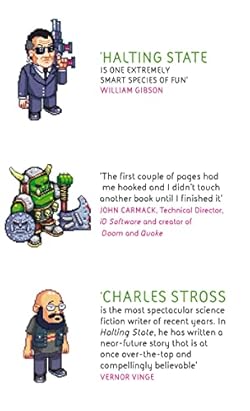
Halting State by Charles Stross

Orbit, 2010, 376p, plus author interview.

 Halting State cover

Since Christopher Priest’s bemoaning of the Clarke Award shortlist in which Halting State‘s sequel Rule 34 is included I bumped this up my reading list.

The usual caveat applies to this review. I did see an early version of the first chapter or so, back in the day. The author is a fellow member of the East Coast Writers’ Group and of Writers’ Bloc.

The setting is a near future independent Republic of Scotland in 2016 or so. A bank in an on-line game is robbed, despite the levels of encryption involved. A panicked employee of Hayek Associates (the Edinburgh company overseeing the game) calls the local police. This leads to the involvement of our first viewpoint character, Detective Sergeant Sue Smith. The other two narrators are Elaine Barnaby, an insurance fraud investigator, and Jack Reed, an IT specialist just sacked from his previous job and on a bender in Amsterdam. An unusual facet of the book is that all three strands are written in the second person – a notoriously difficult authorial trick to pull off. Here the conceit is mostly effective. It only falls down a few times and after a while becomes almost unnoticeable. (Sue Smith’s narrative voice jars, though, at the times when USian creeps in – Defence with an ‘s’, ‘out back’ for ‘out the back,’ ‘fit’ for ‘fitted’.) As the story proceeds layers of complication add in, as not all is what it seems, even in the real world.

The dangers of writing SF set in the near future are apparent even only four years after original publication (2008.) The banking-crash-induced recession and our present day austerity are entirely absent and the ubiquity of the location software, of driverless vehicles and so on feels a bit premature. Not to mention that a Scottish Republic is unlikely in the short term. However, if read as an Altered History (which will actually be necessary in five years’ time) these problems disappear.

Such technologies’ vulnerability to hacking/decryption is foregrounded, highlighting our growing dependence on such things. (I would add that they are equally vulnerable to a simple loss of electricity supply to servers etc.)

One of Christopher Priest’s complaints was that Stross uses ‘Och aye’ dialogue. On this ground I acquit him. The book is set in Scotland after all. Not being Scots born it is more than commendable that Stross makes the effort to convey local speech – he still lives in Edinburgh – even if sometimes his ear is not perfectly attuned. (Oh, and the word dreich doesnâ’t have a ‘t’ at the end.) He even has one of his narrators display the Edinburgher’s antipathy to all things Glaswegian.

The book is clearly aimed at a target audience of games players in addition to SF readers. Small portions consist of the MMORPG which was hacked into; these integrate well with the main thrust, as indeed does game playing. In this respect, pace Mr Priest, outright literary quality might be considered to be a drawback. Horses for courses. Halting State is not deep and not pretending to be, but I enjoyed it. Whether a ‘light’ novel like this deserves an award, though, is surely a matter of subjectivity.

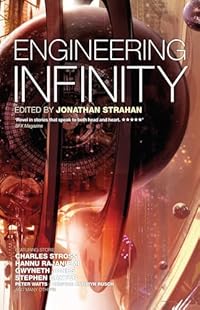
Engineering Infinity edited by Jonathan Strahan. (Solaris, 2010.)

Reviewed for Interzone issue 233, Mar-Apr 2011.

Engineering Infinity cover

According to Strahan’s introduction this anthology is a collection of stories roughly categorisable as hard SF, adding the disclaimer that the term is now a slippery concept hence the stories are inevitably broader in scope than might once have been implied. Whatever his claim that they all invoke the sense of wonder, most exhibit a tendency to be didactic in their narrative styles.

The tone is set early with “Malak” by Peter Watts, the tale of an unmanned airborne war drone that learns from its experiences.

Kristine Kathryn Rusch’s “Watching the Music Dance” deals with the effect of enhanced abilities for children on their dependency and psychological development.

The ghosts of the Soviet space programme are being made real in “Laika’s Ghost” by Karl Schroeder, mainly set in the former cosmodrome in Kazakhstan.

Stephen Baxter’s “The Invasion of Venus” is peculiar in that everything that happens, including the disappearance of the planet Neptune, occurs off stage. Apt, in that humans, and Earth, are of no consequence to the eponymous invaders.

Hannu Rajaniemi’s “The Server and the Dragon” has an intergalactic AI on some inscrutable purpose creating a baby universe as its plaything before being suborned and consumed by a message packet it receives. Extremely dry in the telling, a knowledge of quantum physics and cosmology might be advantageous here.

Charles Stross’s “Bit Rot” is a generation starship type story where the ship is “manned” by cyborgs who are suffering the deleterious aftermath of a gamma and cosmic ray burst. Stross references Tom Godwin’s “The Cold Equations” but overall the story is more reminiscent of John Wyndham’s “Survival.”

In “Creatures with Wings” by Kathleen Ann Goonan the remnants of humanity eke out their lives in what could almost be a zoo which the protagonist leaves to achieve enlightenment. Though Goonan tries to finesse it the story has too large a disjunction when these survivors are taken from Earth by the creatures of wings of the title.

“Walls of Flesh, Bars of Bone” by Damien Broderick & Barbara Lamar is the story from which the collection’s title may have sprung. A man sees himself on a film shot in 1931. The story moves on swiftly to become a concoction of quantum entanglement, self-interference of particles, Bayesian probability, spatial displacements and time travel.

Robert Reed’s “Mantis” concerns the realness (or otherwise) of our experiences and how to tell whether or not we live in stories. The SF gloss involves two way CCTV type screens called infinity windows.

The title of John C Wright’s “Judgement Eve” evokes Edgar Pangborn but unfortunately Wright is no Pangborn. The story, involving angels and Last Judgement, aspires to the condition of myth or Biblicality. As a result the “characters” become cyphers, the prose overblown, the dialogue bombastic and syntactically archaic.

In “A Soldier of the City” by David Moles the eponymous soldier volunteers for the revenge attack on the habitat of the terrorists who attacked his city and killed the goddess whom he loved.

The somewhat loopy protagonist of “Mercies” by Gregory Benford, made rich by inventing a logic for constructing unbreakable codes, invests in and then uses quantum flux technology to “jogg” to nearby timelines in order to execute serial killers before they set out on their sprees; thus becoming himself the object of the same fascination.

In Gwyneth Jones’s ”The Ki-Anna” a man travels to a distant planet to discover the circumstances surrounding his sister’s death and encounters the obligatory strange and disturbing ritual practices.

John Barnes’s “The Birds and the Bees and the Gasoline Trees” features a humaniform who has swum Europa’s oceans and stridden the beds of Titan’s methane seas unravelling the unforeseen consequences of humans trying to offset climate deterioration by seeding Earth’s Southern Ocean with iron from meteorites.

Hard SF? Sense of wonder? In an uneven collection a few stories fail to hit these marks. Enough do, though.

2010 Hugo Awards

I found a list of this year’s winners over at Frederick Pohl‘s blog The Way The Future Blogs. This is because he won the award for Best Fan Writer.

Surprisingly the list isn’t up at the official Hugo site though there is a video of the award ceremony.

Edited to add (9/9/10):- The list is there (see comment.) The link I followed only took you to the video.

Other awards of interest to me were:-
Best Dramatic Presentation, Short Form
Doctor Who: “The Waters of Mars.”
Hmm… I didn’t think that episode was particularly good.

Best Novella
“Palimpsest” by Charles Stross (Wireless, Ace, Orbit.)
Charlie is a one time and now somewhat detached member of the East Coast Writers Group. We bask in his reflected glory.

Best Novel (tie)
“The Windup Girl” by Paolo Bacigalupi (Night Shade)
“The City & The City” by China Mieville (Del Rey; Macmillan UK)
I’ve read the Miéville.

free hit counter script