Archives » BSFA

Clarke Award Stushie*

It seems Christopher Priest, whose BSFA Award listed novel The Islanders I am reading as we speak (or read, or converse, or whatever-the-hell-it-is-we-do-on-the-internet,) has attacked this year’s Clarke Award shortlist.

Go on. Read it. It’s an entertaining rant however unfortunately open to the charge of sour grapes at not himself being on the Clarke list it may be. (Priest tries to cover this angle by saying he would withdraw his novel from any consideration if the Clarke list were to be rethought as he proposes.)

I would insert the turbulent Priest joke here but someone used it decades ago in one of the BSFA’s journals and I actually think Priest has a point. Perhaps several.

My impression of the BSFA shortlist novels I have read is that last year wasn’t a particularly good one for SF novels – though my sample is admittedly small. And I agree that to have China Miéville win the Clarke Award for a fourth time would suggest that no-one else need bother writing SF (nor fantasy) as we could all then give up and go home.

I disagree, though, with his interim assessment of Adam Roberts’s By Light Alone. See my review here.

Charles Stross (whom Priest castigates in his piece) has linked to a comment thread engendered by Priest’s rant and has also seized upon the criticism as a marketing opportunity (see link to Stross’s post.)

Among other things Priest complains Stross writes “och-aye” dialogue. “Och-aye” dialogue. What’s wrong with that? People do not necessarily speak RP, or estuary, or USian, now or in the future. Get over it.

By the way, I used to receive a yearly invitation to the Clarke Award do but I could never go – it’s in London and I always had work that day and the next. Those invitations dried up some while ago now, though.

*Stushie is a Scottish word for contretemps.
stushie [ˈstʊʃɪ], stishie, stashie
n Scot
1. a commotion, rumpus, or row
2. a state of excitement or anxiety; a tizzy. Also spelled stooshie, stoushie.

BSFA Awards Short Stories

Over the past few weeks I have read the short stories nominated for this year’€™s BSFA Awards. I am assuming that, as in the past couple of years, the BSFA will be producing a booklet containing them but since each has been posted on the internet (there is a link from the BSFA’s Awards page to the online versions which is how I managed to read them – though I found off a screen is not the most comfortable of ways to do so) perhaps that might not happen.

The Silver Wind by Nina Allan, from Interzone issue 233, is a kind of time-travel story mixed with parallel worlds. It tells of the encounter of a man from a fascistic future Britain with a genius who makes clocks (which he refers to as time machines.) To begin with there is too much info dumping and throughout a lot is told rather than shown. Perhaps the story needed more space to breathe but I felt the sureness of touch of an accomplished story teller was missing. There is a use of words that is not quite precise -€“ eg ‘hoping one soldier would not see me’ rather than ‘€œhoping none of the soldiers would see me’€ – and twice we are treated to the peculiar phrase, ‘€œIt was growing dusk,’€ but at least Allan knows the use of ‘€œnor’ as in, ‘€œnot for love nor money nor any of these new-fangled gadgets.’

The Copenhagen Interpretation by Paul Cornell, from Asimov’s, July2011, is set in an altered future where European monarchies strive to keep the balance of power throughout the Solar System, souls have weight that is aligned to dark matter and Newton came up with a kind of relativity theory which allows space to be folded – all amenable to a tale of espionage and derring-do admixed with betrayals of various sorts. This stretches suspension of disbelief at times but overflows with ideas and is excellently written.

Afterbirth by Kameron Hurley, from Kameron Hurley’€™s website, is about a woman in a backward-leaning religious society which is engaged in a never-ending war, whose rulers have deliberately cut it off from the stars – originally as an escape from whatever’€™s out there but now to prosecute the war better. In her forbidden astronomical observations she finds God in a torn filter laid across the night sky. Again there is a fair bit of info dumping -€“ perhaps inevitable in stories of short length.

Covehithe by China Miéville, from The Guardian, 20/4/11, features sunken oil-rigs returning to land to drill into the earth and lay – eggs? seeds? – from which smaller rigs later emerge. Atmospheric, but again info-dumpy. The human involvement in Covehithe – a father and his daughter observing one such landing -€“ doesn’€™t really overlap with the SF background. Another scenario where society has suffered extreme breakdown and the military has a strong presence.

Of Dawn by Al Robertson, from Interzone 235, has a woman whose soldier brother has been killed being inspired by his poetry, the music of a long neglected composer, an all but forgotten TV documentary and a figure from Greek myth to produce a synthesis of poetry and music by bringing all those strands together. The final part of the jigsaw is provided by a shadowy figure in a village commandeered by the army long ago, but which had inspired both poet and musician. The story contains echoes of the Green Man myth and illustrates that English fascination with the pastoral. The info dumping here is well embedded.

The futures shown by the five stories are all bleak, having in common repressive regimes of either military or religious stamp. SF is never about the future, though. These stories tell us a lot about where we are now.

As stories though, rounded works of fiction, I found most of them unsatisfying. The only truly successful one was Paul Cornell’s. If these represent the best of last year the SF short story is in a bad way.

BSFA Awards Shortlist

It’s that time of year again. The BSFA Award nominations are out.

The full lists can be found here.

The fiction nominees are:-

Best Novel:-

Cyber Circus by Kim Lakin-Smith (Newcon Press)

Embassytown by China Miéville (Macmillan)

The Islanders by Christopher Priest (Gollancz)

By Light Alone by Adam Roberts (Gollancz)

Osama by Lavie Tidhar (PS Publishing)

Of which I have (so far) read one.

Best Short Fiction:-

The Silver Wind by Nina Allan (Interzone 233, TTA Press)

The Copenhagen Interpretation by Paul Cornell (Asimov’s, July)

Afterbirth by Kameron Hurley (Kameron Hurley’s own website)

Covehithe by China Miéville (The Guardian)

Of Dawn by Al Robertson (Interzone 235, TTA Press)

I have read none of these as yet but only The Copenhagen Interpretation is not available online via the BSFA page linked to above. Presumably the booklet of nominated stories that the BSFA has produced for the past two years will be repeated this time around, too.

Pickerel Meeting

On one of our two nights in Cambridge I had agreed to meet up with Eric Brown who lives nearby.

He arranged for other SF writers from the area to join us. They were Chris Beckett, Una McCormack, Philip Vine, BSFA chairman Ian Whates and Rebecca Payne, most of whom I had not met before. The six of them have semi-regular meetings in the Pickerel Inn in Cambridge.

The good lady and I had a meal in the Pickerel before everyone else arrived. Our plates groaned. So many peas were heaped on them we must have been served about half a kilogram between us.

I had meant to take some pictures of the gathering but such a good time was had by all that I forgot.

(No. I wasn’t drunk. I had to drive back to the hotel.)

BSFA Awards Winners

Over at Science Fiction Awards Watch the results of this year’s BSFA Awards have been posted.

The novel award went to Ian McDonald for The Dervish House and the short story to Aliette de Bodard for The Shipmaker.

Congratulations to all the winners.

BSFA Mailing

The latest BSFA mailing dropped onto my doormat today.

As well as the usual review magazine, Vector, which (unusually, since I’m normally slow at catching up with the latest thing) contains reviews of three books I’ve already read – Hannu Rajaniemi’s The Quantum Thief which I reviewed for Interzone, Ken MacLeod’s The Restoration Game and Ian McDonald’s The Dervish House – the envelope also spilled forth the A4 magazine of those short stories on the ballot for the BSFA Awards for 2010 and an A5 booklet published as a memorial to Robert Holdstock.

Apart from the book reviews this edition of Vector is a special Stephen Baxter issue.

Much of my reading for March is now more or less scheduled. As well as the short stories mentioned above, I have one more of the five novels shortlisted in the BSFA Award novel category in my to be read pile. I’ve just finished Paolo Bagicalupi’s The Windup Girl – review to come. For my thoughts on Ken MacLeod’s The Restoration Game and Ian McDonald’s The Dervish House see previous posts. Tricia Sullivan’s Lightborn awaits. Only Lauren Beukes’s Zoo City will escape my attention.

In addition Interzone has sent me Dominic Green’s Smallworld to review by the end of March. Busy, busy.

This Year’s BSFA Awards

This year’s BSFA Awards shortlist has been published.

Five novels have made it this year (I’ve read one) and four short stories (ditto,) five non-fiction pieces and six art works.

I didn’t make the list with Osmotic Pressure (I doubt I was nominated by anyone) but
I’ll look forward to reading the shorts I’ve missed so far: I assume the BSFA will send them out in a booklet as in the past two years. They’ll all likely be available on the web soon I should think – if not already.

Osmotic Pressure

Osmotic Pressure is the story I had published recently. Along with everyone else in Postcripts 22/23 I’ve been reviewed. Since Postcripts 22/23 contains a lot of stories you have to scroll down a fair way to find the bit dealing with “Osmotic Pressure” which ends with, “It’€™s a good story in terms of character development.”

I sense a “but” after that sentence. I’m happy with it, however. Character development ought to happen in a story. I like to think it’s what I do with my fiction. A strength if you will.

I also recently received my latest mailing from the BSFA which contained their review magazine Vector, wherein was relayed the information that nominations for the BSFA Award are now open.

This is as good a place as any to remind people that Osmotic Pressure is eligible in the short story category.

There is apparently a new rule this year that you ought not to nominate yourself. Would people do such a thing? Tut, tut.

But….

Should any members of the BSFA feel so inclined they know what to do.

Nominations close on 14/1/11.

I’ll shortly start reading some eligible novels with the awards in mind.

E C Tubb

I see from yesterday’s Guardian that the SF author E C Tubb died nearly two months ago. Wikipedia has quite a large entry for him and his work.

He was one of the select group of British SF authors who were published before the 1960s and was one of the co-founders of the BSFA.

Despite his prolific output -125 novels – if you had asked me I would have said that I owned none of them. I would have been wrong. I just checked my bookshelves and discovered a copy of his 1964 novel Moon Base. I read it so long ago, though, I’m afraid I can’t remember any details of it.

His was a name I always recognised, however. SF was such a small field in the 1960s you could not avoid it. His best known work was probably the Dumarest series of novels; 33 of them!

The Guardian obituary is appreciative.

E C Tubb, 15/10/1919-10/09/2010. So it goes.

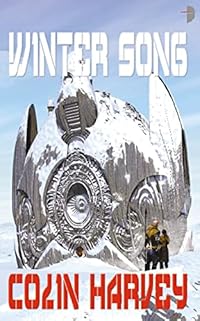
Winter Song by Colin Harvey

Angry Robot, 2009. 373p

Winter Song cover

This is the freebie book I received in a BSFA mailing nearly a year ago. In it Karl Allman’s spaceship is attacked and destroyed and he has to descend with the help of only a protective gel to the surface of the nearest habitable planet, Isheimur, which has been partly terraformed and is inhabited by a group who live and speak in the manner of Icelanders. He is found broken-legged and unconscious and nursed back to health by the local Isheimuri whose chief thereafter regards him as under an obligation to repay this care and attention by working for him. Allman, of course, wishes to escape back to space. These scene setting chapters contained a prodigious quantity of relatively crude info-dumping.

Harvey makes much of the Isheimuri’s life on the edge – poor soil, thin air, lack of food, freezing temperatures, isolation etc – yet in the first part of the book Allman consumes seemingly more than adequate meals and the area teems with flocks of sheep. The Isheimuiri even have horses (which I always thought require a lot of fodder.) Hmmm.

The setting also gives Harvey the opportunity to portray illiberal politics, especially of the sexual variety, which he does attempt to gloss at one point; but all rather unconvincingly.

The narrative is shared between Allman, various Isheimuri and a hasty download from Allman’s ship which co-inhabits his brain. The ship download’s viewpoint, given the name Loki, a nod to Norse mythology – is narrated in the second person; and does not work well. The rest, more thankfully, are in third.

Other aspects of the writing also leave a lot to be desired. The viewpoint often shifts within a narrative section – a distracting authorial/editorial error. Sometimes a passage will contain information the viewpoint character cannot know. On occasion one will inform others about something the author (and we) know, but the character does not.

Even at the sentence level there are many infelicities. Take this sample phrase. “… he had an inner cauldron of anger that flared up at the slightest obstruction to life’s normal flow of life” (page 166.) Life’s normal flow of life? Wouldn’t the simpler usage “life’s normal flow” be more natural, and sufficient?

And parse this sentence if you will. (If you can.) “Arnbjorn and Orn pushed themselves to his father’s side.” Add in the fact that the “his” has no antecedent in a prior sentence and this becomes almost incomprehensible. It is certainly far harder work to read than if “their” replaced “his” or there were a sole subject of the verb, and “themselves” were “himself.”

We also have a terraforming machine that can “break down molecules.” Fair enough. But it also breaks “cerium and samarium from the ores down at sub-molecular level” (Eh?) “into nitrogen and oxygen, which it emits into the atmosphere.” The second part of this is scientific claptrap – nitrogen and oxygen as gases are molecular! The first also has holes – cerium and samarium are not molecular; neither are their ores, nor would they ever be, on or off Earth – and requires a power source so limitless that anything could be synthesised and so food, or any other, shortages would not be a problem; which, of course, vitiates the whole Isheimur scenario. And Harvey gives the impression (page 176) that carbon dioxide is dangerous to humans. It isn’t. Not at the levels indicated here.

Once an author loses our trust in this way it cannot be regained.

Perhaps I was now looking for flaws; because I certainly found them. Harvey has Allman say that the planet’s “magnetic field has just ‘flipped’ from warming to cooling” – more claptrap; a globe’s warming/cooling does not depend on its magnetic field orientation – and just over a page later, “carbon dioxide and water vapour will form a protective layer” (they would disperse throughout the atmosphere) “and seed the ozone layer with water and debris, thereby raising the temperature.” Well make your mind up, man! Is it the magnetic field change or the water/debris in the ozone layer which will cause the warming? In reality of course it would be neither.

The last section betrays a misunderstanding of the trajectoral dynamics of a spaceship under deceleration. Harvey has the engines of the Winter Song, a long-derelict ship once abandoned at Isheimur’s pole but which Allman has somehow managed to get to fly again, being switched on and off in an attempt to relieve strain on them while he tries to slam a comet – which the ship is pushing along with it – into Isheimur. (Don’t ask.) Such a procedure would result in the target being missed, not by a little but by a very long way indeed. It wouldn’t even get near the planet, still less hit it in a precise location. It’s as if a spaceship can be driven in exactly the same way as a car, and its arc were on a defined piece of roadway rather than being a complex interaction between gravity, acceleration and momentum.

Note that in all of the above I have not touched on the cardboardness of the characters, who are straight out of stock casting and provide us with no surprises, nor on Harvey’s habit of trying to create tension through exceedingly unsubtle cliffhangers.

I see from the book’s endpaper that Harvey has had four previous novels published. If this farrago is anything to go by that demands the question; how?

There is also, starting at page 412, an extract from Damage Time by Colin Harvey, headlined as Coming Spring 2010, which I didn’t read.

Needless to say, I shan’t be buying it.

free hit counter script