Winterstrike by Liz Williams
Posted in Reading Reviewed, Science Fiction at 13:00 on 4 June 2011
Tor, 2008. 358p.
 For some reason I just could not get into this book and found it a bit of a slog. As it is the first part of a mooted trilogy this was dispiriting. There were thematic and stylistic similarities between this and the Darkland/ Bloodmind duo of books by Williams which I have read in the recent past but Winterstrike seemed to lack something in comparison.
On a far future Mars inhabited by women – any men are of the changed and to be shunned, contact with them is ostracisable – a woman called Alleghetta has her sights set on becoming a member of the ruling Matriarchy. The daughters of her union with her partner Thea are the main focus of the book as they play out the ramifications of the choices Alleghetta has made about their genetic inheritance.
The changed come in at least two types, strangely altered humans known as demotheas and vulpen who seem to be exclusively male. Curiously – and against the normal English usage (ox/oxen, child/children, brother/brethren) – Williams renders the singular also as vulpen.
Not much is made of the all-female scenario. The characters have all the venalities, jealousies and weaknesses that you might find in any society. Beyond the absence of sex scenes there isn’t much to set this novel apart from others. Maybe, however, this was the point.
The Mars in the book is as you might expect, terraformed and with canals on which someone of course takes a trip. This last is the one bit of using such a setting that is almost obligatory: “the best bit” as Colin Greenland once remarked to me. (No criticism here; I’ve done the same myself in my unpublished novel Who Changes Not. )
The two main protagonists are Essegui and Hestia whose paths soon diverge and never recombine, which is something of a fault in a multi-stranded narrative. (The book does end with a message between the two but this serves only to set up the succeeding volume.) Their other sisters Letetui, also known as Shorn, and Canteley are not viewpoint characters but Letetui is the hinge of the narrative. She has associated with a vulpen, been shut away, but escaped.
At times the treatment tips over from SF into Fantasy – or at least there is no convincing explanation of how certain things occur. Williams has shown such sensibilities in the past and this may be one of the reasons why Winterstrike did not appeal. Her descriptive writing, the convincing dropping in of essential detail, can be excellent though.
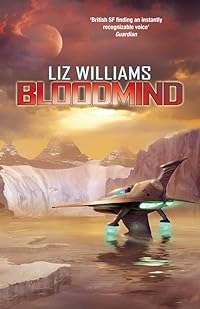
However, when a book fails to grip, infelicities begin to stand out, make the reading more difficult than it might be and, crucially, undermine trust in the author. Examples weren’t hard to find. There is a military aircraft – probably the one depicted on the cover – which Williams dubs a dreadnought and which, to indicate age, is described as having rust on it. Now, I would think that, even on Mars, a flying machine made of iron would have too high a density to get off the ground successfully. Some later chapters are set on Earth and feature a post-warming flooded Ropa (Europe) where there nevertheless is a city with an iron tower still surviving to poke up through the waves. The tower plays an important part in one of the scenes but it seems this iron structure is not susceptible to rust, despite enjoying the optimum conditions for it. Also at one point we have the phrase, “The woman brightened imperceptibly.” Really? If the brightening was imperceptible how, then, did the viewpoint character know it had occurred? There is also some confusion between born and borne.
Maybe it is this lack of the necessary consideration which is at the root of my dissatisfaction. A proper editing could have picked this sort of thing up but, increasingly, books do not receive the sort of close attention during the publication process they once did.
Unlike in either Darkland or Bloodmind this book does not bring all the strands together and as a result ends inconclusively. This is perhaps not surprising from the first part of a trilogy but I did feel somewhat short-changed.