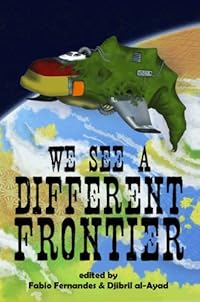
Futurefire.net, 2013, 213 p. Reviewed for Interzone 249, Nov-Dec 2013.
By and large the language of Science Fiction has always been English, its explorations of other worlds in the main tending to describe their exploitation. In literature (as in life) humans have generally gone off planet to seek things, either knowledge or possessions – and damn any natives. Long past time for a corrective? A “straight, white, cis, male” might feel loth to comment.
The Arrangement of Their Parts by Shweta Naryan is a partly fabular tale of clockwork animals taken to pieces by an Englishman and the Artificer Diva who stands up to him.
The delightfully titled but pulpy Pancho Villa’s Flying Circus by Ernest Hogan tells how with the help of Nicola Tesla’s death ray Alejandro Sahagún replaces Pancho Villa and sets out to recover his sweetheart, abducted by Hollywood producers. While a slight tale this nevertheless rightly fingers Hollywood as the centre of cultural colonialism.
Them Ships by Silvia Moreno-Garcia. Aliens in iridescent spacehips have taken over Earth. Our (unnamed) narrator, a former street scavenger, wonders why his cell-mate – the once privileged Leonardo – would want to escape what he regards as a cosseted life.
In J Y Yang’s Old Domes Jing-Li is a cullmaster, charged with despatching guardians – the personifications of buildings – before their renovation. The guardian of Singapore’s Supreme Court is unwilling to go quietly.
Fabio Fernandes’s The Gambiarra Method reads a bit like a 1950s magazine story. Time travel is discovered in 2077. By accident. In anti-gravitational lifts with an attached post-virtual environment. The mechanism is investigated using the Gambiarra method – how to do things with whatever is at hand.
Riya in A Bridge of Words by Dinesh Rao has spent most of her life in Krashnigar, the former colonial power. She is now involved in a project to decipher the tattoos of the Thuri, one of the two sects of her ancestral homeland. Over this world hangs a mysterious red spaceship broadcasting an unchanging coded message.
Droplet by Rahul Kanakia. Subhir has lived in India after his parents took him there from his childhood home in California to avoid the ever worsening drought conditions. On his return to the US he finds out what really happened.
In Joyce Chng’s Lotus most of the Earth is covered in water after an event called the Washing. Landers fight fiercely to hold on to their territories while boaters roam the Waterways, exchanging and bartering. Boater Cecily and her partner Si one day come upon a source of precious drinkable water and food, giving them a moral dilemma.
Lavie Tidhar’s Dark Continents* envisages several different ways in which the past two centuries of Jewish history could have worked themselves out. These include forging a disputed homeland in Africa, intervention in the US Civil War and a peaceful integration into Palestine.
A Heap of Broken Things* by Sonny Moraine features a planet lit by two suns, where human colonists carried out a massacre a generation before. A local tour guide is confronted with that inheritance.
Sandra McDonald’s Fleet* is set a generation after the Night of Fire when solar megaflares destroyed all electronic communication. The people of a Pacific island forge their future in isolation.
Remembering Turinam by N A Ratnyake. A scholar from a defeated people whose language and culture have been oppressed, all but forgotten, returns to his capital city to speak with his grandfather, the last remaining witness to the old days.
Sofia Samatar’s I Stole the DC’s Eyeglass is the story of Pai-te and her sister Minisare who has a spirit-eye and builds a beast of iron as a gesture of “defiance honour, dawn, tomorrow.”
Vector by Benjanun Sriduangkaew. In a US dominated Thailand where no-one has dark hair anymore, nor speaks Thai, a woman’s body has been turned into a viral weapon, both disease and vector, to undo the changes.
In Gabriel Murray’s Forests of the Night* the illegitimate son of the ex-colonial Captain Lyons, brought to Yorkshire to act as his father’s valet, dreams of the tiger that is stalking the local neighbourhood.
What Really Happened in Ficandula by Rochita Loenen-Ruiz. A cultural misunderstanding leads to deaths and reprisals the memories of which are kept alive by the female descendants of the colonised as they themselves head for a new planet.
This collection illustrates how language, or its suppression, has been a primary tool of colonialism on Earth. There is irony, then, that, as Ekaterina Sedia’s afterword notes, all these stories were written in US English. (Double irony when the word “veterinarian” is depicted as being employed by a Yorkshireman.) Yet the theme of resistance, the keeping of traditions, shines through. Under the circumstances resistance becomes necessary.
As with most anthologies the standard can be uneven, but each story works as speculative fiction; and four (asterisked in this blog post) are very good indeed.